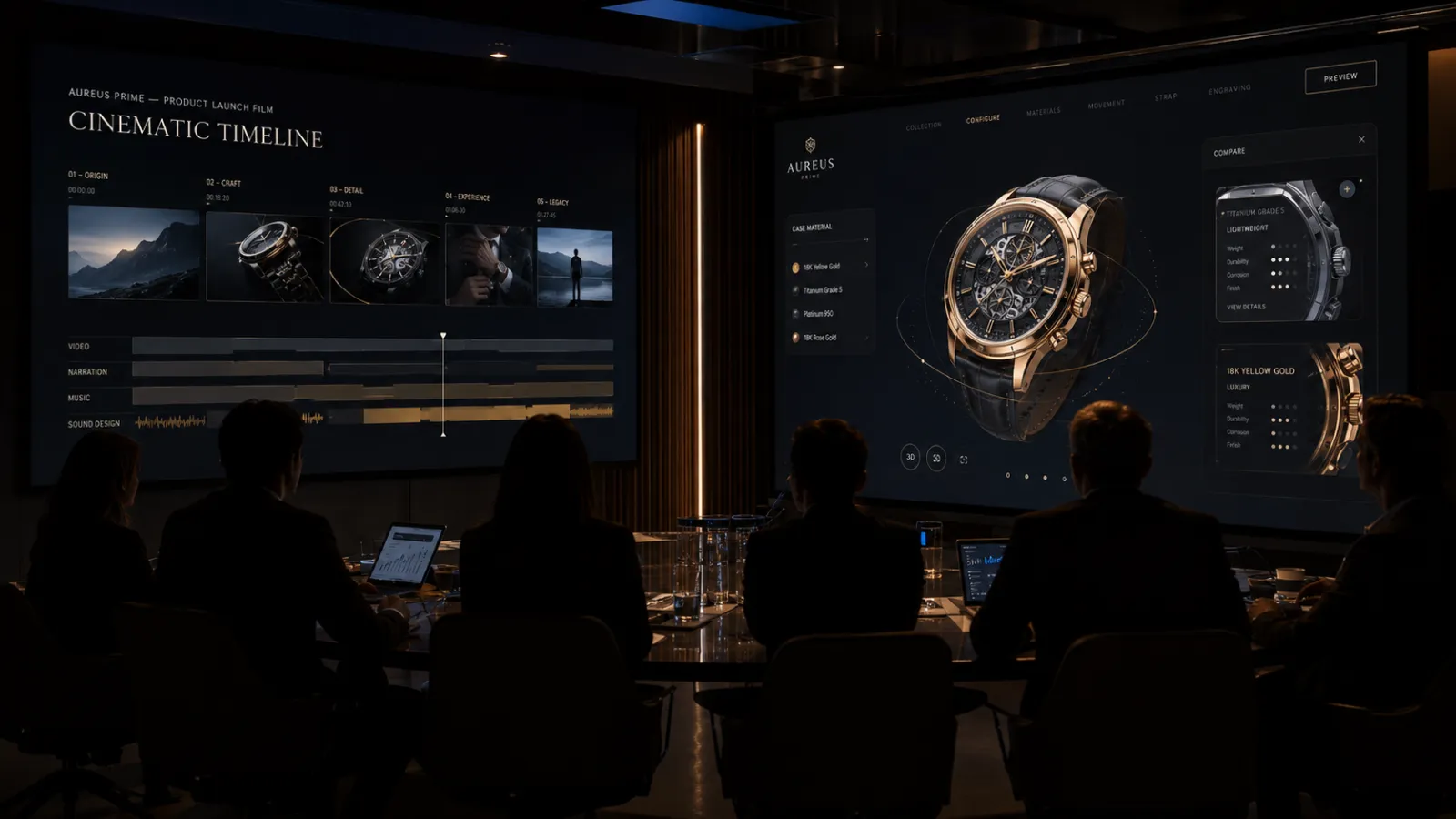
Most Three.js sites lose the SEO fight before the first user lands. The canvas renders nothing crawlers can read, the bundle blows past every Core Web Vitals budget, and the hero animation freezes the device on first paint. This guide is the production playbook we use at Utsubo to ship visually impressive 3D sites that still rank — with a real case study from AthenaHQ, a Generative Engine Optimization platform whose own First Contentful Paint had to be best-in-class.
Who this is for: founders, marketing leads, and creative-web engineers shipping a Three.js, React Three Fiber, or WebGPU-based site that needs to rank in Google and stay visible to AI crawlers (ChatGPT, Perplexity, Gemini).
Key Takeaways
- A
<canvas>element has zero indexable text. Without SSR/SSG fallback content, Googlebot sees an empty page. - The bottleneck is rarely network — it's the main thread. Shader compilation, geometry parsing, and texture decoding all block input and paint by default.
- Defer the 3D bundle past the initial paint, then move the heavy compile work into a Web Worker with
OffscreenCanvas. - On mobile, ship a static image. The trade-off (no animation) wins on every Core Web Vital that matters.
- AI search engines (ChatGPT, Perplexity, Gemini) judge sites partly on speed and structured content. WebGL sites that ignore SEO also lose GEO.
1. Why Three.js Sites Fail SEO by Default
1-1. The canvas is invisible to crawlers
A <canvas> paints pixels. It contains no DOM text, no headings, no anchors. Googlebot reads HTML, runs JavaScript in a headless Chromium with a budget, and extracts what's left in the DOM at that point. If your site's value lives inside the canvas — product reveal, scroll-driven story, immersive intro — none of it gets indexed.
The fix isn't "add more JavaScript." It's HTML-first: every meaningful page state must exist as crawlable markup before the renderer ever boots.
1-2. The bundle wrecks Core Web Vitals
Three.js (core) ships around 600 KB minified before your scene code, models, and textures. Add drei, post-processing, and a .glb and you're past 3 MB before any styling. Result: Largest Contentful Paint blown, Interaction to Next Paint pegged, and a Lighthouse Performance score in the 30s. For the current release line, see what changed in Three.js in 2026.
1-3. AI engines are stricter than Google
Generative Engine Optimization (GEO) — visibility inside ChatGPT, Perplexity, Claude, and Gemini answers — depends on the same fundamentals plus a few extra. AI crawlers are less patient with slow pages, weight structured data more heavily, and prefer answers they can extract verbatim from indexable HTML. A beautiful Three.js site that wins design awards can vanish from AI search entirely.
2. Crawlability: Fix Indexing First
2-1. Ship the page as HTML, hydrate the canvas after
The single most important pattern: render real content server-side, then progressively enhance into 3D. Astro, Next.js, Remix, and SvelteKit all support SSG or SSR; pick one and use it for every route.
Inside the page, the canvas becomes a layer on top of indexable content — not a replacement for it. The hero copy, the H1, the product description, the CTA buttons: all exist in the DOM whether the 3D ever loads or not.
2-2. Use <noscript> and visible fallback text
For users with JavaScript disabled (rare) and for crawlers in low-budget mode (common), put a <noscript> fallback inside the canvas wrapper containing the same headline, summary, and CTA the 3D version communicates. This is also your accessibility floor.
2-3. Pre-render dynamic states
If you use 3D as a product configurator or interactive map, generate one indexable URL per meaningful state. A /product/x-pro?color=black URL with SSR'd metadata beats a client-only JavaScript router every time.
2-4. Audit with the URL Inspection tool
Open Google Search Console → URL Inspection → Test Live URL → View Tested Page → HTML. If your H1, product copy, and links don't appear there, no amount of canvas polish will help.
3. Core Web Vitals for 3D Sites in 2026
Three Vitals matter and 3D sites fail all three by default.
Largest Contentful Paint (LCP). Target under 2.5 seconds. On a Three.js hero, the LCP element is usually the canvas. If the canvas is empty for the first three seconds, your LCP is three seconds. Either (a) the LCP element should be a real image or headline rendered before any 3D, or (b) the canvas must paint a first frame fast.
Interaction to Next Paint (INP). Target under 200ms. INP penalizes any input that the main thread can't process quickly. Three.js render loops on the main thread, shader compilation on the main thread, and large .glb parsing on the main thread all tank INP.
Cumulative Layout Shift (CLS). Target under 0.1. Reserve canvas dimensions with explicit width, height, and aspect-ratio CSS, or you'll get a half-second of jump as the renderer initializes.
4. Case Study: AthenaHQ — Keeping a Brand Animation Without Killing FCP
4-1. The brief
AthenaHQ is a Generative Engine Optimization platform. It tracks how brands appear across ChatGPT, Perplexity, Gemini and other AI search engines, and tells SaaS companies exactly where they're winning, losing, and what to fix. Their entire product premise is that AI search visibility depends on speed and signal quality — so their own site had to be best-in-class on every speed metric. A slow GEO platform is an immediate credibility problem.
The constraint: keep the impactful 3D intro animation we built for the brand. It was the visual handshake — the thing that made the platform feel like a real product, not another SaaS landing page.
4-2. Step 1 — Defer the 3D bundle past initial paint
The first move was structural. The HTML and critical CSS now render and paint before the 3D bundle is even requested. The hero copy, sub-headline, primary CTA, and value-prop bullets exist as DOM text from byte one. The canvas slot is reserved with an aspect-ratio container so layout never shifts when the renderer arrives.
Then we lazy-load the 3D bundle after the browser's load event fires. First Contentful Paint and Largest Contentful Paint now lock onto the headline and CTA, not the canvas.
4-3. Step 2 — The freeze problem
Deferring alone wasn't enough. When the 3D bundle finally loaded, the device froze for several hundred milliseconds before the animation started. The cause is what we call "compiling 3D" — and it's worth explaining in plain language because most teams underestimate it.
When a 3D scene boots, three expensive things happen on the main thread:
- Shader compilation. Every material in your scene has a GLSL (or WGSL on WebGPU) shader program. The GPU driver has to translate that human-readable shader code into machine instructions it can actually run. The compile step is synchronous and can take 50–300ms per shader, depending on complexity and device.
- Geometry parsing. A
.glbor.gltffile is a packed binary. Turning it into the typed arrays a GPU can use means walking the file, decoding the buffer views, building vertex/index arrays, and uploading them to GPU memory. - Texture decoding. A PNG, JPEG, or KTX2 file isn't ready to use — it has to be decompressed into raw pixel data, mipmapped, and uploaded. Each large texture is another 50–200ms of work.
All three happen on the main thread by default. While they run, the page can't respond to clicks, can't scroll, can't paint a new frame. The user sees a frozen tab right after the headline finished rendering — the worst possible moment.
4-4. Step 3 — Move the compile work to a Web Worker
The fix was to move the heavy lifting off the main thread entirely. We transferred the canvas to a Web Worker using OffscreenCanvas and ran the renderer, geometry parsing, and texture decoding inside the worker. The main thread stayed free for input, scroll, and paint.
Concretely: the worker receives the canvas via transferControlToOffscreen(), then performs the entire 3D pipeline — model loading, shader setup, animation tick — without ever touching the main thread again. The user sees the headline, can scroll and click immediately, and the animation fades in once the worker finishes compiling.
This is the pattern that gave AthenaHQ both: the impactful brand animation and a Core Web Vitals scorecard a GEO company can defend. INP stayed under 100ms during the entire load sequence because the main thread was simply not the bottleneck anymore.
4-5. Step 4 — Mobile: ship an image, not an animation
On mobile, even worker-optimized 3D was the wrong call. Mobile GPUs compile shaders more slowly, mobile RAM is tighter, and mobile users are more loading-sensitive. The animation still added perceptible delay before the page felt usable.
We replaced the animation with a static image on mobile breakpoints — a high-quality WebP captured from a frame of the desktop animation. Instant LCP, zero JavaScript cost, identical brand recall. The lesson: animation is a desktop affordance for AthenaHQ's audience; speed is the universal one. Don't ship the same hero everywhere just because the design system has only one.
5. Structured Data for Visually Driven Sites
Schema markup is how you give crawlers — and AI engines — context the visual layer doesn't communicate. For a 3D-heavy marketing site, three schemas earn their keep:
- Organization — name, logo, social profiles, contact. The base layer every site needs.
- Product or SoftwareApplication — for SaaS or e-commerce, the product schema tells AI engines what you actually sell.
- FAQPage — answer the top 5–8 questions about your product in the DOM, then mirror them in
FAQPageJSON-LD. This is the single biggest GEO lever in 2026.
The visual story is for humans; the schema is for everything else. Both have to be there.
6. Internal Linking and Hub-Spoke for Portfolio Sites
Most studio and product sites bury their best content one click too deep. Three rules that move rankings on portfolio-style sites:
- One hub per major topic. A pillar page that lives in the top nav and links out to every relevant case study.
- Cross-link case studies. A project page should link to two or three other related projects, not just back to the index.
- Surface insight pages. If you write articles (like this one), link them from project pages where the topic applies. The Three.js performance article you wrote three months ago should be linked from every 3D project page.
7. Tooling Stack for 3D Site SEO
What we actually use on Utsubo projects:
- Lighthouse — baseline Core Web Vitals plus diagnostic Performance audits. Run it on mobile emulation, not desktop.
- Search Console URL Inspection — see what Googlebot actually rendered.
- WebPageTest — film-strip view of paint events. The single best tool for spotting "canvas blocks LCP" patterns.
- Chrome DevTools Performance panel with Memory + Frames lanes — locate the exact ms where shader compilation lands.
- Spector.js — frame-by-frame WebGL/WebGPU call inspector. Use it to find the draw call that triples your frame time.
- A custom 3D perf budget JSON — checked in alongside the project, defining max bundle size, max textures, max draw calls per route. CI fails the build if you regress.
8. Multilingual 3D Sites: hreflang and Localization
If you ship the site in more than one language, three things matter — and they apply equally to French, German, Japanese, Spanish, or any other locale:
hreflangpairs. Every page must declare its counterparts in other locales, and vice versa, in both HTML head and sitemap. Mismatched or one-wayhreflangtags are a common cause of Google showing the wrong locale to the wrong audience — or showing neither.- Don't translate; localize. A direct translation of English marketing copy rarely ranks well in another language market. Each locale needs native idiom, local pricing, local case studies, and local search-intent phrasing. Original-language pages outperform translated ones.
- 3D works the same. The optimization stack (defer, worker, mobile fallback) ports across locales without modification. A site that's fast in one language will be fast in another. Performance is universal; copy is not.
9. How to Get Started
Looking for a team that builds rankable 3D sites? See our WebGL & Three.js development services for scope, work, and process.
If your 3D site is already live and not ranking, in priority order:
- Run a Search Console URL Inspection on the homepage. Confirm the headline, sub-headline, and CTA appear in the rendered HTML. Fix indexing first.
- Run Lighthouse on mobile. Note LCP, INP, CLS. If LCP is above 4 seconds, defer the 3D bundle today.
- Open Chrome DevTools Performance panel during load. Look for a 200ms+ "Compile Script" or "Recalculate Style" block right after the 3D bundle parses — that's your shader/geometry compile. Plan the worker move.
- Audit your mobile experience. If 3D adds more than 1 second of perceived delay, ship a static image instead.
- Add
FAQPageschema with 5–8 real questions and DOM answers. - Add
hreflang-paired translations for every locale your market reaches.
10. About Utsubo
Utsubo is a creative studio specializing in interactive installations and immersive web experiences. We build Three.js, WebGPU, and WebGL sites for AI startups, premium brands, and cultural institutions — with performance budgets baked into the brief, not bolted on at the end. We also ship the SEO and GEO work that makes those sites discoverable.
What we offer:
- Three.js, WebGPU, and React Three Fiber development
- Performance-first web architecture (Astro, Next.js, SvelteKit)
- SEO and Generative Engine Optimization for 3D sites
- End-to-end design, build, and launch
11. Ready to Make Your 3D Site Rankable?
If you have a Three.js site that needs to rank, or you're planning one and want to avoid the freeze trap, we can help.
Checklist: Making a WebGL Site Rankable
- Headline, sub-headline, and CTA render as DOM text, not inside the canvas
- 3D bundle loaded after the
loadevent, not in the critical path - OffscreenCanvas + Web Worker for shader compile, geometry parse, texture decode
- Static image fallback on mobile breakpoints
- LCP under 2.5s, INP under 200ms, CLS under 0.1 on mobile
FAQPageJSON-LD with 5–8 questions matched to DOM answershreflangpairs for every translated route- Search Console URL Inspection confirms rendered HTML contains your H1
<noscript>fallback inside every canvas wrapper- 3D perf budget checked into the repo and enforced in CI
FAQs
Why does my Three.js site rank lower than the static page it replaced?
Most likely because Googlebot is indexing a near-empty DOM. Canvas content isn't text, and if your site relies on the canvas for hero messaging, the crawler sees a blank page. Move the headline, sub-headline, and CTA into real HTML rendered before any JavaScript runs.
Will deferring the 3D animation hurt user engagement?
Not if you ship the right hero first. Users judge a site in the first 800ms; if that 800ms shows a clear headline and CTA, perceived speed wins over animation impact. AthenaHQ kept the animation as a layered enhancement and saw no engagement drop after the optimization.
What is OffscreenCanvas and which browsers support it?
OffscreenCanvas is a Web API that lets you transfer a canvas from the main thread to a Web Worker, so rendering, shader compilation, and asset processing happen off the main thread. As of 2026, Chrome, Edge, Firefox, and Safari (16.4+) support it. For older Safari, ship a static image fallback automatically.
Can I use WebGPU and still rank well?
Yes. WebGPU is faster than WebGL once running, but shader compilation can be slower on first load. The defer + worker pattern still applies and helps more, not less. WebGPU also has better compute support, which helps when you offload heavy parsing.
Does AI search (ChatGPT, Perplexity, Gemini) crawl WebGL pages differently?
Yes. AI crawlers are stricter about speed and structured data than traditional search. They also tend to prefer extractable HTML answers over rich media. A WebGL site without SSR fallback content and FAQ schema is often invisible to AI search entirely.
How long does it take to optimize a Three.js site for SEO?
For a site that already exists: 2–4 weeks for the full defer + worker + mobile fallback + schema work. For a site being built from scratch: zero added time if performance is part of the brief from day one. Retrofits are always more expensive than getting it right the first time.
What's the difference between SEO and GEO for 3D sites?
SEO targets traditional search engines (Google, Bing). GEO targets generative AI engines (ChatGPT, Perplexity, Gemini, Claude). The technical fundamentals overlap — fast, crawlable, well-structured — but GEO weights structured data and authoritative answers more heavily. A 3D site optimized for SEO is usually 80% of the way to GEO; the last 20% is FAQPage schema, direct-answer copy, and citation-friendly references.
Should every 3D site have a mobile image fallback?
Not always, but usually yes. The exception is products where the 3D is the product itself (a configurator, a 3D viewer). For brand or marketing sites where the 3D is decoration, a static image on mobile almost always wins on Core Web Vitals, conversion, and bounce.


 WebGL & Three.js Development