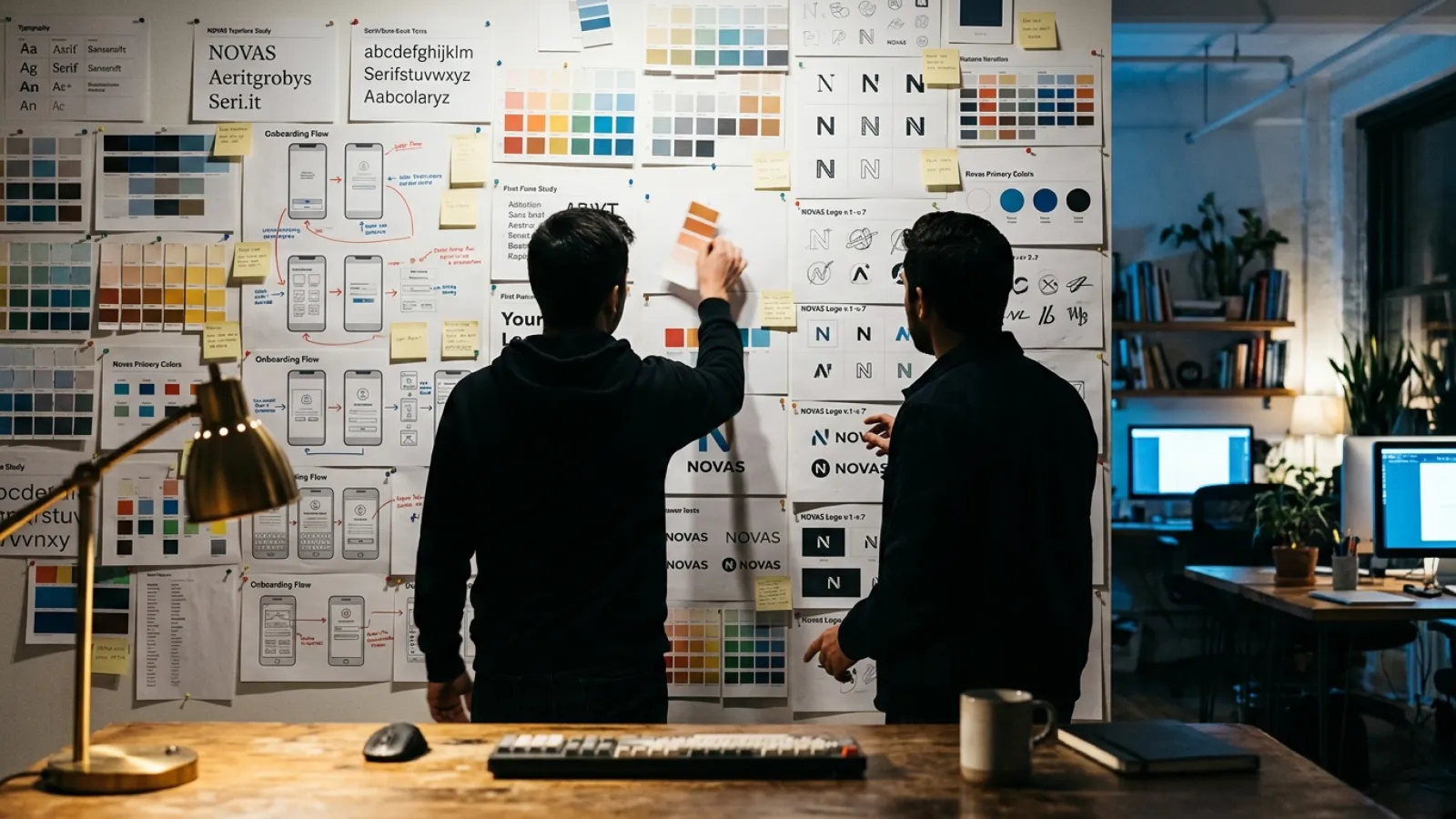
Forward Deployed Engineer got the 1,165% year-over-year posting growth, the a16z explainers, and the LinkedIn discourse. Nobody hired a Forward Deployed Designer. The job does not exist on any greenhouse board, no AI lab is staffing it, and yet the gap it would fill is bigger than the engineering-side gap that produced the FDE category in the first place. AI labs ship FDEs because their models cannot self-deploy into messy enterprise systems. AI labs do not ship Forward Deployed Designers because they have already told you, in writing, that brand and identity are out of scope. The job description for an Anthropic Applied AI Engineer reads, almost verbatim, that the role will not name your product, design your empty state, write your launch sequence, or own your visual identity.
That sentence is the entire reason this article exists.
The companies most exposed to the missing half are the same companies the FDE programs cannot reach anyway: SMB and seed-to-Series-A AI startups whose homepage reads "AI-default" the second a visitor lands on it, whose Stripe checkout looks like every other Stripe checkout, whose product launches arrive as a 200-word Substack post and a screenshot. The integration code shipped. The product surface around it did not. This is what a Forward Deployed Designer (FDD) does, and this guide names the category before someone with a worse track record names it first.
Who this is for: Non-technical and technical founders, 0–18 months post-launch, who built with Claude, Cursor, Lovable, Bolt, or v0 and shipped a product that works but reads as generic to every visitor. Operators at AI-adjacent startups (11–500 employees) who already have engineers but no brand owner. Anyone evaluating a freelance designer, a brand agency, or a "we'll hire a Head of Design in Q4" plan and not finding the right shape for an embedded 4–12 week engagement.
Key Takeaways
- An AI-lab Forward Deployed Engineer will not ship your brand. This is not opinion; it is in writing. Anthropic's Applied AI Engineer scope explicitly excludes product naming, visual identity, empty states, and launch communications. The integration code ships; the half that decides whether the launch lands does not.
- The "AI-default" look is now the loudest signal of an unbranded product. Inter type stack, zinc-and-slate palette, gradient hero, shadcn/ui dashboard. Visitors register the visual category in under three seconds and bounce. Stall #1 in our rebrand-or-relaunch diagnostic is exactly this — and rebranding at 1,000 users costs $30K–$100K plus a measurable retention hit.
- A Forward Deployed Designer is an embedded brand and product-design partner sized for an AI startup. Pod of 2–4 people for 4–12 weeks, in-repo and on the brief, shipping naming, visual identity, first-run UX, empty states, the launch site, and the launch sequence as one engagement — not as a vendor handoff to three agencies.
- Total engagement: $40K–$120K depending on scope. Equivalent to roughly 3–4 months of a senior brand designer hire at $180K loaded comp. Lower than the median FDE annual compensation ($173,816 per Bloomberry). Far lower than the $30K–$100K rebrand cost at 1,000 users plus the retention hit.
- An FDD is not an agency. Agencies sell projects with stage gates and a Figma handoff. FDDs embed in your repo, on your Linear, and on your launch calendar — same operating model as an FDE, opposite half of the surface.
- Skip an FDD when you have no marketing surface (pure B2B2B internal tool), no PMF yet (budget should go to interviews), or a designer co-founder who already owns the work. This is the wrong tool for some problems and the right tool for others.
1. What "Forward Deployed Designer" Means in 2026
The honest version, before the playbook.
1-1. The term and the gap
The Forward Deployed Engineer role exists because AI labs admitted in public that their models cannot self-deploy. The Forward Deployed Designer role exists because AI labs admitted, just as publicly, that their FDEs will not ship the brand. The first admission produced a 1,165% YoY job-posting surge and a thousand LinkedIn thinkpieces. The second admission produced silence — because designers do not get the same conference talks engineers get, and because the AI economy still treats brand as a downstream concern.
The honest framing borrows directly from the FDE analogue: a regular product designer designs one product for many users; a Forward Deployed Designer designs many surfaces — brand, product UI, empty states, launch site, first-run, post-mortem comms — for one company. The embed is the unit, not the deliverable. For the structural background on why embedded models are eating both engineering and brand work at AI-adjacent SMBs, see our companion piece on the Forward Deployed Engineer Studio.
1-2. Why no AI lab ships one
OpenAI and Anthropic are not in the brand business and never will be. Their margin lives in tokens, model performance, and enterprise contracts measured in the high six figures and up. A Forward Deployed Designer's deliverables — a name, a logo, a launch sequence — do not pull through token revenue and do not show up on a quarterly slide deck. Worse, owning the customer's brand creates legal and IP exposure the labs have no interest in absorbing. The result is structural: the FDE program exists; an FDD program will not exist, in any AI lab, ever.
This is identical to the SMB lockout that produced the Forward Deployed Studio category in the first place. The labs ship the part that compounds for them. The rest of the surface is left to the customer to figure out. SMBs and AI-adjacent startups discover this the hard way, usually three months after launch when the dashboard hasn't moved and the demo calls keep returning the same comment: "looks like every other SaaS we saw this quarter."
1-3. Why AI startups need one more than an FDE
For most AI startups under 500 employees, the integration problem the FDE solves is real but solvable: hire a senior engineer, use a vendor SDK, ship in six weeks. The brand problem is the harder one — because branding is, as the SaaS founder kickoff guide puts it, "the highest-leverage thing AI won't do for you." Claude will write a working Stripe integration in twenty minutes. It will not tell you whether to charge $29 or $290, name the product, or design the empty state that decides whether a trial user comes back on day two. The gap is not "we need engineers." The gap is "we need someone to own the half of the surface our tools categorically refuse to touch."
The FDD model is built for that. The Forward Deployed Engineer model is built for the integration problem of large regulated enterprises. Mixing them up — and most discourse does — is how AI startups end up spending $80K on integration consulting and shipping a homepage that looks like every other Cursor-built homepage.
2. The Four Things an FDE Will Not Ship
Read the published Anthropic Applied AI Engineer job description end to end. Match it against what the public roles at OpenAI, Palantir, and Ramp say. Four categories show up nowhere, in any FDE-equivalent listing, ever.
2-1. Naming
Product naming is the single highest-leverage early decision in any company's lifecycle, and it is also the deliverable that will never appear on an FDE's task list. Naming requires market positioning, trademark research, brand voice, and a written defensibility memo. It does not require Python 66% of the time or AWS 32% of the time. It is a different job. An FDE will integrate against the name you have already chosen; they will not produce one.
2-2. Empty states
The "empty state" — the screen a new user sees the first time they log in — is the single most predictive surface for trial-to-paid conversion in AI products, because AI products often have a cold-start problem an FDE will not solve. Empty states require copy, illustration, micro-interaction, and a point of view on what the user should do first. Default empty states in shadcn/ui say "No data yet." A good empty state says "Drop your first PDF here and we'll extract the contracts in 90 seconds." The difference is a product designer with a writer's instinct. That is not an FDE.
2-3. The launch sequence
A launch is not a press release. A launch is a sequence: pre-announce list, founder note, demo video, partner quotes, Product Hunt timing, Hacker News post, Twitter/X thread, customer testimonial drop, and a follow-up campaign two weeks later. Every one of those artifacts is brand-side work. None of it is FDE work. Shipping an AI feature without the sequence is, per the FDE article, half a launch. The product update went live; the news cycle didn't happen.
2-4. Visual identity
Logo, typography, color, motion, photographic style, illustration style, sound — the entire vocabulary that signals "this is a real company, not a Lovable template" — is out of scope for every FDE role anywhere. Vibe-coded AI startups inherit the visual default of their build tool. The default is identical across thousands of products. Visitors register the category in 1.5 seconds and bounce.
These four are not orthogonal. They compound. A startup with no name, no empty state, no launch sequence, and no visual identity has, by definition, no brand — and the integration code does not save it. This is the gap the Forward Deployed Designer is built for.
3. What a Forward Deployed Designer Actually Does
Day-to-day, the role looks like a senior brand designer with the latitude of a product manager, the in-repo access of an FDE, and the launch-calendar ownership of a marketing lead. The work is structured around the four categories above plus the connective tissue between them.
3-1. Naming and voice
Naming is week one of the engagement, not month three. The deliverable is a shortlist of five names with trademark clearance, .com availability, and a one-page brand voice document — tone, vocabulary, sentence rhythm, what the brand says and what it explicitly refuses to say. The voice document is the constraint document the rest of the engagement runs against. If the homepage reads as generic AI prose ("Empower your team to unlock the power of AI"), the voice document hasn't been written yet, or it has been ignored.
3-2. Visual identity
Logo, typography, color, motion. A logo is not a $400 Fiverr deliverable. A typeface choice is not "use Inter, everyone does." A color system is not "zinc-50 to zinc-950." Visual identity at this stage means picking a vocabulary that is coherent with the product positioning and different enough from the AI-default category that visitors register a distinct brand within the first second of landing. This is the highest-leverage anti-generic move in the engagement. For the wider design-direction context, see our web design trends 2026 guide — the trends are now the baseline, not the differentiator.
3-3. First-run UX and empty states
Activation lives in the first five minutes. AI-built funnels are notorious for shipping the happy path and silently breaking the unhappy paths — this is Stall #4 in the rebrand-or-relaunch diagnostic. An FDD audits every empty state, writes the copy, designs the micro-interactions, and ships the activation events that the analytics stack can actually measure against. The deliverable is a measurable lift in week-2 retention, not a Figma file.
3-4. Launch site and launch sequence
The launch site is the highest-traffic version of the product anyone will ever see — usually 10x more visitors than the product itself on launch day. It needs to be its own surface: not a Webflow template, not a v0 homepage. Build the hero, the demo video frame, the social proof block, the pricing surface, and the founder note. Then ship the sequence: pre-announce, day-of, week-after. This is the artifact most often handed off to a separate agency and most often ruined in the handoff.
3-5. Brand site vs product UI — where they diverge
A common confusion: the brand site and the product UI are not the same surface and should not look the same. The brand site is editorial, opinionated, type-led, and personality-forward. The product UI is functional, scannable, and dense. An FDD knows where they should share tokens (color, type, voice) and where they should not (layout density, motion vocabulary, hierarchy). Most vibe-coded AI startups collapse them into a single template — both surfaces lose.
4. Pod Shape and Engagement Model
4-1. Two to four people, mixed disciplines
A Forward Deployed Designer pod is not one designer. It is a minimum of two — typically a senior brand designer and a senior product designer working in parallel — plus a strategist who owns the brief and decision log, plus optionally a copywriter for engagements where naming and launch sequence are in scope. The pod composition shifts based on what the engagement is solving. Naming-heavy and launch-heavy engagements lean toward copywriter and brand designer. Activation-heavy engagements lean toward product designer and motion. The strategist is constant.
4-2. Four to twelve weeks
Engagements run shorter than FDE engagements. Four weeks is the minimum to ship naming, visual identity, and a brand site — a "kickoff" engagement for a pre-launch startup. Twelve weeks is the upper bound for a full surface rebuild: naming, visual identity, brand site, product UI refresh, first-run, empty states, and a launch sequence. Beyond twelve weeks, the question becomes whether to bring the work in-house. Six to eight weeks is the most common shape.
4-3. Embedded async, with intensive co-working weeks
Unlike FDE 25–50% travel defaults, design work is mostly async — Figma, Linear, Loom — with one or two intensive co-working weeks for kickoff, mid-engagement decision points, and launch readiness. The unit is the in-repo pull request and the Figma component update, not the airline mileage. For US-based founders working with non-US studios, this is the operating reality that makes the model economically viable for both sides.
4-4. Vendor-neutral by structure
An FDD does not sell a particular SaaS, a particular framework, or a particular design system. The pod's incentive is to ship the surface that works for the brand, not to pull through licensing revenue. This is identical to the structural vendor-neutrality argument in the Forward Deployed Engineer Studio article: the absence of pull-through incentives is itself a feature, not a marketing line.
5. Pricing Anchors
5-1. What an FDD engagement actually costs
A typical engagement lands in the $40K–$120K range, total, depending on scope, pod size, and engagement length. Breakdown:
- $40K–$60K — four-week kickoff: naming, voice, visual identity, brand site. Pod of two (brand designer + strategist). Pre-launch or just-launched startups.
- $60K–$90K — eight-week mid engagement: above plus product UI refresh, empty states, first-run UX. Pod of three (add product designer).
- $90K–$120K — twelve-week full engagement: above plus launch sequence, demo video, post-launch follow-up campaign. Pod of three to four (add copywriter for launch).
5-2. The honest comparables
- A senior brand designer hire at $180K base + benefits costs roughly $235K loaded annually — about $59K for three months, $78K for four. An FDD engagement at $40K–$90K ships more surface, faster, with the strategist and product designer included in the same number.
- A traditional brand agency project for an equivalent scope costs $80K–$250K with a 4–6 month timeline, plus a separate $30K–$80K product design contract for the activation work. The FDD model collapses both into one engagement at a lower total.
- Rebranding at 1,000 users costs $30K–$100K plus a retention hit (per the SaaS founder kickoff guide). An FDD at month two costs less and ships before the retention hit happens.
- The median FDE total compensation is $173,816 (Bloomberry); mid-band lab FDEs clear $350K–$550K. An entire FDD engagement runs at roughly one quarter of a single mid-band FDE's annual compensation.
The pricing logic is the same as the FDE Studio article: this is not a tier table. Every engagement has a different shape. What is published is the band; what is published on the first call is the fixed monthly number and the engagement dates.
6. FDD vs Agency vs In-House vs Lovable Default
Four common alternatives. None is wrong in every context. The model that fits depends on the problem shape, not the prestige of the option.
| Factor | Forward Deployed Designer | Brand Agency | In-House Hire | Lovable / v0 Default |
|---|---|---|---|---|
| Ships production-ready brand + UI | Yes, primary | Yes, but handoff-heavy | Yes, eventually | No, template-grade only |
| Embeds in your repo and Linear | Yes | Rarely | Yes | N/A |
| Owns naming and trademark research | Yes | Sometimes | Rarely | No |
| Owns launch sequence and comms | Optional, in scope | Rarely | No (separate marketing hire) | No |
| Typical engagement length | 4–12 weeks | 4–6 months | Permanent | One-shot |
| Time-to-start | 1–3 weeks | 6–10 weeks | 6–12 months | Immediate |
| Total cost band | $40K–$120K | $80K–$250K + product UI separate | $180K–$300K loaded annually | $0–$100/month |
| Differentiation from AI-default look | Strong by design | Strong | Depends on hire | None |
| Best for | AI startups 0–18 months post-launch | Established companies with marketing infra | Series A+ with full product team | Pre-PMF MVPs only |
The two rows that matter most for AI startups: differentiation from AI-default look and time-to-start. The Lovable default fails the first row. The in-house hire fails the second. The agency fails both on price and on operating model (handoff-heavy, slow). The FDD is the only option that solves both at the engagement size an AI startup can absorb.
For procurement-side criteria when evaluating any external partner, the evaluate a web agency checklist applies equally well to FDD selection.
7. When You Don't Need a Forward Deployed Designer
The honest list of cases where the FDD model is the wrong tool:
- Pure internal tool or B2B2B with no marketing surface. If the product never has a public homepage and the only "users" are integration partners pulling an API, the FDD model is overkill. Spend the budget on docs and DX instead.
- Pre-PMF. If you have fewer than 20 paying customers and you are not sure if the product is the right shape yet, the budget belongs in customer interviews and product iteration, not in a brand sprint. An FDD engagement before PMF gets thrown away when the pivot happens.
- Designer co-founder. If a co-founder owns brand and product design and is genuinely shipping, you do not need a pod. Bring in an FDD when the co-founder is the bottleneck for a specific surface (e.g., the launch site for a fundraising round), not as a default.
- Already locked in on a brand and a designer. If the visual identity is final, you trust it, and the designer is producing — the FDD model adds nothing. Hire for the specific seam (motion, illustration, copy) instead of replacing the whole engagement.
If any of these describe the current state, the right move is to skip this engagement entirely. The FDD model is designed for the case where naming, visual identity, first-run, and launch are simultaneously gaps and the founder cannot wait six to twelve months to fix them with a permanent hire.
8. Signals You Need One
Five concrete signals — drawn from the rebrand-or-relaunch diagnostic, GA4 data patterns, and demo-call feedback — that an FDD engagement would pay back.
- Demo-call comments include "looks like every other SaaS I saw this quarter." This is Stall #1, generic look, in unambiguous language. Visitors are pattern-matching your product to a category before reading the headline. The fix is brand differentiation, not more features.
- Landing-page bounce rate above 70% with scroll depth under 25%. The visual category is registered, the visitor leaves before reading. No marketing spend on top of this funnel survives the leak.
- Trial-to-paid conversion under 2% with no clear funnel break. Signups happen, conversions don't, and the funnel analytics don't show where users disappear. This usually means the positioning copy and the first-run experience are both unclear simultaneously — naming and empty states.
- Week-2 user retention near zero on activated trial users. Activation succeeded; nothing brought users back. Empty states, first-run UX, and the activation event sequence are the diagnosis.
- Launch went live and nothing happened. No press, no Hacker News thread, no investor inbound. Either the launch sequence wasn't built or it wasn't shipped. Both are FDD scope.
Two or more of these in the same quarter is the signal. One is recoverable with point fixes. Three or more is the brand-side equivalent of "the integration code shipped but the platform doesn't work" — the structural fix is an embedded engagement, not a freelancer.
9. How to Engage a Forward Deployed Designer
The six steps before briefing anyone — us or otherwise:
- Write the one-paragraph problem brief. What the product does in one sentence. Who the user is in one sentence. Why this quarter and not last in one sentence. If the brief takes more than three sentences, the problem isn't sharp enough for any partner to solve well. The FDE article's brief discipline applies equally here.
- Decide whether naming is in scope. Renaming a launched product is expensive and disruptive; if the name is fine, the engagement is shorter and cheaper. Be honest about whether the name is actually fine or whether nobody has questioned it yet.
- Decide whether the launch sequence is in scope. If a launch is on the calendar within the engagement window, scope the sequence in; the brand and the launch should ship together, not in two separate engagements three months apart.
- Pick the pod size honestly. Two people for a four-week kickoff. Three for an eight-week mid engagement. Four only when the launch sequence is the deliverable and the timeline is fixed.
- Decide on co-working weeks. Mostly async, but pick one or two weeks where the pod and the founder are in the same room. Kickoff week one is non-negotiable. The other co-working week is usually mid-engagement decision lock-in or pre-launch readiness.
- Set kill criteria at week 2 and week 6. Same logic as the SaaS kickoff playbook and the FDE Studio playbook: if specific milestones aren't met by specific dates, the engagement pauses or restructures. Write these down before signing.
Context:
- Product: [one sentence on what it does]
- Stage: [pre-launch / 0-6 months post-launch / 6-18 months post-launch]
- Current state of brand: [no brand / template-default / partial / needs refresh]
- Build tools used: [Claude / Cursor / Lovable / Bolt / v0 / custom]
- Team: [solo / 2-5 / 6-20 / 20+]
- Stall signals observed: [list 1-5 from the article's signal list]
- Budget band: [under $50K / $50K-$100K / $100K+]
- Engagement window: [4 weeks / 8 weeks / 12 weeks]
- Launch on calendar: [yes, date / no]
Please help me:
- Sharpen the problem brief to three sentences
- Identify which of the four FDE-excluded categories (naming, visual identity, first-run/empty states, launch sequence) need scope and which don't
- Recommend pod composition (brand designer / product designer / strategist / copywriter)
- Define week-2 and week-6 kill criteria as measurable milestones
- Flag any reasons not to do this engagement at all (pre-PMF, internal tool only, designer co-founder shipping, etc.)
10. About Utsubo
Utsubo is a creative web studio that runs Forward Deployed engagements — both Forward Deployed Studio (engineering + brand) and Forward Deployed Designer (brand-side only) — for AI-adjacent SMBs and startups. We embed a small pod into the client's product and brand surface for four to twelve weeks, working in the client's repo and Figma file rather than handing off deliverables across a vendor wall.
We work mostly with companies between 0 and 500 employees that have shipped an AI-built product, hit one or more of the stall signals above, and need naming, visual identity, first-run, or launch as a single engagement rather than three separate vendor contracts. We are vendor-neutral by structure on AI models, design tools, and frameworks — we do not pull through licensing revenue from any tool we recommend.
We say no when a freelance designer alone, a single product UI sprint, or a permanent in-house hire is the right answer. If you do not need us, we will tell you.
11. Let's Talk
Building an AI-adjacent product and looking for the brand half of the surface — naming, visual identity, first-run, launch — without going through a six-month agency engagement?
If you are exploring a Forward Deployed Designer engagement, let's discuss your project:
- The product, the stage, and the current state of the brand
- Which of the four FDE-excluded categories need scope and which don't
- Whether we are the right team — and if not, who is
12. Forward Deployed Designer Fit Checklist
Eight questions before signing with anyone — us included.
- You can describe the product in one sentence. If not, naming and positioning will be guesswork. Spend the week before signing on the brief, not the contract.
- You need shipped brand surface, not advice. Brand consultants are correctly priced for advice; an FDD is correctly priced for shipping.
- At least two of the four FDE-excluded categories (naming, visual identity, first-run, launch) are real gaps. One is solvable with a freelancer; two or more is the FDD model's territory.
- You have measurable stall signals from the signal list above. "It feels generic" is not enough. Bounce rate, scroll depth, trial-to-paid, week-2 retention, launch-day inbound — pick at least two and write them down.
- You can absorb a $40K–$120K engagement in this quarter. If the budget would force a payment plan over twelve months, the engagement is too big for your current stage.
- You can give the pod in-repo access and a Figma seat. Embedded means embedded. If access is blocked by security review for four weeks, the engagement starts in week five.
- You are not pre-PMF. Fewer than 20 paying customers and unclear product shape — the budget belongs in customer interviews, not in brand.
- You want one team accountable for the whole brand surface, not three vendors handing off. This is the same single-throat-to-choke argument from the FDE Studio article, on the design side.
FAQs
What is a Forward Deployed Designer? A Forward Deployed Designer (FDD) is an embedded brand and product-design partner for AI-adjacent startups, modeled on the Forward Deployed Engineer role but covering the surface area FDEs categorically refuse to ship: naming, visual identity, first-run UX, empty states, the launch site, and the launch sequence. A typical engagement runs four to twelve weeks as a pod of two to four people (brand designer, product designer, strategist, optional copywriter) working in the client's repo and Figma file. Total cost lands at $40K–$120K depending on scope.
How is an FDD different from a traditional brand agency? Three structural differences. First, an FDD ships into the client's repo and Linear rather than handing off Figma files across a vendor wall. Second, the engagement covers naming, visual identity, first-run UX, and launch in one contract rather than splitting them across a brand agency and a separate product design firm. Third, the engagement is four to twelve weeks rather than the four-to-six-month agency norm — sized for an AI startup's velocity, not a Fortune 500 brand review. Agencies are stronger on multi-quarter campaigns; FDDs are stronger on getting the brand to a shippable state inside a single quarter.
How is an FDD different from a Forward Deployed Engineer? Opposite halves of the same surface. An FDE writes the integration code, owns model selection, and negotiates with the customer's security team. An FDE will not name your product, design your empty state, write your launch sequence, or own your visual identity — that scope is explicit in published AI-lab job descriptions. An FDD owns exactly those four categories. The same studio can run both at once for a single client (the Forward Deployed Studio model), or either one separately depending on what's actually missing.
When should an AI startup hire a Forward Deployed Designer? When two or more of these are true: (1) demo-call feedback includes "looks like every other SaaS"; (2) landing-page bounce rate is above 70% with scroll depth under 25%; (3) trial-to-paid conversion is under 2% with no clear funnel break; (4) week-2 retention is near zero; (5) a launch shipped and nothing happened. One signal is recoverable with point fixes. Two or more is the brand-side equivalent of structural failure and the case the FDD model is built for.
How much does a Forward Deployed Designer cost? $40K–$120K total, depending on scope. A four-week kickoff (naming, voice, visual identity, brand site) is $40K–$60K with a two-person pod. An eight-week mid engagement adding product UI refresh and first-run UX is $60K–$90K with a three-person pod. A twelve-week full engagement adding launch sequence and demo video is $90K–$120K with a three-to-four-person pod. Comparable to roughly three to four months of a senior brand designer hire at $180K loaded comp — except the FDD engagement ships more surface, faster, with strategist and product designer included.
Can the same studio provide both FDE and FDD? Yes, and this is often the optimal shape for AI-adjacent SMBs. A combined Forward Deployed Studio engagement covers both the integration-engineering half and the brand half in one pod, with a single point of accountability across the entire product surface. The pricing anchor is the same as the FDE Studio article: total engagement lands at roughly one mid-band AI-lab FDE's annual compensation, but covers both engineering and brand for the full engagement instead of one customer's integration code.
Do I need a Forward Deployed Designer before product-market fit? Usually no. Before PMF, the highest-leverage spend is customer interviews and product iteration. An FDD engagement before PMF gets thrown away when the pivot happens — the naming, the visual identity, and the launch sequence are all built against a product hypothesis that turns out to be wrong. The exception is a pre-launch startup with fundraising tied to the launch, where a strong brand-and-launch engagement materially affects the round outcome. In that narrow case, a four-week kickoff engagement before PMF can pay back. Outside it, wait until 20+ paying customers and a clear product shape.


 Technology-First Creative Studio