Your employees complete 25% of their training. But what if they wanted to finish?
Traditional e-learning has a completion problem. Click-through slides, passive videos, and checkbox quizzes create a system employees tolerate rather than engage with. The result: wasted training budgets, skills gaps that never close, and compliance programs that exist in name only.
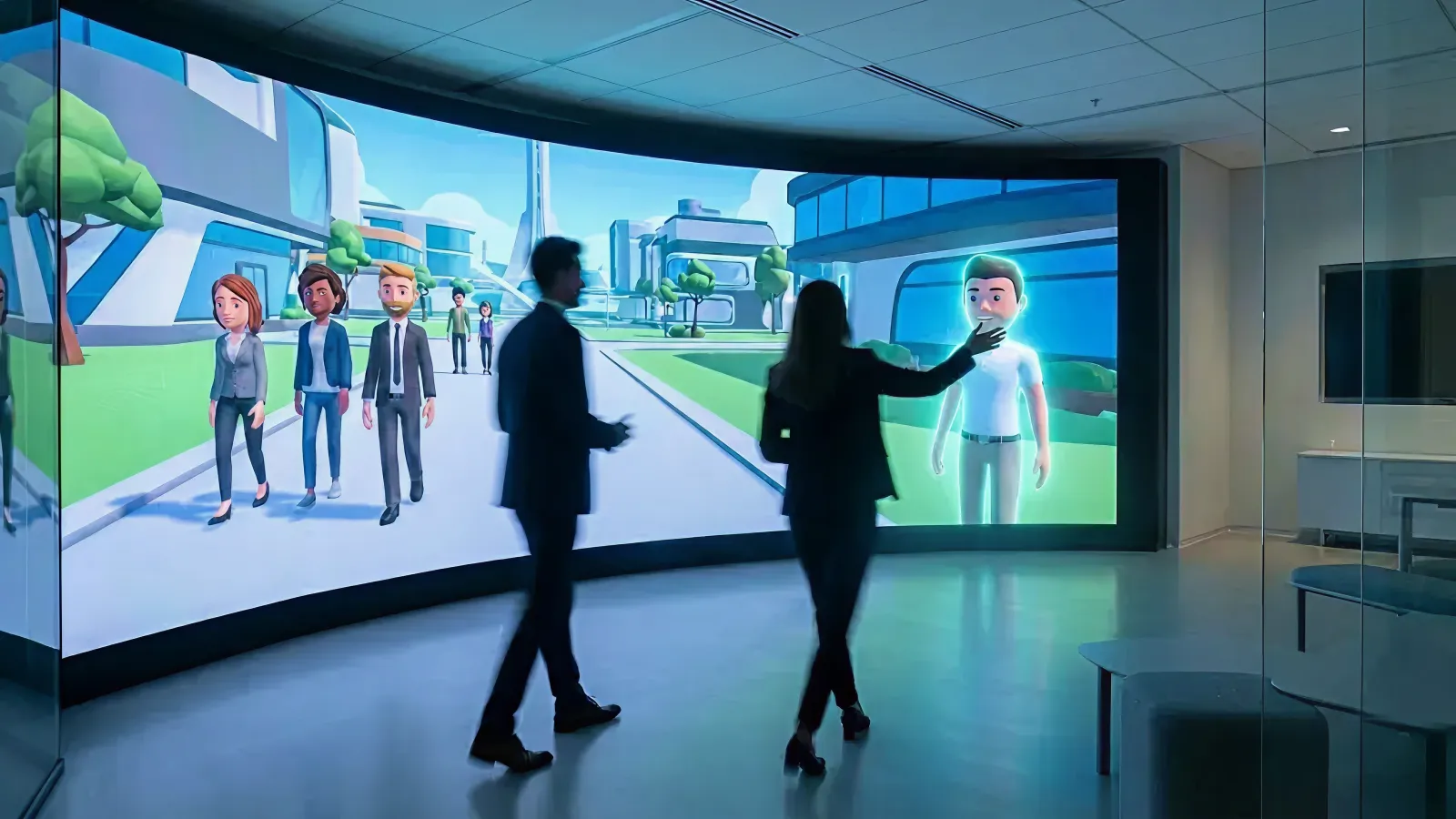
Meanwhile, a new approach is transforming corporate training. Companies are building 3D e-learning games—browser-based virtual worlds where employees explore, interact with AI-powered characters, and learn through play. These aren't children's games or VR headset experiments. They're sophisticated training platforms that run in any browser, work on any device, and turn completion rates from 25% to over 80%.
This guide covers how 3D e-learning games work, why they deliver measurable ROI, and what it takes to build one for your organization.
Who this is for: L&D directors evaluating next-generation training solutions, HR technology buyers comparing options, and training consultants advising enterprise clients on immersive learning investments.
Key Takeaways
- Completion rates jump from 25% to 80%+ when training becomes an interactive 3D experience rather than passive content consumption
- Knowledge retention improves by 75-90% through active engagement versus traditional e-learning methods
- Browser-based means no IT friction—employees access training instantly without downloads, installations, or headset purchases
- Budget tiers range from $50,000 to $200,000+ depending on world complexity, NPC count, and number of mini-games
- ROI reaches 25-353% based on enterprise case studies, with payback through higher productivity, reduced turnover, and faster onboarding
- WebGPU and AI are changing what's possible—2025-2026 technology advances enable richer experiences and adaptive NPCs
1. Why Traditional E-Learning Fails (And What 3D Games Fix)
1-1. The Completion Rate Crisis
The numbers are stark. Traditional corporate e-learning sees completion rates of 7-25% for optional training and barely higher for mandatory programs. Employees click through as fast as possible, retain little, and check a box.
This isn't laziness—it's design failure. Passive consumption doesn't engage adult learners who bring experience and want relevance. Click-next interfaces feel like busywork. And when training competes with actual job responsibilities, anything that feels unproductive loses.
The training industry's response—more content, shorter modules, better graphics—treats symptoms rather than causes. The fundamental problem remains: employees are spectators in their own development.
1-2. From Passive Watching to Active Doing
3D e-learning games flip the model. Instead of watching someone explain a concept, employees:
- Explore a virtual environment relevant to their role
- Talk with NPC characters who respond to their choices
- Practice skills in realistic scenarios without real-world consequences
- Play mini-games that reinforce concepts through repetition and challenge
- Progress through a narrative that creates meaning and motivation
This shift from passive to active transforms completion rates. When learners have agency—when they're protagonists rather than audiences—engagement follows naturally.
Research backs this up. Gamified training programs show completion rates increasing by 50-74%. Companies using interactive approaches report 80% enhanced learning retention (Deloitte) and 40% reduced training costs (IBM) compared to traditional methods.
1-3. What "Immersive" Actually Means for Business
"Immersive" has become a buzzword, often meaning "VR headset required" or "expensive experiment." For practical business applications, we define immersive differently:
Immersive 3D e-learning means:
- A persistent virtual world employees explore at their own pace
- Characters (NPCs) who deliver content through dialog rather than slides
- Game mechanics (quests, achievements, progression) that create motivation
- Realistic scenarios where choices have consequences
- Browser-based delivery that works on existing devices
This approach delivers the engagement benefits of immersive experiences without the deployment challenges of VR hardware. Employees don't need training on headsets. IT doesn't need to manage devices. The experience simply loads in a browser.
2. What Is a 3D E-Learning Game?
2-1. Definition and Core Components
A 3D e-learning game is a browser-based training environment built using web technologies (WebGPU, Three.js) where employees navigate a virtual world, interact with characters, and complete learning objectives through gameplay rather than content consumption.
Unlike traditional e-learning authoring tools that produce interactive slides, 3D e-learning games provide:
| Component | Traditional E-Learning | 3D E-Learning Game |
|---|---|---|
| Environment | Static screens, linear flow | Explorable 3D world |
| Content Delivery | Text, video, voice-over | NPC dialogs, discovery |
| Assessment | Multiple choice quizzes | Scenario simulations, mini-games |
| Motivation | Compliance requirement | Intrinsic engagement |
| Progress | Module completion % | Character level, achievements |
2-2. 3D World Exploration
The virtual world serves as the training context. Depending on your industry, this might be:
- Virtual office for onboarding (explore departments, meet teams)
- Factory floor for safety training (identify hazards, practice procedures)
- Customer environment for sales enablement (navigate objections, close deals)
- Simulated workplace for compliance (encounter scenarios, make decisions)
World design matters for learning transfer. When the training environment mirrors the work environment, skills learned in-game apply directly to real situations. A sales rep who practices conversations in a realistic virtual office carries those skills into actual client meetings.
2-3. NPC Interactions (Characters That Teach)
Non-player characters (NPCs) replace traditional narration with conversational learning. Instead of hearing an explanation, employees talk with characters who:
- Ask questions that prompt reflection
- Respond differently based on learner choices
- Provide feedback in context rather than as separate assessment
- Create memorable personalities that anchor information
NPCs can be colleagues, managers, customers, or even historical figures—anyone relevant to the learning objectives. The dialog-based approach makes abstract content concrete and personal.
With AI integration (Section 5-3), NPCs can adapt to individual learners, creating conversations that feel natural rather than scripted.
2-4. Mini-Games (Quizzes, Memory, Simulations)
Mini-games embedded within the 3D world create spaced repetition and active recall—two techniques proven to improve long-term retention:
- Quiz games: Knowledge checks disguised as challenges (trivia, matching, categorization)
- Memory games: Reinforce terminology and associations through repeated play
- Simulation games: Practice procedures in accelerated, consequence-free environments
- Collection games: Gather items that represent concepts, building complete understanding
- Conversation games: Navigate dialogs with scoring based on approach quality
Mini-games provide instant feedback, create low-stakes practice opportunities, and break learning into engaging chunks. Research shows 40-90% retention improvements when training includes gamified skill-based assessments.
2-5. How It Differs from VR Training
VR training (headset-based) and 3D e-learning games solve different problems:
| Factor | VR Training | 3D E-Learning Game |
|---|---|---|
| Hardware | Headset required | Any browser/device |
| Deployment | Hardware logistics | URL distribution |
| Scale | Limited by device count | Unlimited concurrent users |
| Cost per learner | High (hardware + content) | Low (content amortized) |
| Best for | High-stakes physical skills | Knowledge, soft skills, compliance |
VR excels for training that requires physical presence simulation—surgery, equipment operation, dangerous scenarios. 3D e-learning games excel for scalable knowledge transfer where the barrier to entry must be zero.
3. The Business Case: ROI and Measurable Outcomes
3-1. Engagement Metrics That Matter
The shift from passive to active learning produces measurable engagement improvements:
| Metric | Traditional E-Learning | 3D E-Learning Game |
|---|---|---|
| Completion rate | 7-25% | 80%+ |
| Time in training | Minimized (skip ahead) | Extended (voluntary) |
| Return visits | Rare | Common |
| Peer discussion | None | Organic (shared experience) |
Microsoft's gamified compliance training achieved 94% completion vs. 60% non-gamified. When employees want to complete training rather than being forced, the entire dynamic shifts.
3-2. Knowledge Retention Improvements
Engagement means nothing without learning outcomes. Studies comparing immersive approaches to traditional methods show:
- 75-90% retention rates in immersive 3D environments vs. 10-20% for lectures
- 30% knowledge retention increase with gamification (Chief Learning Officer)
- VR learning quadruples recall by developing emotional and cognitive connections
- 93% skill gap closure in VR-based training (Hiscox case study)
The difference comes from active processing. When learners make decisions, encounter consequences, and reflect on outcomes, information encodes more deeply than passive consumption allows.
3-3. Cost Comparison: 3D Game vs. Traditional vs. In-Person
| Cost Factor | In-Person Training | Traditional E-Learning | 3D E-Learning Game |
|---|---|---|---|
| Development | Low (per session) | Medium | High |
| Delivery | High (facilities, travel, time) | Low | Low |
| Maintenance | High (per update) | Medium | Low (content refresh) |
| Opportunity cost | High (employee time) | Medium | Low (engaging = efficient) |
| Scale | Linear (more = more cost) | Flat | Flat |
The economics favor 3D e-learning games at scale. McDonald's saved $30 million annually by transitioning to e-learning. IBM estimates $30 productivity gain per $1 invested in modern training platforms.
3-4. ROI Benchmarks from Enterprise Implementations
Real-world enterprise deployments demonstrate strong returns (ImmersiveEdge case studies):
- 353% ROI in sales training using immersive approaches
- Volvo simulations: 5% productivity improvement, 10% fuel savings ($40,000/site annually)
- Hiscox VR training: £1.6 million capacity freed through 93% knowledge gap closure
- Deloitte leadership program: 80% enhanced retention, measurable productivity gains
- Centurion gamified academy: 38% reduced turnover, 25% higher mandatory completion
ROI calculation follows: ((Training Benefits - Training Costs) / Training Costs) × 100
Benefits include productivity improvements, error reduction, faster onboarding, and reduced turnover. When completion rates triple and retention doubles, these numbers compound quickly.
4. Why Browser-Based Matters (Web-First Benefits)
4-1. No Downloads, No IT Friction
The biggest barrier to training technology adoption isn't cost—it's deployment friction. IT departments must evaluate security, users must install software, devices must be compatible, updates must be managed.
Browser-based 3D e-learning games eliminate this entirely:
- One URL reaches all employees
- No installation required—works in existing browsers
- No IT approval for software deployment
- Automatic updates without user action
- Zero device management overhead
This isn't a minor convenience—it's the difference between 10% pilot adoption and 100% organization deployment.
4-2. Instant Deployment Across Global Offices
For multinational organizations, deployment speed determines training effectiveness. When compliance requirements change or product knowledge needs updating:
- Traditional approach: Develop content → Test → Deploy through LMS → Hope for completion
- 3D e-learning game: Update server → All users see changes immediately
No app store approvals. No device compatibility testing. No staggered rollouts. The same experience reaches Singapore and Seattle simultaneously.
4-3. Mobile Accessibility (Train Anywhere)
Modern WebGPU-powered experiences run on mobile devices, not just desktops. This means:
- Field employees complete training between tasks
- Remote workers engage from any location
- Commuters make productive use of travel time
- Shift workers access training without dedicated computer time
Mobile-first design ensures touch controls feel native—not like desktop compromises. Gyroscope interactions add immersion without requiring controller hardware.
4-4. SCORM/xAPI Integration with Existing LMS
Browser-based delivery doesn't mean abandoning existing infrastructure. 3D e-learning games integrate with learning management systems through:
- SCORM: Track completion, scores, time spent
- xAPI (Tin Can): Detailed behavioral analytics (paths taken, choices made, areas struggled)
- LTI: Launch from existing platforms seamlessly
Your LMS remains the system of record while the 3D experience delivers engagement that traditional content can't match.
5. The Technology Behind It (For Business Leaders)
5-1. WebGPU: Why Performance Matters for Engagement
WebGPU is the browser standard that makes rich 3D experiences possible without plugins or apps. Here's why it matters for your training:
Before WebGPU (2024 and earlier):
- Laggy graphics on standard laptops
- Limited visual quality
- Heavy battery drain on mobile
- "Good enough" experiences
After WebGPU (2025 onward):
- Console-quality graphics in a browser
- Smooth 60fps on standard business hardware
- Efficient enough for all-day mobile use
- Experiences that feel like games, not training tools
Performance directly impacts completion. When training loads slowly or runs poorly, employees disengage. When it runs smoothly and looks impressive, engagement sustains.
The 2025 milestone of WebGPU support in all major browsers (Chrome, Firefox, Safari, Edge) means the technology is now deployment-ready for enterprise.
5-2. Mobile Support: Reaching All Employees
60%+ of web traffic is mobile. For training to reach all employees—especially field workers, retail staff, and distributed teams—mobile support isn't optional.
Technical considerations that affect business outcomes:
| Factor | Business Impact |
|---|---|
| Load time | Under 3 seconds or users abandon |
| Touch controls | Must feel native to mobile users |
| Battery efficiency | Can't drain phones during training |
| Offline capability | Some environments lack connectivity |
| Screen adaptation | Same content works on all devices |
Well-built 3D e-learning games handle these automatically, detecting device capabilities and serving appropriate experiences.
5-3. Future AI Integration: NPCs That Adapt to Learners
The next evolution in 3D e-learning games is AI-powered NPCs that respond dynamically to each learner:
Current state (scripted):
- Predefined dialog trees
- Same responses for all learners
- Limited conversation paths
- Updates require development
Near future (AI-enabled):
- Natural language conversations
- Adaptive difficulty based on learner performance
- Personalized feedback and hints
- Infinite conversation possibilities
- Content updates through training, not code
Organizations investing in 3D e-learning games now should ensure architecture supports future AI integration. The platform you build in 2026 should be ready for AI NPCs in 2027.
6. Use Cases by Training Type
6-1. Compliance Training
The challenge: Mandatory, often dry, frequently resented. Employees click through to complete the requirement, retain nothing.
The 3D approach: Create scenarios where compliance decisions have visible consequences. An NPC customer becomes frustrated when privacy isn't protected. A virtual workplace shows safety hazards that cause visible (simulated) incidents. Employees experience why compliance matters rather than being told.
Results:Microsoft achieved 94% completion in compliance programs versus 60% non-gamified.
6-2. Onboarding
The challenge: New employees need context, relationships, and culture—not just policies and procedures.
The 3D approach: Virtual office tours where new hires explore departments, meet team NPCs, and understand how their role connects to the organization. Scavenger hunts for information create engagement. Conversation games help practice introducing themselves.
Results:Companies report up to 45% improvement in turnover rates with gamified approaches.
6-3. Sales Enablement
The challenge: Product knowledge is necessary but insufficient. Sales success requires conversation skills that traditional training can't build.
The 3D approach: Practice environments where employees sell to NPC customers with different personalities, objections, and needs. Conversation games score approach quality. Simulation mini-games accelerate product knowledge.
Results:Sales training using immersive methods shows 353% ROI.
6-4. Safety Training
The challenge: High-stakes scenarios can't be practiced safely in real environments. Classroom training doesn't build muscle memory.
The 3D approach: Navigate virtual hazardous environments. Identify risks before they cause (simulated) incidents. Practice emergency procedures without real danger. Experience consequences that create lasting memory.
Results:VR/3D safety training shows 75-90% retention versus traditional methods.
6-5. Soft Skills (Leadership, Communication)
The challenge: Interpersonal skills require practice, feedback, and iteration—not lectures.
The 3D approach: Conversation scenarios with NPC subordinates, colleagues, and executives. Practice difficult conversations (performance feedback, conflict resolution) in safe environments. Receive instant feedback on approach quality.
Results:Deloitte's leadership program showed 80% enhanced learning retention and measurable productivity gains.
7. Budget and Timeline
7-1. Budget Tiers
| Project Type | Budget Range | What's Included |
|---|---|---|
| Pilot Module | $50,000–$80,000 | Single world, 5-10 NPCs, 3-5 mini-games, one training objective |
| Comprehensive Program | $80,000–$150,000 | Multiple areas, 15-20 NPCs, 8-12 mini-games, full curriculum |
| Enterprise Platform | $150,000–$250,000+ | Large world, 25+ NPCs, branching narratives, multiple languages, LMS integration |
These ranges assume content design collaboration—you provide learning objectives and subject matter expertise; the development partner creates the experience.
7-2. What Affects Cost
Cost drivers:
- World complexity: More environments = more asset creation
- NPC count: Each character needs dialog, personality, and potentially AI integration
- Mini-game variety: Custom game mechanics require development
- Languages: Localization multiplies content work
- Integration depth: SCORM basic vs. xAPI detailed vs. custom analytics
Cost reducers:
- Starting with a pilot (prove value before full investment)
- Reusing assets across modules
- Templated mini-game mechanics
- Single language first, localize later
7-3. Typical Timeline (12-20 Weeks)
| Phase | Duration | Activities |
|---|---|---|
| Discovery | 2-3 weeks | Learning objectives, content audit, technical requirements |
| Design | 3-4 weeks | World concept, NPC characters, mini-game mechanics, storyboard |
| Development | 6-10 weeks | 3D environment, character creation, game building, dialog writing |
| Testing | 2-3 weeks | QA, user testing, LMS integration, mobile optimization |
| Launch | 1-2 weeks | Deployment, monitoring, initial support |
Complex projects with multiple languages or extensive custom development can extend to 24+ weeks.
7-4. Ongoing Costs
After initial development, budget for:
- Hosting: $500-2,000/month depending on scale
- Content updates: $5,000-15,000 per significant refresh
- Support: Included or retainer-based
- Analytics: Often included in hosting
Unlike traditional e-learning that requires rebuilding outdated modules, 3D platforms allow incremental content updates without full redevelopment.
8. Common Pitfalls (And How to Avoid Them)
Overscoping the First Project
The trap: Trying to solve all training challenges in one massive platform.
The fix: Start with a single, high-impact use case. Prove ROI. Expand from success.
Focusing on Graphics Over Learning Design
The trap: Beautiful 3D worlds where nothing meaningful happens.
The fix: Define learning objectives first. Design interactions that achieve them. Add visual polish last.
Ignoring Mobile Users
The trap: Desktop-optimized experience that fails on phones where employees actually train.
The fix: Mobile-first development. Test on actual devices. Ensure touch controls feel native.
No Measurement Framework
The trap: Impressive demo, no data on actual impact.
The fix: Define success metrics before development. Instrument analytics from day one. Compare to baseline performance.
Treating It as a One-Time Project
The trap: Launch, celebrate, abandon. Content grows stale, engagement drops.
The fix: Budget for ongoing updates. Plan content refresh cycles. Treat the platform as a living product.
9. How to Get Started: A Practical Roadmap
9-1. Define Learning Objectives First
Before discussing technology, answer:
- What specific behaviors should change after training?
- How will you measure success?
- What's the cost of the current training gap?
Clear objectives guide every subsequent decision.
9-2. Start with a Pilot
Rather than organization-wide rollout:
- Select one high-impact training need (compliance, onboarding, sales)
- Build a focused experience ($50-80K, 12-16 weeks)
- Measure against clear metrics (completion, retention, behavior change)
- Document ROI to justify expansion
- Iterate based on learner feedback
Pilots prove value with manageable risk and create internal champions for broader adoption.
9-3. Measure, Iterate, Expand
After successful pilot:
- Analyze data: What worked? Where did learners struggle?
- Gather feedback: What did employees love? What frustrated them?
- Plan expansion: Which other training needs justify investment?
- Build the business case: Use pilot ROI to secure larger budgets
9-4. Questions to Ask Potential Development Partners
| Area | Questions |
|---|---|
| Technical | What technologies do you use? How do you handle mobile? What's your WebGPU experience? |
| Learning design | How do you translate objectives into game mechanics? Who handles instructional design? |
| Portfolio | Can you show examples of corporate training projects? What were the outcomes? |
| Process | How do you involve our team? What does the revision process look like? |
| Support | What ongoing support is included? How are updates handled? |
10. About Utsubo
Utsubo is a creative studio specializing in immersive web experiences and interactive installations, based in Osaka with clients worldwide.
Web expertise:
- Three.js/WebGPU 3D web experiences
- Interactive storytelling and narrative design
- Performance optimization (rich experiences that load fast)
Why we're credible for e-learning games: Our technical foundation—real-time 3D, interaction design, performance optimization—translates directly to training applications. We understand both the technology and the experience design that makes it effective.
We're building our e-learning portfolio and bring genuine enthusiasm for creating training that employees actually want to complete.
11. Book a 30-Minute Project Call
Evaluating 3D e-learning games for your organization? Book a 30-minute project call to discuss:
- Whether this approach fits your training challenges
- What a realistic pilot might look like
- How to define success metrics
- Budget and timeline expectations
12. Checklist
- Identified a high-impact training use case for pilot
- Defined clear learning objectives and success metrics
- Established baseline completion/retention rates for comparison
- Confirmed mobile support requirements
- Evaluated LMS integration needs (SCORM/xAPI)
- Budgeted for pilot project ($50-80K typical)
- Allowed adequate timeline (12-16 weeks minimum)
- Planned for ongoing content updates post-launch
- Selected partner with 3D web and learning design expertise
- Built internal stakeholder support for immersive approach
FAQs
How is this different from VR training? VR requires headsets and dedicated hardware. 3D e-learning games run in any browser on any device—no special equipment, no IT deployment, no scale limitations. VR excels for physical skill practice; browser-based 3D excels for knowledge transfer, soft skills, and compliance training at scale.
What devices does it work on? Modern 3D e-learning games work on laptops, desktops, tablets, and smartphones—any device with a modern browser. WebGPU support (standard since 2025) ensures smooth performance across hardware. Older devices may see reduced visual quality while maintaining functionality.
Can it integrate with our existing LMS? Yes. Standard integrations include SCORM (completion and scores) and xAPI/Tin Can (detailed behavioral analytics). LTI launch allows seamless access from existing platforms. Your LMS remains the system of record.
How do we measure ROI? Track completion rates (typically 80%+ vs. 25% baseline), knowledge retention (pre/post assessments), time-to-competency, and business metrics (error rates, productivity, turnover). ROI formula: ((Training Benefits - Training Costs) / Training Costs) × 100. Enterprise case studies show 25-353% returns.
How long does it take to build? Pilot projects (single module, focused scope) take 12-16 weeks. Comprehensive programs take 16-20 weeks. Enterprise platforms with multiple languages and extensive content can extend to 24+ weeks. Timeline depends primarily on content complexity and review cycles.
Can we update content ourselves? Dialog updates and content refreshes can be managed through a CMS interface in well-designed systems. Major additions (new NPCs, mini-games, environments) require development partner involvement. Plan for ongoing content budgets rather than one-time projects.
Is it accessible (WCAG compliant)? Yes, with proper implementation. Accessibility features include keyboard navigation, screen reader support for dialog, audio descriptions, and adjustable visual settings. Discuss specific requirements with development partners during scoping.
What about data privacy and security? Browser-based delivery means data stays within your control—no third-party app installations. Standard security includes HTTPS encryption, authentication integration, and data residency options. Enterprise deployments can include SSO, audit logging, and compliance certifications as needed.


 Technology-First Creative Studio