You've decided you need a real object, room, or building turned into 3D data. The next question is the one that stalls most projects: which capture method do you actually commission? Vendors will each tell you their method is the best one — and they're not lying, exactly. They're answering the wrong question.
The right question isn't "which technology is best." It's "which method produces the thing I'm building." A photoreal hero for a website, a survey-accurate as-built model, an editable asset for a game pipeline, and a live installation are four different deliverables — and they point to four different capture decisions, sometimes to a combination of two.
This guide is the decision matrix. Four methods — Gaussian Splatting, photogrammetry, NeRF, and LiDAR — scored on the things a buyer actually pays for, then mapped to the deliverable you have in mind. By the end you should be able to walk into a vendor conversation already knowing what to ask for.
Who this is for: Heritage and museum digitization leads, real-estate developers, 3D production and VFX managers, and brand or technical decision-makers scoping a 3D capture commission — anyone who needs to brief a vendor and doesn't want to be sold the wrong method.
Key Takeaways
- The deliverable decides the method, not the other way around. Pick what you're building first; the capture method falls out of that. Choosing the tech first is the most common and most expensive mistake.
- Photogrammetry gives you an editable mesh — the right call when the output has to enter a 3D pipeline (game, film, product viz) or be measured and modified.
- Gaussian Splatting gives you photoreal, real-time capture that runs beautifully on the web — the right call when the realness of a place or product is the point and the destination is a screen.
- NeRF is, in 2026, mostly a research-grade input and a quality benchmark — rarely the thing you commission directly for a commercial deliverable.
- LiDAR gives you survey-accurate metric geometry and scale — the right call for as-builts, measurement, and large architectural sites — but it needs color and detail from another method.
- The two most useful methods are often combined: LiDAR for accurate geometry plus photogrammetry or splats for appearance. Hybrid is a feature, not a compromise.
- Capture cost runs roughly $500–$15,000 depending on method and scale; building the final deliverable (a website, an installation, a game asset) is a separate budget line — don't conflate the two.
1. The Only Question That Matters: What Are You Building?
Every capture method is a set of trade-offs. There is no method that is simultaneously the most photoreal, the most editable, the most accurate, the lightest to stream, and the cheapest to capture. Pick any technology and you are accepting some weaknesses to get some strengths.
Which weaknesses you can live with depends entirely on the deliverable. A museum putting a fragile artifact online cares about photorealism and web performance, and does not care that the capture isn't editable down to the polygon. An architecture firm documenting an as-built condition cares about millimetre accuracy and does not care that the result looks a little clinical. A game studio capturing a prop cares that the asset drops cleanly into its engine with clean topology — photorealism it can art-direct later.
So before you compare methods, finish this sentence: "The output of this capture has to end up as ___." A web page. A measurement. A film set extension. A live, sensor-driven installation. That ending is what the rest of this guide maps against.
2. The Four Capture Methods in One Line Each
Here is what each method is as a commissioning choice — not how the math works, but what you're buying. (If you want the deeper "how Gaussian Splatting actually works" explanation, our 3D Gaussian Splatting guide covers it in full.)
2-1. Photogrammetry
You're buying an editable 3D mesh with textures, reconstructed from overlapping photos. It behaves like any other 3D model: it has geometry you can edit, retopologize, UV-unwrap, and drop into Blender, Unreal, Unity, or a CAD tool. It's the most mature, most pipeline-friendly method. Its weaknesses are reflective, transparent, and featureless surfaces (glass, chrome, water, blank walls) and the cleanup labour a high-quality mesh demands.
2-2. Gaussian Splatting
You're buying captured light — a photoreal representation of a scene that renders in real time, including the reflections and view-dependent sparkle that photogrammetry struggles with. It is exceptional on the web and in real-time viewers. Its weakness is that it is not a conventional editable model: you don't easily relight it, reshape it, or hand it to a modeller to modify. Once you've chosen splats, shipping them well — the formats, the compression, the loading discipline — is its own engineering discipline, and we keep that lane in the Gaussian Splatting guide rather than repeating it here.
2-3. NeRF
You're buying a neural reconstruction of a scene — historically the quality benchmark that proved photoreal novel-view synthesis was possible. In 2026, for most commissioned commercial work, NeRF has largely been overtaken by Gaussian Splatting for the same goals, because splats render far faster and slot into real-time and web pipelines more readily. NeRF still matters in research, in specific scientific and effects pipelines, and as an input step — but it's rarely the thing a buyer commissions directly as a deliverable. Treat it as a technique that may sit inside a vendor's pipeline, not as the product you ask for by name.
2-4. LiDAR
You're buying metric geometry — a laser-scanned point cloud (often converted to a mesh) where the measurements are survey-accurate and the scale is true. It's the method of record for as-builts, heritage documentation at architectural scale, BIM, and anywhere a number on the model has to match a number in the real world. Its weakness is appearance: raw LiDAR is geometry and intensity, not photoreal color, so it's usually paired with photography for a presentable result.
One important distinction. This guide treats LiDAR as a capture method — scanning a site to produce a 3D dataset. That is different from LiDAR used as a live interactivity sensor (tracking people moving through a room in real time). If your project is a live, sensor-driven physical installation, the sensor side of LiDAR lives in our interactive point cloud installations guide, not here.
3. The Decision Matrix
This is the core artifact. Each method scored on the six things buyers actually weigh. Read it as "good / fair / poor for a typical commercial commission," not as an absolute physics ranking — a specialist can push any method beyond its row with enough budget.
| Criterion | Photogrammetry | Gaussian Splatting | NeRF | LiDAR |
|---|---|---|---|---|
| Photorealism / fidelity | Good (texture-dependent) | Excellent — captures reflections, fine detail | Excellent | Geometry only; not photoreal alone |
| Relighting & geometry accuracy | Editable geometry, relightable; accuracy fair | Limited relight; geometry approximate | Very limited edit; geometry approximate | Survey-accurate geometry; not relightable alone |
| File size / web-streamability | Heavy (mesh + textures), but standard & optimizable | Medium; purpose-built for real-time/web | Poor — slow to render, not web-native | Very heavy raw; needs heavy processing for web |
| Capture cost & turnaround | Low capture cost; cleanup adds time | Low capture cost; fast processing | High effort; slow training | Higher (specialist hardware); fast on-site |
| Edit-ability | Excellent — full DCC/CAD pipeline | Poor — not a conventional model | Poor | Fair — point cloud → mesh, then editable |
| Reflective / transparent surfaces | Poor (glass, chrome, water fail) | Good — handles view-dependent reflections | Good | N/A (geometry only; surface unaffected by reflectance) |
How to read it: find the one or two criteria that are non-negotiable for your deliverable, then pick the column that wins those. Don't optimize for a criterion you don't actually need — "editable" is worthless if nobody will ever edit it, and "survey-accurate" is overkill for a marketing hero.
4. Which Method for Which Deliverable
Now flip the matrix around. Start from what you're building and read off the method.
| What you're building | Commission this | Why |
|---|---|---|
| A web landing page or product page where a real place/product is the hero | Gaussian Splatting | Photoreal + real-time + web-friendly. → Gaussian Splatting landing pages |
| A real-estate marketing experience (pre-leasing, investor tours, walkthroughs) | Gaussian Splatting | Smooth navigation, photoreal interiors. → Gaussian Splatting for commercial real estate |
| A live, sensor-driven physical installation | Point cloud / real-time capture (method depends on interactivity) | Real-time rendering and sensor input are the constraint. → Interactive point cloud installations |
| An editable asset for a game / film / product-viz pipeline | Photogrammetry (or LiDAR + photo for scale) | You need clean, modifiable geometry in a DCC tool |
| A survey, as-built, or measurement record | LiDAR | Metric accuracy and true scale are the whole point |
| A heritage / architectural digitization that must be both accurate and presentable | LiDAR + photogrammetry/splat | Accurate geometry from LiDAR, appearance from the other |
The pattern is clear: screen-bound, appearance-led deliverables lean splatting; pipeline-bound, editable deliverables lean photogrammetry; measurement-bound deliverables lean LiDAR; and the demanding jobs combine them. Notice that three of these rows hand off to an existing, deeper guide — once the capture method is chosen, the delivery of that method is a separate body of work.
5. Capture Logistics & What You Provide
Methods differ not just in output but in what the commission demands from you — access, time, and conditions. This is what you're actually scheduling and paying for.
- Photogrammetry. A photographer (or a crew for large subjects) shoots hundreds to thousands of overlapping images. Needs even, diffuse lighting and a subject that holds still. On-site time is moderate; the larger cost is often post — mesh reconstruction and cleanup. You provide access and, ideally, controllable lighting.
- Gaussian Splatting. Capture is similar to photogrammetry — images or video of the scene from many angles — but processing is faster and cleanup is lighter. On-site time is typically short. You provide access and a scene that isn't changing during capture (no moving people or shifting light if you want a clean result).
- NeRF. Capture resembles the above, but training is computationally heavy and slow, which is part of why it's rarely the commissioned deliverable in 2026. If a vendor uses it, it's usually inside their pipeline, not a scheduling concern for you.
- LiDAR. A specialist operates a terrestrial or handheld scanner, often from multiple set-up positions for full coverage of a site. On-site capture is fast and precise; the hardware and operator expertise drive the cost. You provide site access and coordination — large or occupied sites need scheduling around foot traffic.
Across all methods, the single biggest avoidable cost is re-capture. Scenes change, sites become inaccessible, lighting shifts. Scope enough on-site time to get it right once.
6. Cost & Turnaround Bands
Capture costs are method- and scale-dependent. These are capture-only bands — turning the captured data into a finished deliverable (a website, an installation, a game-ready asset) is a separate budget.
| Method | Typical capture cost | Turnaround | Cost drivers |
|---|---|---|---|
| Photogrammetry | $500–$5,000 | Days to weeks (cleanup-bound) | Subject size, mesh quality, cleanup labour |
| Gaussian Splatting | $500–$5,000 | Hours to days | Scene size, number of captures, target quality |
| NeRF | Varies (often higher effort) | Days (training-bound) | Compute, specialist time |
| LiDAR | $2,000–$15,000+ | Hours on-site; days to process | Site scale, scan positions, accuracy spec |
These capture figures are deliberately consistent with the numbers in our splat articles — for the Gaussian Splatting guide and the landing-page guide, capture sits in the same $500–$5,000 band, and the experience built on top is the larger, separate line item. Hold that distinction in your budget from day one: capture is the raw material, not the finished thing.
7. Combining Methods
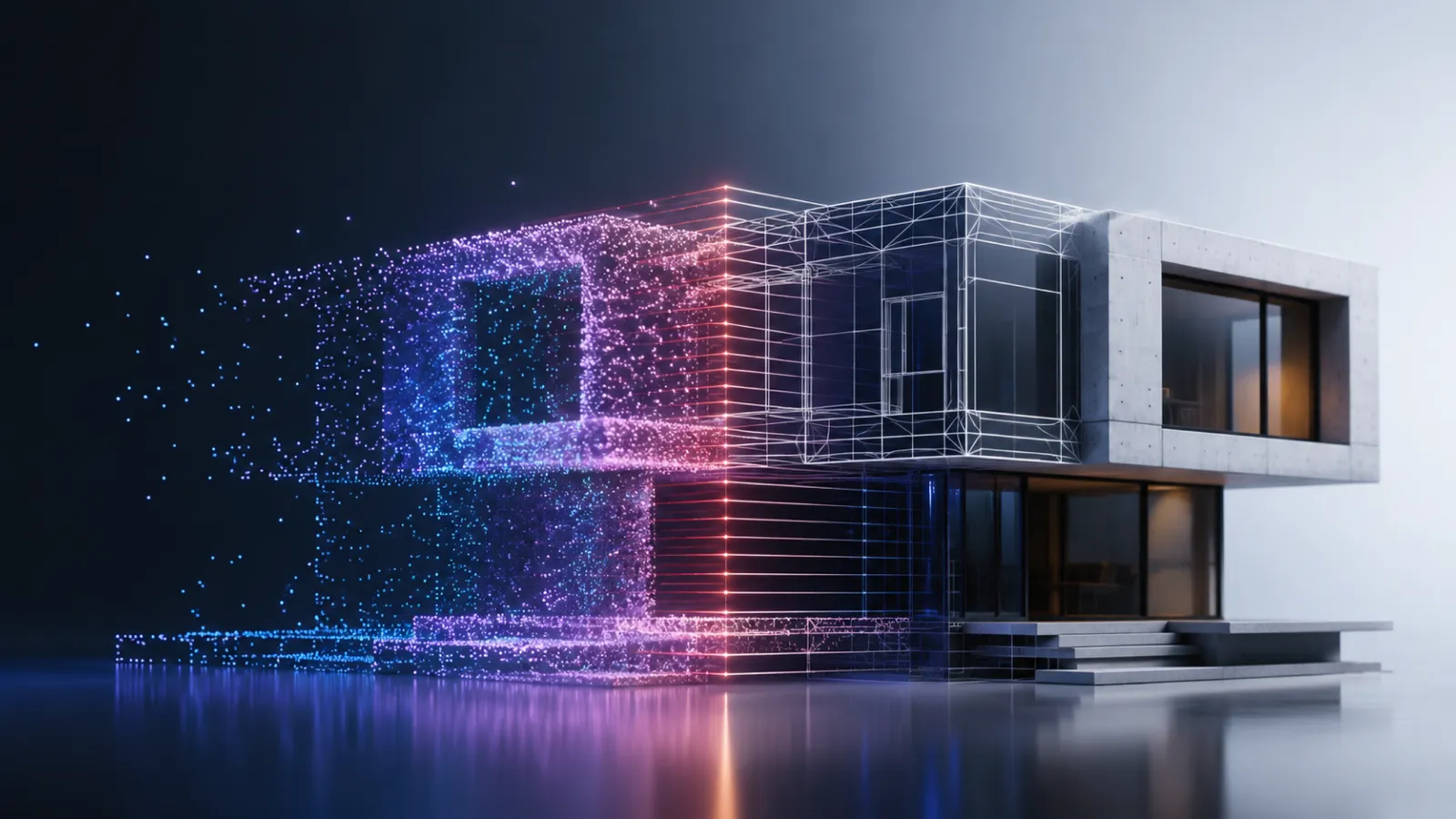
The framing of this article is "vs," but the most sophisticated commissions are "and." The two methods that pair most naturally are LiDAR and photogrammetry (or splatting): LiDAR provides the accurate skeleton — true scale and geometry — while photography or splats provide the skin: color, texture, and photoreal surface.
This hybrid is standard practice for heritage digitization and high-end architectural work, where the deliverable must be both trustworthy as a measurement and convincing as an image. It's also common in film and AAA games, where LiDAR captures the set or environment at scale and photogrammetry fills in detailed assets.
You don't usually need to specify the combination yourself — a capable vendor will propose it when the deliverable demands both accuracy and appearance. But knowing it exists changes the conversation: if a single method can't satisfy two non-negotiable criteria from the matrix above, the answer isn't to compromise, it's to combine.
8. Common Pitfalls
- Choosing the technology before the deliverable. "We want a Gaussian splat" is a solution looking for a problem. Start from what you're building.
- Expecting splats to be editable. Splats are captured light, not a model. If you need to reshape, retopologize, or hand the asset to a modeller, that's a photogrammetry (mesh) job.
- Expecting photogrammetry to handle glass and chrome. Reflective and transparent surfaces are photogrammetry's classic failure mode. If those surfaces are central, splatting handles them better — or plan for manual modelling.
- Under-scoping on-site time. Re-capture is the expensive surprise. Sites change and access windows close; budget to get it right in one visit.
- Treating capture and delivery as one line item. The capture is the raw material. Building the website, installation, or game asset on top is separate work with its own budget and timeline. Conflating them produces estimates that are wrong in both directions.
9. About Utsubo
Utsubo is a creative technology studio that helps clients choose the right 3D capture method for what they're actually building — and then builds the web experience on top of it. We're method-agnostic about capture and opinionated about outcomes: the deliverable drives the decision.
Where we go deep is the destination most of these captures are headed toward — the screen:
- Custom Gaussian splatting player on a three.js WebGPU renderer: photoreal splats and ordinary 3D objects in one scene, with correct depth between them.
- Our own physics engine and lighting system: captured scenes that respond to input and share one coherent lighting model with injected 3D, not two layers pasted together.
- A web optimization pipeline that ships heavy photoreal scenes with green Core Web Vitals.
If you're weighing a capture commission, we can help you map it to the right method before you spend on the wrong one. For the deeper material on each destination, see our guides on the Gaussian Splatting fundamentals, scroll-driven splat landing pages, Gaussian Splatting for commercial real estate, and live, sensor-driven installations.
10. Let's Talk
Want to bring your Gaussian splat to the web — animated or not? That's our deep expertise. We work with teams on photoreal web experiences, product configurators, and immersive brand projects, and we help scope the capture that feeds them.
If you're exploring a partnership, let's discuss your project:
- What you're building and the constraints you're working with
- Which capture method makes sense for your deliverable
- Whether we're the right fit to help you execute
11. Checklist
- Define the deliverable first — write down what the capture output has to become
- Identify your one or two non-negotiable criteria (photorealism? accuracy? edit-ability? web weight?)
- Use the decision matrix to pick the method that wins those criteria
- If two non-negotiables conflict, plan to combine methods (e.g. LiDAR + photogrammetry)
- Confirm how reflective/transparent surfaces will be handled, if relevant
- Scope enough on-site time to avoid re-capture
- Budget capture and final-deliverable production as separate line items
- Brief your vendor on the deliverable, not the technology — let them confirm the method
FAQs
What is the difference between Gaussian Splatting and photogrammetry? Photogrammetry reconstructs an editable polygon mesh with textures from photos — you can modify it and drop it into a 3D pipeline. Gaussian Splatting captures the scene as photoreal "light" that renders in real time, including reflections, but isn't a conventional editable model. Commission photogrammetry when you need an editable asset; commission splatting when you need photoreal realism on a screen.
Gaussian Splatting vs NeRF vs LiDAR — which should I commission? For most commercial deliverables in 2026, Gaussian Splatting has overtaken NeRF for photoreal real-time work because it renders far faster and is web-native. NeRF is now mostly a research-grade or pipeline-internal technique, rarely the named deliverable. LiDAR is a different tool entirely — commission it when you need survey-accurate geometry and true scale, not photoreal appearance.
Is NeRF still worth commissioning in 2026? Rarely as a standalone commercial deliverable. Gaussian Splatting achieves comparable visual quality with real-time rendering and far easier web and pipeline integration. NeRF remains relevant in research, certain scientific and effects pipelines, and as an internal step — but if a vendor proposes it, ask what it gives you that splatting wouldn't.
Can you edit a Gaussian splat like a 3D model? Not in the conventional sense. A splat is captured light, not geometry with clean topology, so you can't easily reshape it, retopologize it, or relight it the way you would a mesh. If editing is a requirement, photogrammetry (which produces a mesh) is the right capture method, or you plan for manual modelling.
Which capture method handles reflective and transparent surfaces like glass and chrome? Gaussian Splatting handles view-dependent reflections far better than photogrammetry, whose classic failure mode is exactly glass, chrome, and water. If reflective or transparent surfaces are central to your subject, lean toward splatting — or budget for manual modelling to fix what photogrammetry can't reconstruct.
LiDAR vs photogrammetry — which is more accurate? LiDAR is the method of record for metric accuracy and true scale, which is why it's used for as-builts, BIM, and survey work. Photogrammetry can be accurate but is more sensitive to capture conditions and lacks LiDAR's guaranteed scale. For heritage and architecture that must be both accurate and presentable, the two are often combined — LiDAR for geometry, photography for appearance.
Which method should I use for a website versus a game or film asset? For a website where a real place or product is the hero, commission Gaussian Splatting — it's photoreal and web-native. For a game, film, or product-viz pipeline that needs an editable, modifiable asset, commission photogrammetry (a mesh), optionally paired with LiDAR for accurate scale on large environments.
How much does 3D capture cost and how long does it take? Capture-only costs run roughly $500–$5,000 for photogrammetry or Gaussian Splatting and $2,000–$15,000+ for LiDAR, depending on scale and accuracy. Turnaround ranges from hours (splatting) to weeks (photogrammetry cleanup). Building the final deliverable — the website, installation, or asset — is a separate budget and timeline from the capture itself.


 Technology-First Creative Studio