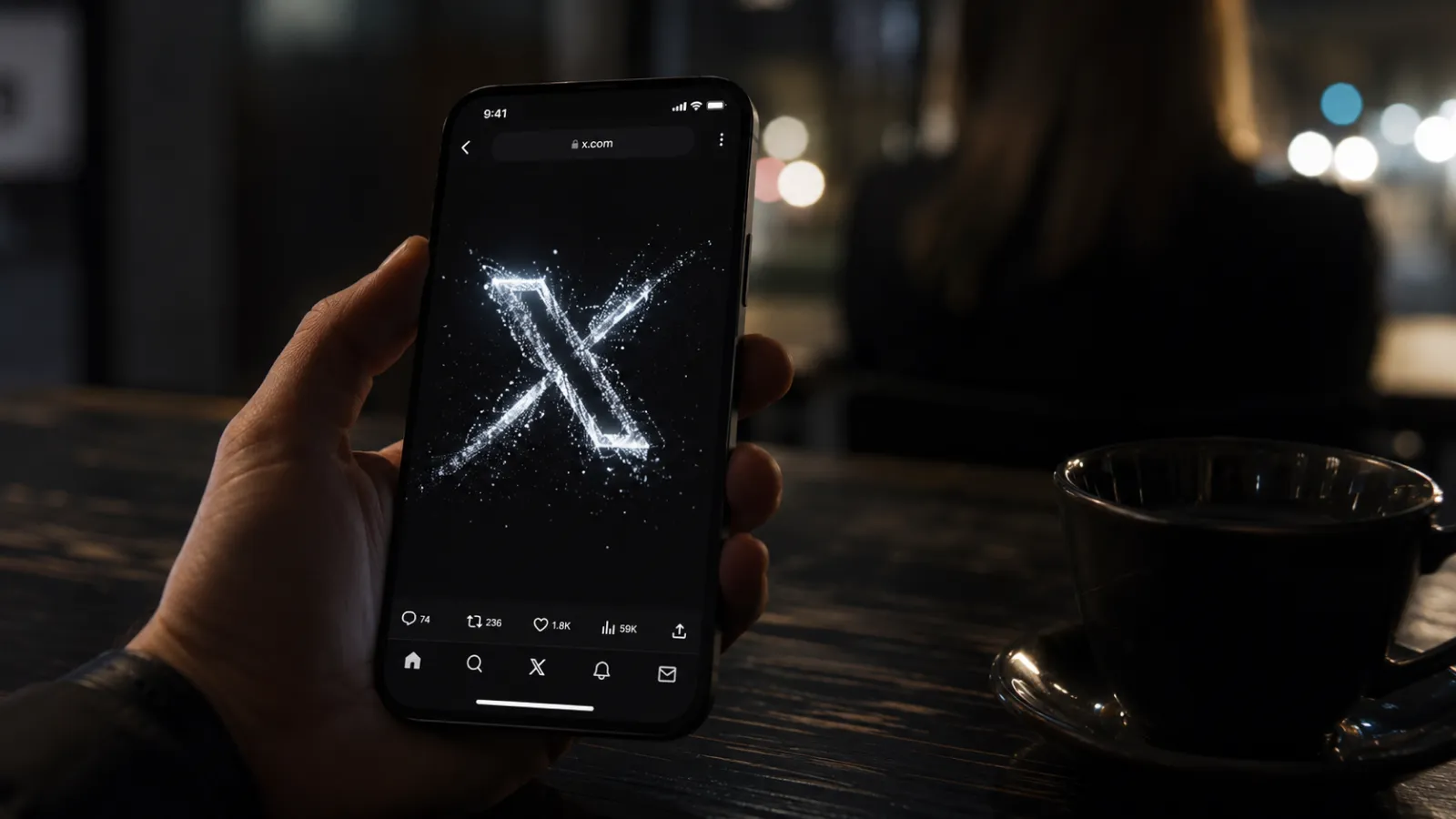
A tweet hits. The quote-tweets start. For a few hours, more people will look at your brand than in the previous quarter. Then someone taps your link.
Where do they land? Not in Chrome. Not in Safari. They land inside X's in-app browser — a stripped-down WebView wrapped in X's own chrome, on a phone, on a cold cache, with the algorithm one swipe away pulling them back. That handoff is the entire game, and most brands lose it in the first second.
If you already know what a hit post feels like, you know the problem too: the attention is real, but it's rented, and it evaporates. The only thing you own is the experience on the other side of the tap. This article is about engineering that experience so it survives X's browser and turns a viral moment into something people remember — and something a decision-maker can put a number against.
Who this is for: Founders, CMOs, brand leads, and marketing owners who get real traffic from X and want the destination to match the moment — a fast, immersive, in-browser experience that converts borrowed attention into brand memory, not a bounce.
Key Takeaways
- The battlefield is the in-app browser, not your desktop preview. X opens links in an embedded WebView: a short viewport, a throttled GPU, a cold cache, and mobile-only. A site that dazzles on your 27-inch monitor can stutter or crash here.
- Platforms are built to keep users captive. The tap out to your site is the one moment X hands you the user. Waste it with a slow load or a broken hero and the swipe back is instant.
- Speed and "wow" are not a trade-off — sequencing is the trick. Ship a static, server-rendered hero that lands in under a second, then layer the 3D and interaction on top. You keep the first impression and the immersive payload.
- Design for a short screen. X's chrome eats vertical space. The impact has to live above a phone fold that is smaller than you think — one strong idea, not a scroll marathon.
- A viral post alone is dead-end reach. A linked experience is an asset. People screenshot, screen-record, and re-share an experience worth exploring — turning one post into sustained earned media.
- This is measurable. Utsubo's own studio site drew ~5 million organic views on X with zero paid spend — earned reach a media buyer would price at $100K–$300K. That is the ROI language a decision-maker signs off on.
1. The Moment a Tweet Hits
Attention on X arrives in a spike and leaves just as fast. A post does its numbers in hours, not weeks. During that window you are not competing with other brands — you are competing with the next post in the feed.
The post itself is not the asset. It lives on X's servers, ranked by X's algorithm, monetized by X. What you actually own is the destination: the page behind the link. Everything upstream is borrowed. So the entire value of a viral moment compresses into a single event — the tap-through — and what happens in the two seconds after it.
Get that handoff right and a spike becomes a wave of screenshots, shares, and "who built this?" replies. Get it wrong and you paid for reach with nothing to bank.
2. Platforms Want Your Users Captive
Every major platform is engineered to minimize the exit. Infinite feeds, autoplay, in-app browsers that keep a back-swipe to the timeline one gesture away — none of it is accidental. X wants the user to glance at your link and come straight back.
That means the link-out is the only moment the platform genuinely cedes the user to you, and it does so grudgingly. You do not get a second impression. There is no "let me refresh and try again." The user is on mobile, mid-scroll, dopamine-primed, and the timeline is still glowing behind your tab.
Your website is the escape hatch from someone else's platform into something you own — your brand, your story, your call to action, your data. But an escape hatch only works if it opens fast and leads somewhere worth the trip.
3. The X In-App Browser Is Not the Browser You Tested
This is the part almost everyone skips, and it is where viral traffic quietly dies. When a user taps a link in X, the site does not open in their default browser. It opens in an in-app WebView — an embedded browser controlled by X, with real constraints that your desktop preview never shows you.
| The constraint | What actually happens | What it means for design |
|---|---|---|
| Short viewport | X's top and bottom chrome eat vertical space. The usable height is well below a normal mobile browser. | Your "above the fold" is shorter than you think. One idea has to land in that band — not a hero that assumes full-screen height. |
| Throttled / restricted GPU | In-app WebViews often get less GPU headroom and can drop WebGL extensions or fail context creation outright. | Heavy WebGL/WebGPU scenes can stutter, fall back, or crash. The 3D must degrade gracefully, never white-screen. |
| WebGL context loss | Backgrounding the tab, low memory, or the swipe-away/return cycle can kill and fail to restore the GL context. | Handle context loss explicitly. An unrecovered context is a black rectangle where your brand should be. |
| Cold cache, every time | The WebView often starts with little to no cache. Nothing is pre-warmed. | Every kilobyte in the critical path is paid in full, on cellular. Ship the smallest possible first load. |
| Mobile-only, one-handed | Effectively all of this traffic is a thumb on a phone. | Desktop hover states and precise cursor interactions are irrelevant. Design for the thumb. |
| Autoplay & interaction rules | Audio and some motion need a user gesture; WebView policies vary. | Never depend on autoplay audio for the payoff. Assume muted, assume the user must tap to go deeper. |
None of this means "don't build something ambitious." It means the ambition has to be engineered for the harshest browser your best traffic will ever use. (The same warning applies to Instagram and other in-app browsers — if X drives your traffic today, TikTok or Instagram will tomorrow, and the WebView problem only compounds.)
The studios that win on X are not the ones with the heaviest scenes. They are the ones whose heavy scene still loads, still runs, and still recovers inside a WebView on a mid-range phone.
4. Wow That Survives the WebView
The instinct after reading section 3 is to strip everything down until it's a plain page that loads fast. That is the wrong lesson. A plain page is safe and forgettable — it converts a viral moment into a bounce with good Core Web Vitals. The goal is the harder thing: immersive and fast. It is achievable, but only by sequencing the load, not by cutting the ambition.
Server-render the hero, defer the spectacle. The headline, the key visual, and the call to action should be real HTML that paints before a single line of 3D code runs. Users judge a site in well under a second; if that first paint is clear and on-brand, perceived speed is already won. The WebGL layer then fades in as an enhancement on top — the rankable WebGL guide covers the defer-and-worker mechanics in depth.
Design one idea for a short screen. In a WebView's cramped viewport, a sprawling scroll-narrative loses. Pick the single strongest moment — the one thing that makes someone stop and screenshot — and make it land in the first band. Depth can come after the user has already decided to stay.
Keep the effect on the display, not floating in the void. The wow should feel like a crafted object the user is holding, not an abstract particle cloud. Grounded, tactile, responsive-to-touch beats decorative motion that costs frames and means nothing.
Make the fallback beautiful, not broken. When the GPU says no, the user should get a gorgeous static composition — not a spinner, not a blank canvas. A great fallback is a design deliverable, not an error state.
Budget the first load like it costs money — because it does. Compress aggressively (Draco/meshopt for geometry, modern texture formats), lazy-load everything below the fold, and keep the critical path lean enough to run on a cold cache over cellular. The immersive storytelling playbook shows how far the craft can go once the performance floor is solid.
The through-line: lighter and faster on the outside, immersive on the inside. The 3D and the interactive story are still the point — they are just delivered in an order the WebView can survive.
5. From Viral Post to Owned Experience — the Math
Here is the reframe that lands with a decision-maker: a viral post, by itself, is reach you rented and can't repeat. An experience worth exploring is reach that compounds.
When a website is content — when the destination is surprising enough to screenshot and screen-record — the audience does your distribution for you. One post becomes a thread of "how is this made," a wave of quote-tweets, and a second and third spike the algorithm never charged you for.
The proof, and the number. Utsubo's own studio website generated ~5 million organic views on X in 2025 with zero paid promotion — not because of a clever ad campaign, but because the site was a full 3D interactive experience unlike any other studio's, so people shared it as content. Priced as paid social reach, ~5M views is an estimated $100K–$300K in earned media value. That is the sentence that moves a marketing budget: not "it looks cool," but "it produced six figures of reach we didn't pay for."
This is the part the 2026 web design trends guide frames as a shift in the core website KPI — from organic search traffic toward earned media value and social reach. If your buyers live on X, your website's job is no longer only to rank. It is to be worth sharing.
6. What It Costs
For the person who has to approve it, here is the honest range (figures consistent across our premium website cost guide):
- One immersive moment added to an existing site: from ~$20K. A single focused 3D/WebGL hero — the screenshot-worthy destination for a campaign — engineered to survive the in-app browser. Below ~$20K you are buying decoration, not an experience.
- A full 3D-driven marketing site: ~$40K–$120K. Scroll-driven storytelling, integrated 3D, a proper mobile/WebView fallback path, and the performance engineering to keep Core Web Vitals healthy.
- Flagship: ~$120K–$200K+. A full experiential build where the site itself is the campaign — the kind that earns the five-figure-view moments in section 5.
Set against $100K–$300K of earned media from a single viral run, the entry tier is not an expense line — it's the cheapest reach in the plan. The budget question isn't "can we afford an immersive site." It's "can we afford to send our biggest traffic of the year to a page that bounces." For the launch-specific version of this trade-off, see interactive website vs. launch video budget.
7. The Playbook: Briefing an X-Ready Experience
If you take one viral moment seriously enough to build for it, brief the studio against the browser, not the mockup:
- Name the moment. What is the one thing that makes a stranger stop and screenshot? Build the site around that, not around a feature list.
- Set a performance budget up front. Target a sub-1-second meaningful first paint on a mid-range phone over 4G. Make it a requirement, not a hope.
- Demand a WebView test matrix. The build is not done until it's verified inside X's in-app browser on real iOS and Android devices — plus Instagram's, if that's a channel.
- Require a graceful fallback. Ask to see the no-GPU experience. If it's a spinner or a blank canvas, it's not finished.
- Instrument the earned media. Decide before launch how you'll count it: social reach, shares × equivalent ad cost, referral and direct traffic lift, time on site.
Context:
- What we're linking to today: [current landing page / homepage]
- Our biggest recent viral or high-traffic moment: [describe]
- Primary goal for the destination: [brand memory / signups / sales / talent]
Help me:
- List where our current destination likely fails inside X's in-app browser (load time, viewport height, GPU/WebGL risk, mobile fallback).
- Define the single "screenshot-worthy" moment the experience should be built around.
- Draft a performance-and-fallback brief I can hand to a studio.
8. About Utsubo
Utsubo is a creative studio that designs and engineers immersive, real-time 3D experiences for the web — with the design and the shader work happening under one roof. We build the kind of site people share as content: fast enough to survive an in-app browser, immersive enough to be worth the tap. Our own studio site is the case study — ~5 million organic views on X, zero paid spend, because the website was the marketing.
9. Let's Talk
Getting real traffic from X and want the destination to match the moment? We work with teams on immersive, in-browser experiences engineered for the harsh reality of mobile and in-app browsers — not just the desktop demo.
If you're exploring a partnership, let's discuss your project:
- What you're building and the constraints you're working with
- Which technical approach makes sense for your goals
- Whether we're the right fit to help you execute
10. Checklist
- Identified the single screenshot-worthy moment the destination is built around
- Server-rendered hero (headline + CTA) paints before any 3D runs
- Impact lands inside a short in-app-browser viewport, above the phone fold
- WebGL/WebGPU scene degrades gracefully; context loss handled
- Beautiful static fallback for no-GPU / restricted WebViews
- Critical path lean enough for a cold cache on cellular
- Verified inside X's in-app browser on real iOS and Android devices
- Earned-media measurement defined before launch
FAQs
Why does my site look worse when opened from X than in a normal browser? Because X opens links in an in-app WebView, not your default browser. That embedded browser has a shorter usable viewport, often less GPU headroom, and typically a cold cache. Heavy WebGL scenes that run fine in desktop Chrome can stutter, fall back, or fail to create a GL context in the WebView. The fix is to server-render the hero, defer the 3D, and ship a graceful fallback.
Do I have to choose between a fast site and an immersive one? No — but you have to sequence the load instead of dumping everything at once. Paint a static, server-rendered hero in under a second, then layer the interactive 3D on top as an enhancement. You keep the sub-second first impression and the immersive payload; you just deliver them in the right order.
How much does an X-ready immersive experience cost? A single immersive moment added to an existing site starts around $20K. A full 3D-driven marketing site runs roughly $40K–$120K, and a flagship experiential build is $120K–$200K+. For context, a single viral run on X can produce $100K–$300K in earned media value, which is how the entry tier usually pays for itself.
Is it worth building this if the traffic spike only lasts a few hours? The spike is short, but a shareable experience extends it. When the destination is worth screenshotting, the audience re-shares it, which triggers additional organic reach the platform never charges you for. A plain landing page ends the moment; an experience worth exploring compounds it.
What should I test before trusting an immersive site with viral traffic? Test it inside X's actual in-app browser on real iOS and Android phones — not just desktop Chrome. Verify first-paint time on a mid-range device over cellular, confirm the 3D degrades to a clean fallback when the GPU is restricted, and check behavior across the swipe-away-and-return cycle that can kill the WebGL context.
How do I measure the ROI of this to justify the budget? Measure earned media value (social reach multiplied by the equivalent cost of buying that reach through paid social), plus referral and direct traffic lift, time on site, and share counts. Utsubo's ~5M organic X views would cost an estimated $100K–$300K as paid reach — that framing turns "it looks cool" into a number a decision-maker can approve.


 Technology-First Creative Studio