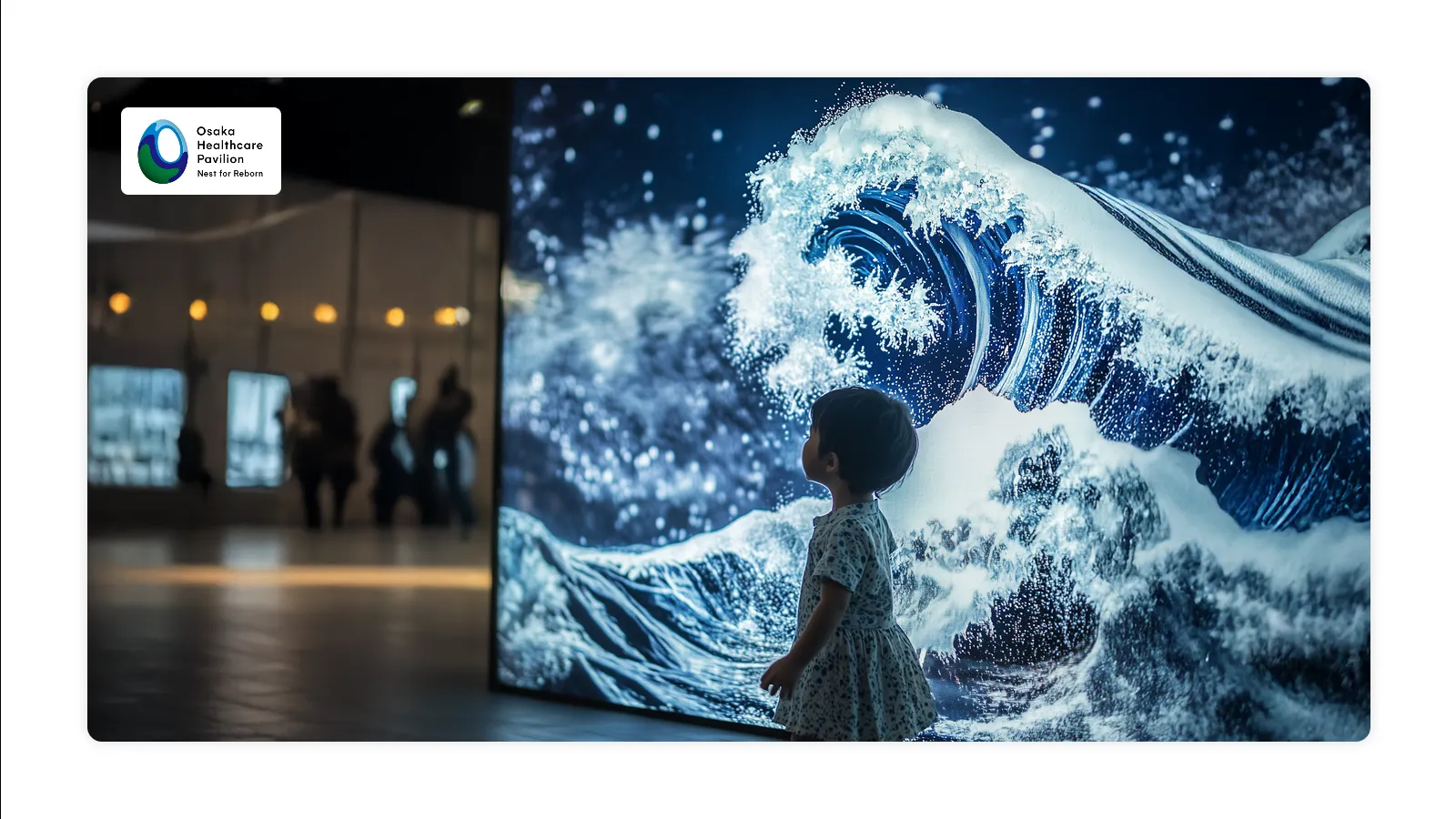
Case study of interactive Great Wave installation for museums
In the summer of 2025, Utsubo exhibited the interactive installation “Waves of Connection” inside the Healthcare Pavilion at Expo 2025 Osaka, Kansai, Japan.
Visitors stepped into the world of Katsushika Hokusai’s “The Great Wave off Kanagawa” and
used nothing but their own bodies to move the wave.
Throughout the exhibition period, children and adults kept coming back to play with the wave.
Kids queued again and again, while adults and seniors started out unsure and ended up smiling and waving their arms in front of the screen.
This page is a case study for:
- Museums planning Hokusai or ukiyoe exhibitions and looking for a Hokusai interactive installation or ukiyoe interactive installation
- Curators and exhibition planners interested in interactive digital art installations for museums
We’ll cover:
- Why we chose Hokusai’s Great Wave as the motif
- How the visitor experience and technology are designed
- How the piece can be rented / re-exhibited in your museum, and what conditions you need
1. Project Context – “Waves of Connection” at Expo 2025 Osaka
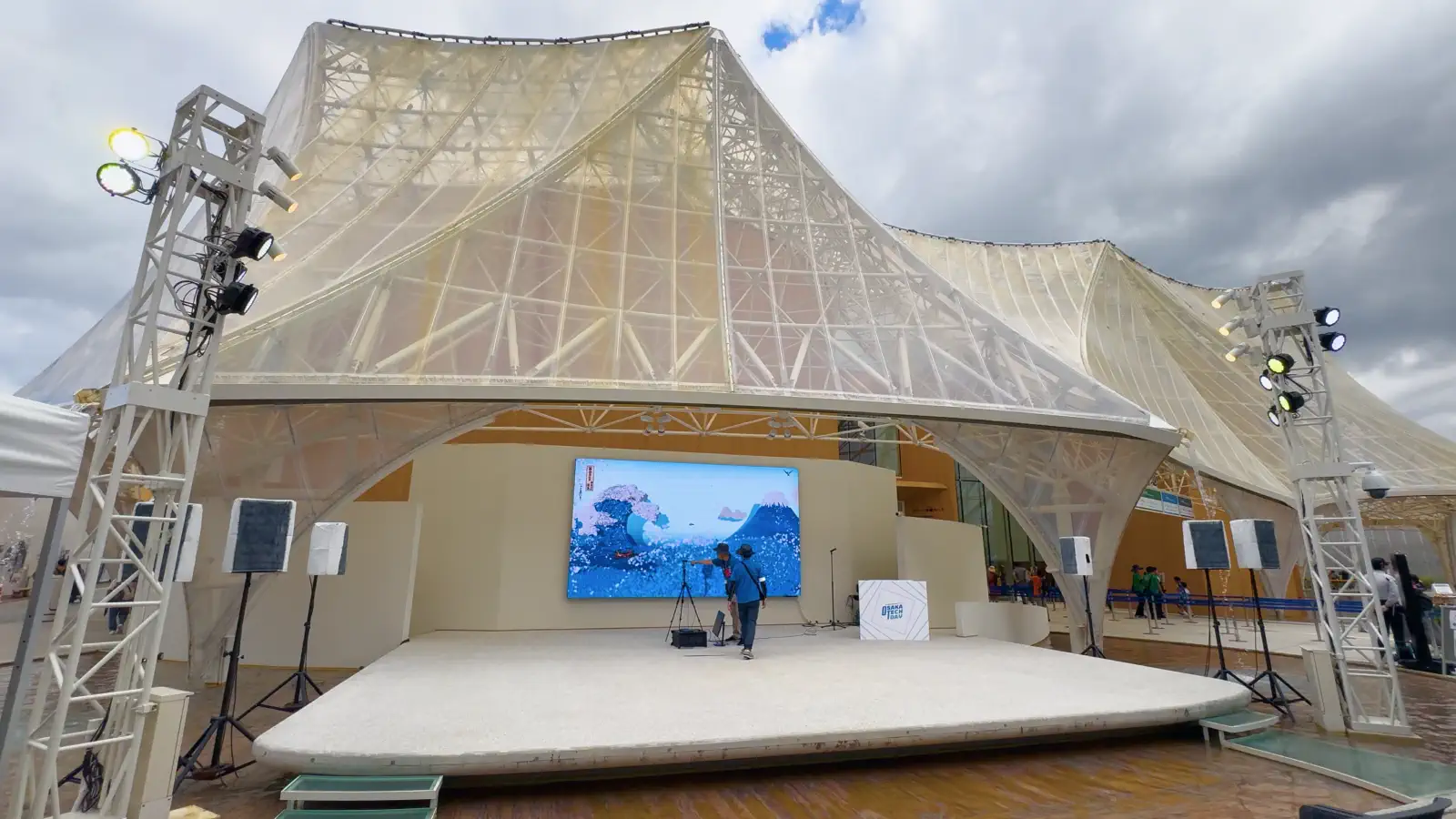
Waves of Connection: Connecting Humans through Technology
was exhibited in the Healthcare Pavilion at Expo 2025 Osaka under the following conditions:
- Dates: August 12–18, 2025 (7 days)
- Location: Healthcare Pavilion, Expo 2025 Osaka, Kansai, Japan
- Format: Interactive art installation on a 98-inch 4K display
- Audience: General public (families, children, domestic and international visitors)
The project was selected as part of “Reborn Challenge”, a startup support program by the Osaka Chamber of Commerce and Industry, and is
not a client commission, but an original artwork by Utsubo.
As a foreign-founded studio based in Osaka, we wanted to use the World Expo — a global stage — to explore:
“A piece of Japanese art that everyone knows and the world loves”
×
“A technologically challenging, high-impact interactive experience using cutting-edge tools”
That led us to a concept that felt both natural and ambitious:
- Using Hokusai’s masterpiece “The Great Wave off Kanagawa” as the motif, and
- Turning it into a technically challenging Hokusai interactive installation built for public spaces.
2. Concept – Rebooting Hokusai’s Great Wave with 21st-Century Technology
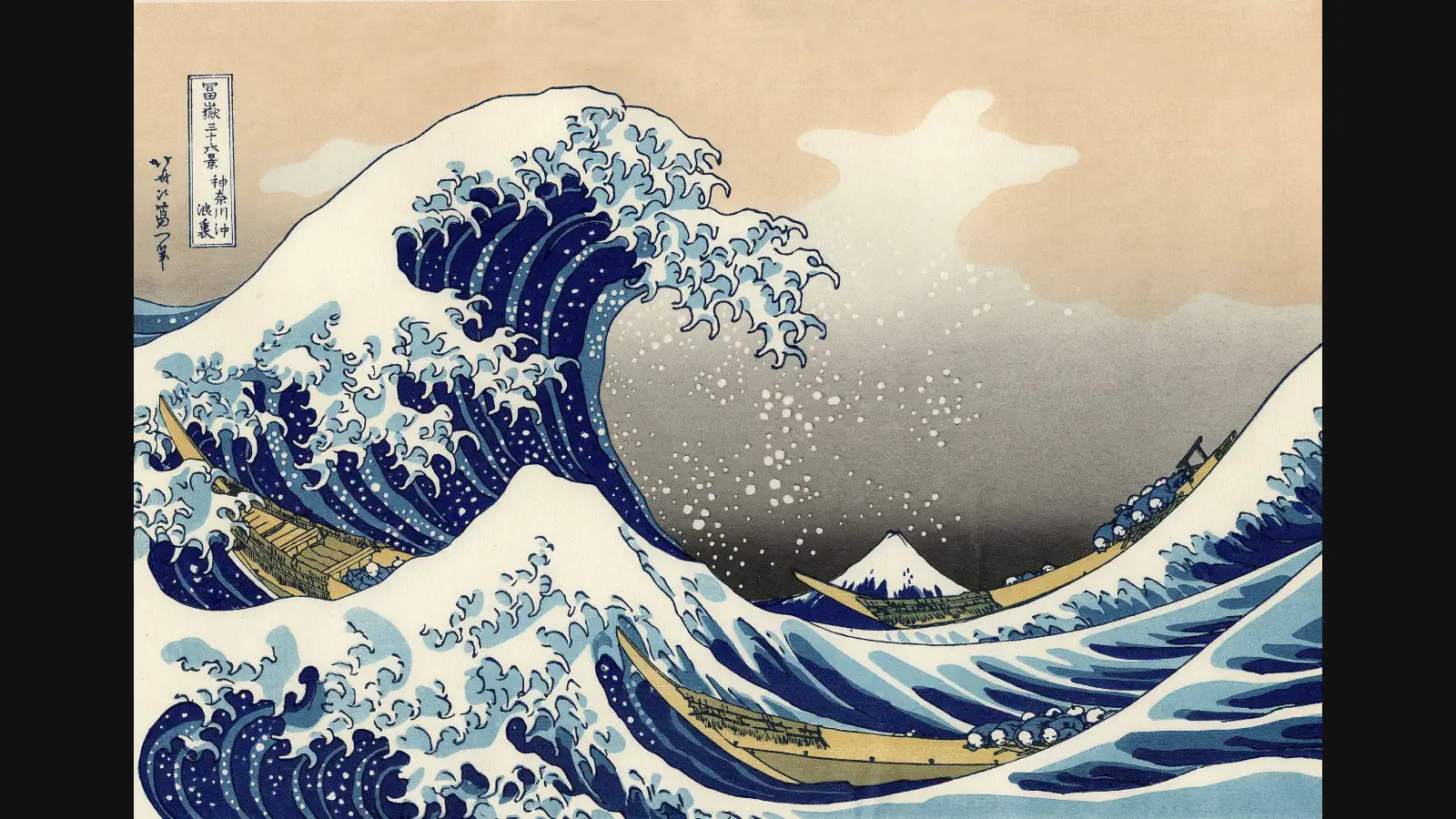
In the 19th century, Japanese ukiyoe prints had a profound influence on European painters, especially in France.
Artists such as Monet, Degas and Van Gogh were deeply inspired by Hokusai’s compositions and colors.
With Waves of Connection, we wanted to bring that art-historical context into the 21st century:
- Treat The Great Wave off Kanagawa as a Japanese cultural icon,
and reinterpret it as a “living wave” using contemporary interactive technology. - Respond to the historical story of “Japanese art influencing French painters” by reversing the direction:
now, French creators based in Japan reimagine Japanese art through digital tools. - Transform the wave from something you only look at into something you co-create with your body.
Our goal was never to faithfully reproduce the original print.
Instead, we tried to translate the energy of the wave — its force, motion and light — into:
- Particle movement
- Fluid simulation
- Interactive response
3. Experience – An Interface You Understand Without Instructions
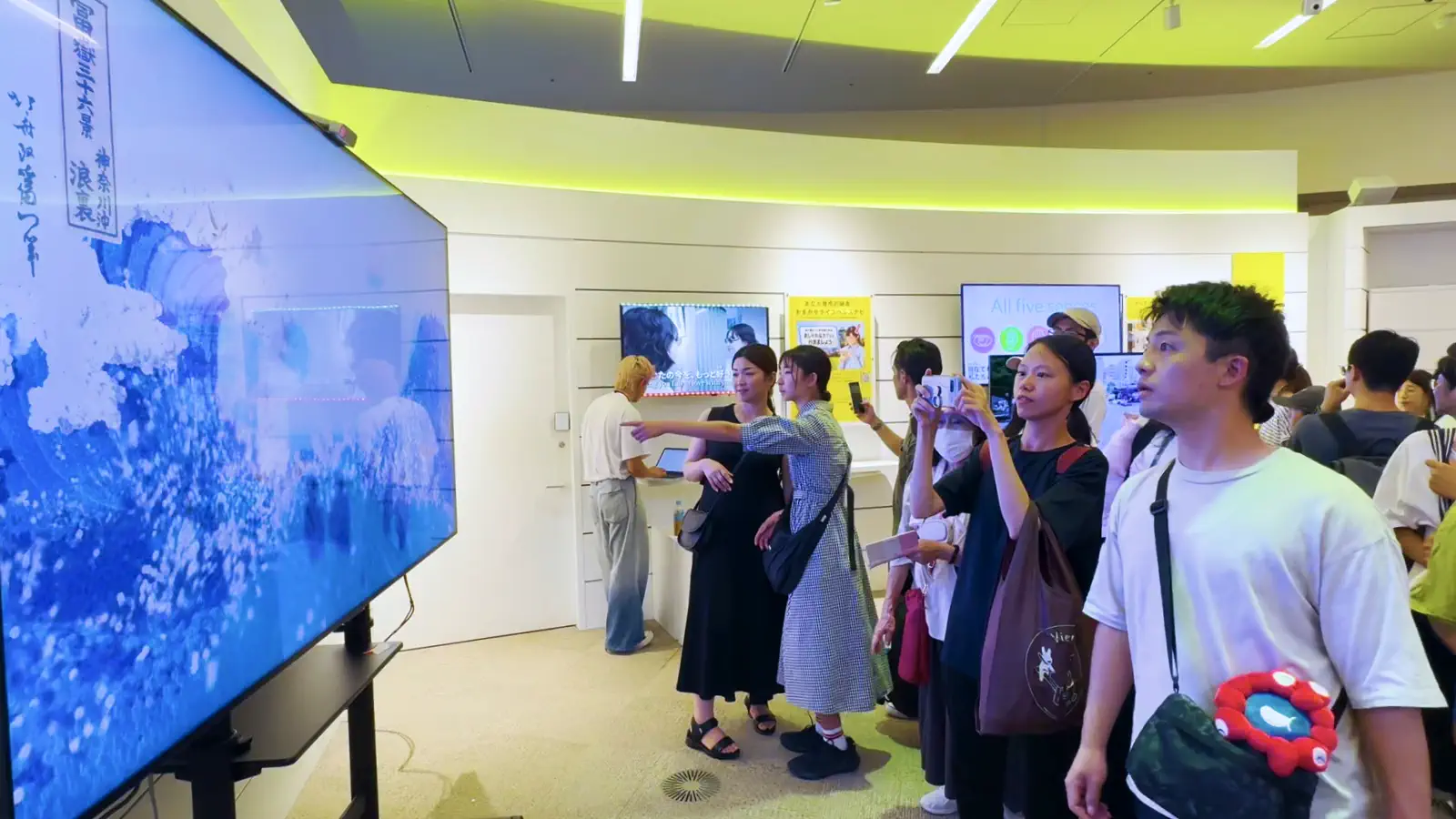
At its core, the rule of the experience is extremely simple:
Move your body, and the wave responds.
There are no written instructions on how to use the installation.
This was a deliberate design choice.
- Visitors first watch the Great Wave gently moving on the screen.
- For a few seconds, most people stand still, wondering: “What am I supposed to do?”
- Someone hesitantly raises a hand.
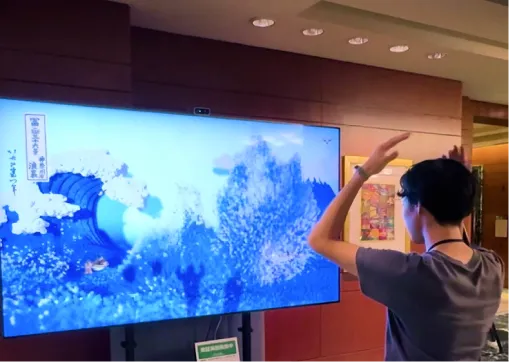
- At that moment, the wave on the screen reacts dramatically, and particles swirl around their silhouette.
- A spontaneous “Wow!” and laughter break out.
During the 7 days of the exhibition, several moments especially stood out:
- One visitor, without any explanation or music, started dancing in front of the screen for several minutes.
The wave responded to their movements, and people around them began to clap again and again. - Once children tried it, many of them got back in line to play repeatedly,
experimenting with friends and siblings to see “how to create the biggest wave”. - Adults and seniors often began by standing still in front of the screen, a little unsure of what to do.
After a few seconds, they would tentatively move one hand.
The moment the wave reacted, they said “Oh!”, smiled, and started moving both arms in large gestures.
We watched this transformation happen many times.
3-1. See the experience in motion
You can watch the atmosphere of the Expo and the interaction in the video below:
4. Visual Direction – Not a Cold Tech Demo, but a Christmas Window
From the start, we knew we did not want this to feel like a cold technology demo.
Instead, our visual reference was closer to a department store Christmas window:
- A small world that feels carefully handcrafted
- Tiny details that reward those who come closer
- “Cute” and fun for children, but also a bit nostalgic and poetic for adults
To get there, we made several choices:
- The wave is made of tiny, pearl-like particles, softly glowing rather than harshly shining.
- Colors and lighting are kept gentle and drifting, aiming for a warm, floating atmosphere rather than a “cyber” or hyper-futuristic look.
As a result, even visitors who don’t usually engage with technology felt:
“I want to get closer and try this.”
5. Technology – WebGPU, Kinect and a Wave of One Million Particles
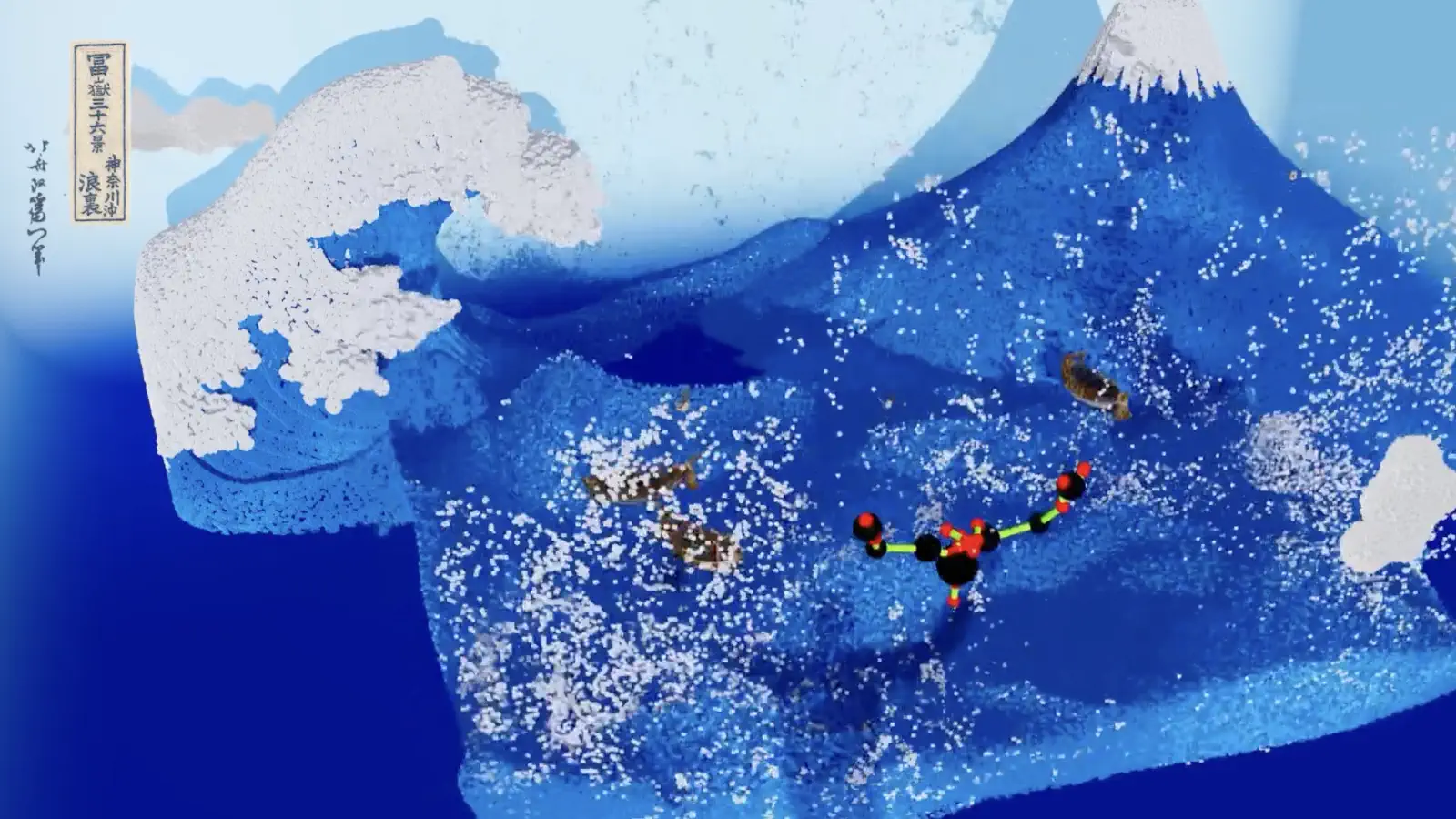
Behind the scenes, Waves of Connection is also a fairly ambitious real-time graphics experiment, the result of over four months of R&D and prototyping before Expo 2025.
5-1. Why WebGPU?
We had several hard constraints:
- The installation had to be highly responsive in real time
- It needed to handle hundreds of thousands to around one million particles
Our graphics stack:
- WebGPU
- A new-generation web graphics API co-developed by companies such as Apple, Google, Mozilla and Intel
- Provides low-level access to the GPU and high-performance compute shaders
- Three.js
- Used as the 3D framework for rendering and scene management
Using WebGPU, we simulate up to ~1,000,000 particles in real time while keeping the motion smooth and responsive.
5-2. Full-body motion tracking with Kinect
Visitor motion is captured with a Kinect depth camera:
- Skeleton tracking detects body positions and orientations
- Up to six people can be tracked simultaneously
- Their silhouettes and gestures are turned into forces that disturb and reshape the wave
This makes the piece work well as a multi-player interactive installation, encouraging groups and families to play together.
5-3. Custom fluid simulation
The water movement is driven by a custom fluid simulation on the GPU:
- Particles are advected along a fluid vector field that mimics the motion of water
- Visitor input injects velocity and disturbances into the field
- The result evokes waves, splashes and currents, but stays artistic rather than purely physically accurate
We did not aim for perfect realism.
Instead, we tuned parameters so that:
“A small movement produces a clear, beautiful reaction”
making the behavior easy to understand for visitors of all ages.
5-4. Immersion through a 98-inch 4K display
The installation uses a TCL 98-inch 4K display.
- With a screen roughly 2 meters wide, the wave fills visitors’ field of view
- Standing in front of it, many people reported feeling as if they were right at the edge of the water
- No headset or handheld device is required — just being in the space is enough to feel immersed
6. For Museums – A Highlight Piece for Hokusai and Ukiyoe Exhibitions
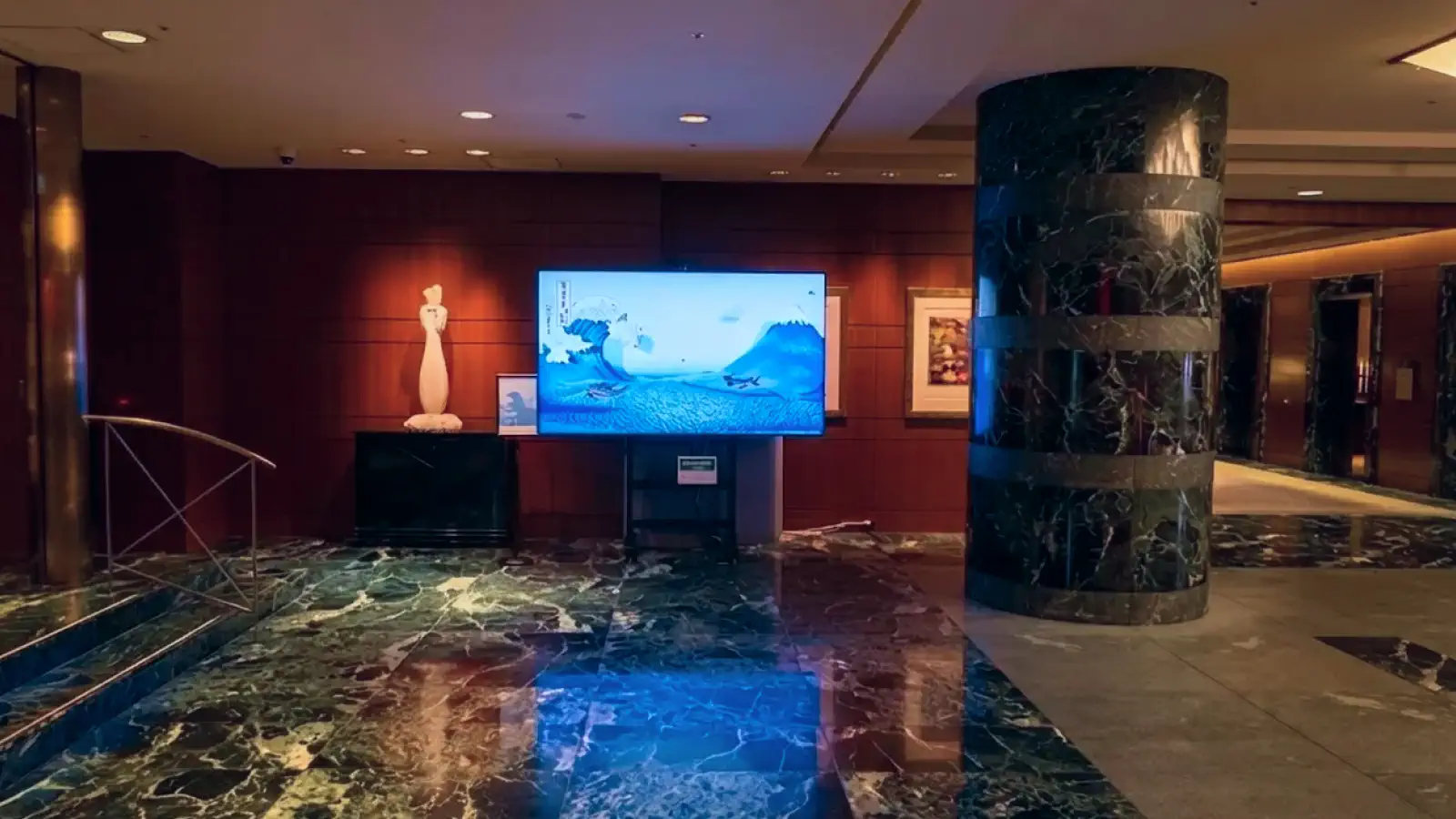
After Expo 2025 Osaka, Waves of Connection is available for rental and re-exhibition in museums and galleries.
We see it as a strong highlight for:
- Hokusai or ukiyoe exhibitions (the kind of shows searched for internationally as a “Hokusai exhibit”)
- Exhibitions that combine Japanese art and digital art in an interactive way
- Cultural events and festivals in commercial spaces
- Corporate or brand exhibitions that need a cultural, photogenic centerpiece
6-1. Space and equipment requirements
As a rule of thumb, we recommend:
- Display or projection
- A large display around 2m wide (e.g. 98-inch 4K screen)
- Smaller displays are possible, but a wide screen significantly improves immersion
- For projection: a 4K projector and a reasonably dark room
- Environment
- A wall behind the screen (rather than a bright window)
- 1–2 meters of free space in front of the screen so visitors can move and queue
- Network
- The installation runs fully offline
- No permanent internet connection is required
We can fine-tune details like power, PC specs and cable routing based on your floor plan.
6-2. Optional AI analytics for visitor insights
If desired, we can add an AI analytics module based on camera input to provide anonymous statistics such as:
- Number of people who interacted
- Estimated age distribution
- Estimated gender distribution
- Peak time slots
Important:
- No face recognition or individual identification
- No storage of personally identifiable images or video
- Only aggregated statistics are collected
This allows you to measure the impact of the installation while respecting visitor privacy and conservation guidelines.
7. Outcomes and Learnings – From Numbers to Floor-Level Insights
7-1. By the numbers
- Exhibition duration: 7 days
- Total interactions: 10,000+
- Max simultaneous users: 6
- Particles: up to ~1,000,000 in real-time simulation
7-2. What we observed on the floor
From this Hokusai interactive installation, we learned:
- “No instructions” can be part of the experience
Removing written how-to text made the first discovery moment stronger — the surprise and laughter of the first reaction became a core part of the memory. - Play spreads across generations
Children jumped in immediately, while adults took a bit more time before committing — and that transition itself was beautiful to watch. - Scale creates a bodily sense of water
The combination of a 98-inch screen and dense particles made many visitors comment that they felt the power of the waves”. - Art × technology × cultural story is a powerful mix
The simple story of “Hokusai × digital art” was easy to communicate even to visitors with no prior context.
8. About Utsubo – Exploring the Space Between Art and Technology
Utsubo is an interactive creative studio, founded in 2021.
We specialize in new kinds of experiences that live between the browser and physical space, including:
- Web3D experiences
- Interactive installations
- WebGPU-based real-time art
- Web-based games and playful experiences
Our projects have been recognized by international awards such as:
- Awwwards
- FWA
- The Webby Awards
9. Let’s Talk – 30-Minute Online Consultation
Waves of Connection is a good fit if you:
- Want to add a body-controlled interactive installation to a Hokusai or ukiyoe exhibition
- Are planning a renewal and looking for a digital art installation for museums
- Want to develop a new concept from scratch, such as a ukiyoe interactive installation around other artworks or themes
We offer a free 30-minute online consultation to explore possibilities and constraints together.
Book a 30-minute consultation, and we'll talk through:
- Your exhibition theme and target visitors
- Venue conditions and budget range
- How this installation could connect to your existing displays
From there, we can discuss:
- Plans for renting Waves of Connection as-is
- Options for adapting it to your specific Hokusai / ukiyoe exhibit
- How to approach a fully original interactive installation project
We regularly work with international teams and can collaborate in English, Japanese or French.
10. Frequently Asked Questions (FAQs)
Q. Can we rent this installation just for our Hokusai or ukiyoe exhibition?
Yes.
Based on your exhibition schedule, venue conditions and budget, we can propose a plan that includes:
- Rental of the artwork
- Setup and on-site or remote technical support
- Optional AI-based visitor analytics
Q. What space and equipment do we need?
As a typical setup, we recommend:
- A large display around 2m wide, or an equivalent 4K projection
- 1–2 meters of free space in front of the screen
- A relatively dark area with a wall behind the screen
- Standard power supply
The installation runs fully offline, so continuous internet access is not required.
We can review your floor plan and adjust details accordingly.
Q. Do you collect personal data or use face recognition?
No.
In the standard configuration, the installation does not collect personally identifiable information.
If you choose to use the AI analytics option, we only collect:
- Estimated age bands
- Estimated gender distribution
- Visitor counts and peak time slots
All of these are aggregated statistics.
We do not store face images or identify individual visitors.
Q. Can you adapt the concept beyond Hokusai?
Yes — including onto surfaces that are not flat. The particle simulation is independent of the camera, so putting it on a spherical LED display or a dome is a port rather than a rebuild: the camera, the input method and the field's boundary condition change, and the fluid solver does not. We walk through that port in detail in our LED sphere and dome content guide.
We can adapt the visuals and behavior for:
- Other ukiyoe or Japanese artworks
- Your museum’s or brand’s visual identity
- Fully abstract, original motifs
Q. Can you support installations outside Japan?
Yes.
We regularly collaborate with international institutions and can:
- Coordinate shipping and hardware procurement
- Provide remote setup and testing support
- Offer on-site support where budget and scheduling allow
We’re comfortable working in English, Japanese and French, and can align with your local technical and exhibition teams.


 Osaka Interactive Installation Studio