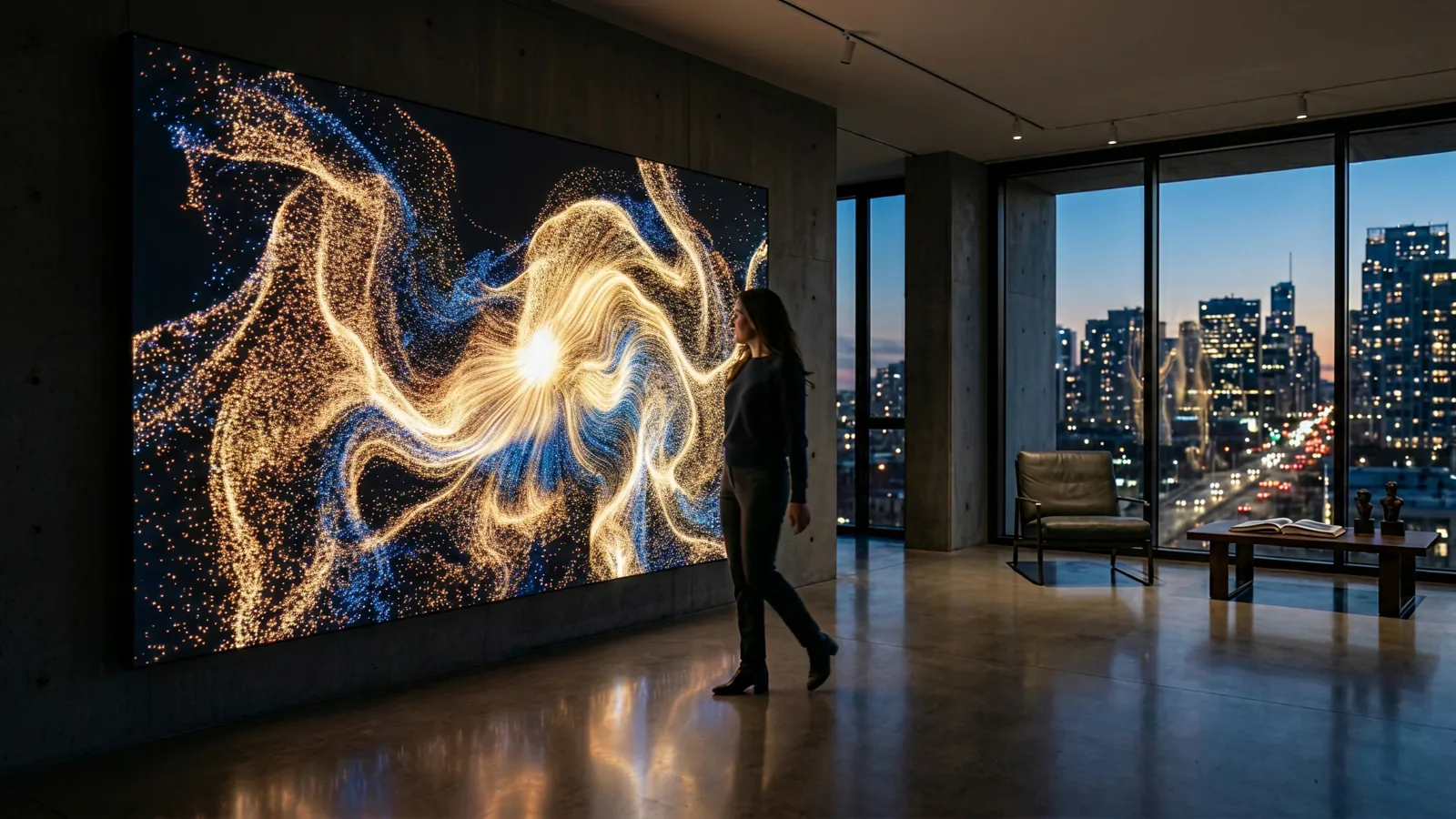
$2,400–$500K+ price ranges, 5 acquisition models, and maintenance costs. What private collectors need before buying interactive installations.
The private art market has a new frontier. While blue-chip collectors chase Basquiats and Hockneys at auction, a parallel market is forming around artworks that move, respond, and evolve.
Rafael Lozano-Hemmer has placed 20+ permanent interactive works in institutional and private collections. Refik Anadol's AI-driven data sculptures sell for six figures. Art Basel launched its "Zero 10" section specifically for digital and new media art.
Interactive art is no longer an experiment. It's a collecting category — and private buyers are entering the market faster than institutions can keep up.
This guide covers what you need to know before acquiring your first — or next — interactive installation for a private residence, personal gallery, or corporate collection.
Who this is for: Private art collectors, art advisors, family office managers, and interior architects designing high-end residences with integrated art programs.
Key Takeaways
- Interactive art responds to human presence — movement, touch, voice — making it fundamentally different from digital art or NFTs
- Five acquisition models exist: commission ($50K–$500K+), edition ($15K–$150K), gallery ($2,400–$100K+), rental ($5K–$25K/quarter), and lease-to-own
- Technology obsolescence is the top collector concern — mitigate with open web standards, source code escrow, and maintenance contracts
- Ongoing maintenance costs run $500–$3,000/month depending on complexity, with hardware refresh cycles every 3–7 years
- A residential interactive installation can run on a single 98-inch display with standard power — no dedicated server room required
1. Why Collectors Are Turning to Interactive Art
1-1. The Shift from Object to Experience
The art market is mirroring a broader cultural shift. In the experience economy, value is measured by engagement, not just aesthetics. A painting hangs on a wall. An interactive installation changes every time someone enters the room.
For private collectors, this creates something rare: an artwork that never repeats itself. Each interaction produces a unique visual moment — no two experiences are identical. Guests don't just look at the work. They become part of it.
1-2. Market Signals You Can't Ignore
Several institutional moves signal that interactive art is no longer fringe:
- Art Basel "Zero 10" — a dedicated section for digital and new media art, launched to meet collector demand
- Pace Gallery's immersive program — one of the world's largest galleries now represents interactive artists including Rafael Lozano-Hemmer and teamLab
- Christie's digital art department — auction sales of technology-based art are growing year over year
- 1stDibs — lists 4,700+ interactive art works, with prices from $150 to $36,000+ for gallery pieces
When major institutions allocate floor space and staff to a category, the collector market follows.
1-3. What Motivates Collectors
Research from art market surveys shows that 86% of digital art collectors cite "appreciation of the art itself" as their primary motivation — not speculation or investment returns. And 75% prioritize direct relationships with artists or studios, suggesting this market values partnership over transaction.
This aligns with what we see in the interactive art space: collectors who acquire these works tend to be deeply engaged with the creative and technical process, not passive buyers.
2. What Is Interactive Art? (A Collector's Perspective)
2-1. How It Differs from Digital Art, NFTs, and Video Art
The terminology can be confusing. Here's the distinction that matters:
| Category | What It Is | Audience Role |
|---|---|---|
| Digital art | Any artwork created or displayed digitally | Viewer |
| Video art | Moving image on a loop or sequence | Viewer |
| NFTs | Blockchain-based ownership certificate | Owner (not inherently visual) |
| Interactive art | Artwork that requires human input to activate | Participant |
The defining feature of interactive art is the feedback loop: the work changes in response to the person in front of it. Without an audience, the work is dormant or minimal. With an audience, it comes alive.
This has practical implications for collectors. An interactive piece is not something you hang and forget. It's something that performs for you and your guests — and that performance requires maintenance, power, and occasional attention.
2-2. Five Common Formats
| Format | How It Works | Space Needed | Price Range |
|---|---|---|---|
| Sensor-reactive | Body tracking, depth cameras, proximity sensors detect movement and translate it into visual/audio response | 3–5m clearance in front of display | $25K–$500K+ |
| Particle systems | Thousands to millions of digital particles respond to physical input in real time | Wall-mounted display + 1–2m clearance | $15K–$300K |
| Projection mapping | Images projected onto architectural surfaces, sometimes responsive | Dedicated room or surface | $40K–$500K+ |
| Generative | Algorithm creates unique visuals continuously, no two moments identical | Screen or display of any size | $2,400–$100K |
| Web-connected | Live data (weather, markets, social feeds) shapes the artwork in real time | Screen + internet connection | $10K–$150K |
Most studio-commissioned works combine two or more of these formats. To see them at museum and venue scale, browse our 38 interactive installation examples.
2-3. What You Actually Need in Your Space
Interactive art has a smaller physical footprint than most collectors expect:
- Screen-based works: A single large display (65–98 inches) mounted on a wall, with 1–2 meters of open floor space in front. Standard residential power outlet.
- Sensor-reactive works: Same as above, plus a depth camera (about the size of a small soundbar) mounted above or below the display. Needs 3–5 meters of open space for body tracking.
- Projection works: A dedicated wall or room, a ceiling-mounted projector, and controlled lighting (ideally dimmable or dark).
- Compute requirements: A single high-performance PC (about the size of a desktop tower) handles most installations. No server room needed.
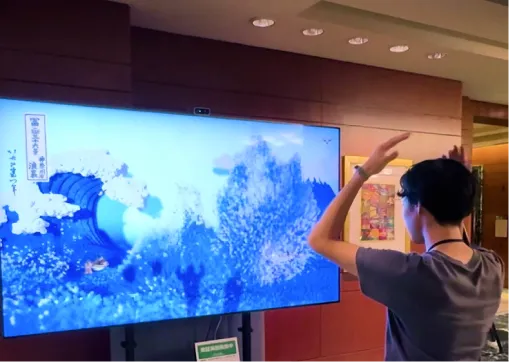
For comparison: a Hokusai-themed interactive installation that tracks up to 6 people simultaneously and renders ~1,000,000 particles in real time runs on a 98-inch display and a single PC.
3. The Five Acquisition Models
Not every collector wants to commission a $200K custom piece. The market has matured enough to offer multiple entry points:
3-1. Commission (Custom Work): $50K–$500K+
You work directly with an artist or studio to create a one-of-a-kind piece for your space. This is the most personal path — and the most involved.
What to expect:
- 3–6 month creation timeline
- Multiple concept and prototype reviews
- Site visit or detailed space documentation
- Custom hardware specification and procurement
- Installation and calibration on-site
Best for: Collectors who want a piece designed around their space, their aesthetic, and their interaction preferences.
3-2. Edition Purchase (Limited Runs): $15K–$150K
Some artists and studios release interactive works in limited editions — typically 3 to 10 copies. Each edition is identical in software but may be calibrated to the collector's space.
What to expect:
- Shorter lead time (4–8 weeks for hardware and setup)
- Certificate of Authenticity specifying edition number
- Standard hardware package included
- Installation guide or on-site setup
Best for: Collectors who want a known work from a specific artist without the timeline and cost of a full commission.
3-3. Gallery Acquisition (Secondary Market): $2,400–$100K+
Galleries increasingly represent interactive artists. Works can be purchased through the gallery, similar to a painting or sculpture.
What to expect:
- Gallery markup (typically 50% commission)
- Viewing at the gallery or art fair before purchase
- Certificate of Authenticity from the gallery
- Hardware may or may not be included — confirm before purchasing
Best for: Collectors who prefer the gallery relationship and want to see the work in person before committing.
3-4. Rental / Rotating Program: $5K–$25K/quarter
Rental programs let you experience a work in your space before committing to purchase, or rotate pieces seasonally.
What to expect:
- Quarterly or annual agreements
- Full setup and removal included
- Maintenance covered during rental period
- Option to apply rental fees toward purchase (in some programs)
Best for: First-time collectors testing the category, or experienced collectors who enjoy variety and seasonal rotation.
3-5. Lease-to-Own: Structured Payments Over 12–36 Months
Some studios offer structured payment plans, spreading the cost of a commission or edition over 1–3 years.
What to expect:
- Monthly or quarterly payments
- Work installed at the start of the lease
- Ownership transfers upon final payment
- Maintenance typically included during lease period
Best for: Collectors who want to acquire a significant work without a single large outlay.
4. Due Diligence: What Experienced Collectors Check
Interactive art introduces concerns that traditional art doesn't. An oil painting from 1890 still works in 2026. A software-based installation from 2020 might not — unless the right protections are in place.
4-1. Technology Obsolescence Risk
This is the top concern for collectors, and rightly so. Hardware ages. Software dependencies change. Operating systems update.
How to mitigate:
- Prefer open web standards. Works built on WebGPU and Three.js run in standard web browsers — the technology is maintained by Apple, Google, Mozilla, and Intel. Proprietary engines or custom frameworks carry higher obsolescence risk.
- Ask about hardware refresh cycles. Displays and compute units typically need replacement every 5–7 years. A good studio will specify this upfront.
- Confirm software update commitments. The artist or studio should commit to maintaining compatibility for a defined period (5–10 years minimum).
4-2. Certificate of Authenticity for Software-Based Works
A Certificate of Authenticity (CoA) for interactive art should include:
- Artist/studio name and creation date
- Edition number (if applicable)
- Description of the work's behavior and parameters
- Software version at time of sale
- Hardware specifications
- Statement of authenticity signed by the artist
Without a CoA, resale value and provenance verification become difficult.
4-3. Source Code Escrow and Format Migration
For works valued above $50K, consider requesting:
- Source code escrow — the complete source code deposited with a neutral third party, accessible if the artist or studio ceases operations
- Format migration commitment — a written agreement that the studio will port the work to new platforms or hardware as technology evolves
- Technical documentation — installation manuals, wiring diagrams, hardware specs, and software architecture notes
This is the digital equivalent of conservation documentation for physical art.
4-4. Insurance, Valuation, and Appraisal
Specialized art insurance brokers increasingly cover interactive works. You'll need:
- Certificate of Authenticity
- Detailed technical specification
- Professional appraisal (some brokers have in-house appraisers for new media)
- Documentation of the maintenance contract
Premiums vary, but expect 0.5–1.5% of appraised value annually — comparable to traditional art insurance.
4-5. Studio Track Record
Before commissioning or purchasing, verify:
- Exhibition history — has the work (or similar works) been shown publicly?
- Institutional references — does the studio have relationships with galleries, museums, or cultural institutions?
- Maintenance track record — how long have their oldest installations been running?
- Technical capabilities — what technologies do they specialize in?
A studio that has exhibited at a venue like Expo 2025 Osaka and maintained works for years has proven durability that a newer operation hasn't yet demonstrated.
5. Site Requirements and Installation Planning
5-1. Space, Power, and Environment
| Requirement | Typical Spec | Notes |
|---|---|---|
| Floor space | 3–5m x 3–5m for sensor-reactive | Less for screen-only generative works |
| Ceiling height | 2.4m minimum | Higher is better for projection works |
| Power | Standard residential outlet (15A) | Larger installations may need dedicated circuit |
| Lighting | Dimmable or dark preferred | Ambient light reduces contrast on displays |
| Temperature | 18–26°C, <60% humidity | Standard residential HVAC is usually sufficient |
| Noise | Compute unit generates light fan noise | Can be placed in adjacent closet or cabinet |
5-2. Display Options
| Option | Pros | Cons | Budget |
|---|---|---|---|
| LED video wall | Seamless, scalable, bright | Expensive, requires professional install | $15K–$100K+ |
| Large-format display (85–98") | Plug-and-play, 4K resolution, reliable | Fixed size, visible bezels at close range | $3K–$8K |
| Projector | Flexible size, can cover entire walls | Requires dark room, lamp replacement | $2K–$15K |
| Custom screen | Curved, transparent, or unusual shapes | Expensive, long lead time | $20K–$200K+ |
For most residential installations, a high-quality 85–98" display offers the best balance of image quality, reliability, and cost.
5-3. Network: Offline vs. Connected Works
Most interactive installations run fully offline — no internet connection required. The work runs on a local computer connected directly to the display and sensors.
Connected works (those using live data feeds) need a stable internet connection but minimal bandwidth — comparable to streaming a video.
Security note: Offline installations have zero network attack surface. For collectors concerned about smart-home security, this is an advantage over connected display art.
5-4. Working with Your Interior Architect
If you're integrating interactive art into a new build or renovation, involve the studio early — ideally during schematic design. Key coordination points:
- Electrical — dedicated circuit locations and cable routing
- Structural — wall reinforcement for heavy displays or projection mounts
- Lighting — zone control to dim ambient light near the artwork
- Acoustics — sound isolation if the work includes audio
- HVAC — ventilation for compute hardware if enclosed in cabinetry
6. Ongoing Care: Maintenance, Updates, and Longevity
6-1. Monthly and Annual Costs
| Component | Frequency | Typical Cost |
|---|---|---|
| Remote monitoring | Continuous | $200–$500/month |
| Software updates | Quarterly | Included in maintenance contract |
| On-site check-up | Annual | $1,000–$3,000/visit |
| Hardware cleaning | Biannual | $200–$500/visit |
| Electricity | Continuous | $30–$80/month (display + PC) |
Total: approximately $500–$3,000/month, depending on complexity and location.
For comparison, climate-controlled art storage for a single painting runs $50–$200/month. Interactive art costs more to maintain but delivers daily engagement rather than sitting in a vault.
6-2. Hardware Refresh Cycles
| Component | Expected Lifespan | Replacement Cost |
|---|---|---|
| Display | 7–10 years | $3K–$8K |
| Compute unit (PC) | 5–7 years | $2K–$5K |
| Depth camera/sensors | 5–8 years | $300–$1,500 |
| Cables and connectors | 10+ years | Minimal |
A well-maintained interactive installation can run for 10+ years with one display replacement and one or two PC upgrades. Total lifetime hardware cost: $8K–$20K beyond the initial purchase.
6-3. Works That Evolve Over Time
Some interactive works are designed to change. A generative piece might produce a different visual composition each season. A data-driven work might shift as real-world inputs change.
This is a feature, not a bug — but confirm with the artist what kind of evolution is intentional and what constitutes a malfunction.
6-4. Remote Monitoring and Support
Modern interactive installations can be monitored remotely. The compute unit sends periodic health checks to the studio, reporting:
- System uptime and crash logs
- Display status
- Sensor calibration drift
- Software version and update status
If something goes wrong, the studio can often diagnose and fix the issue remotely — without scheduling an on-site visit.
7. Case Study: "Waves of Connection" — From Expo 2025 to Private Collections
To make this guide concrete, here's an example of an interactive work designed for public exhibition that is equally suited to a private collection.
7-1. The Work
"Waves of Connection" reinterprets Katsushika Hokusai's The Great Wave off Kanagawa as a living, interactive experience. Visitors — or residents — move their bodies to control a wave made of approximately 1,000,000 digital particles. The wave responds to movement in real time: raise your arms and particles swirl upward; step back and the water settles.
There are no instructions. The discovery moment — when someone first realizes their body controls the wave — is part of the experience.
Read the full case study: Hokusai Interactive Installation at Expo 2025
7-2. Technology
| Component | Specification |
|---|---|
| Rendering | WebGPU + Three.js (open web standards) |
| Particle count | ~1,000,000 in real-time GPU simulation |
| Body tracking | Kinect depth camera, up to 6 simultaneous users |
| Physics | Custom fluid simulation on GPU |
| Display | 98-inch 4K display (TCL) |
| Compute | Single high-performance PC |
| Network | Fully offline — no internet required |
The technology choices directly address collector concerns: WebGPU and Three.js are open standards maintained by browser vendors, not proprietary software that could be discontinued. The psychology of why immersive 3D experiences create lasting impressions is well-documented — the combination of spatial presence, body tracking, and particle dynamics triggers measurable neurological responses.
7-3. Exhibition History
- Healthcare Pavilion, Expo 2025 Osaka — 7 days, 10,000+ visitors
- Selected through the "Reborn Challenge" startup support program by the Osaka Chamber of Commerce and Industry
- Created as an original artwork by Utsubo, not a client commission
7-4. What Makes It Collector-Ready
| Feature | Why It Matters for Collectors |
|---|---|
| Fully offline | No internet dependency, no data privacy concerns |
| Compact footprint | 98-inch display + PC + sensor — fits in a living room |
| Proven reliability | 10,000+ visitors at Expo without failure |
| Open web standards | WebGPU/Three.js maintained by Apple, Google, Mozilla — low obsolescence risk |
| No instructions needed | Guests discover the interaction naturally — no awkward explanations |
| Multi-user | Up to 6 people interact simultaneously — works for gatherings |
7-5. Acquisition Options
Waves of Connection is available through multiple models:
- Purchase — acquire the original work with full documentation, source code archive, and maintenance agreement
- Rental — quarterly or event-based rental with full setup and support
- Custom adaptation — commission a variation with a different motif (other ukiyoe, abstract, branded) while keeping the same interaction model and technology
8. Five Questions to Ask Before Your First Acquisition
Before committing to any interactive artwork, ask the artist or studio:
- "What happens when the hardware fails in 5 years?" — You want a specific answer: which components, what cost, who handles it.
- "Can I see a Certificate of Authenticity sample?" — If they don't have a standard CoA format, that's a warning sign.
- "What is the annual maintenance cost, and what does it cover?" — Get this in writing before purchase, not after.
- "Is the source code documented and escrowed?" — For works above $50K, this is non-negotiable.
- "How many installations have you maintained for 3+ years?" — Track record matters more than promises.
Context:
- Budget range: [fill in]
- Space: [describe room dimensions, ceiling height, lighting]
- Intended use: [private enjoyment / entertaining guests / corporate lobby]
- Aesthetic preference: [abstract / figurative / data-driven / nature-inspired]
Please help me:
- Create 10 due-diligence questions covering technology, maintenance, and documentation
- Draft a comparison scorecard for evaluating 2-3 studios
- List red flags I should watch for during the consultation
9. Common Mistakes First-Time Collectors Make
9-1. Treating It Like a TV Purchase
An interactive installation is not a consumer product. It's a custom artwork with ongoing care requirements. Collectors who approach it like buying a large television — expecting plug-and-play with zero maintenance — are consistently disappointed.
Instead: Budget for the maintenance contract from day one. Factor it into the total cost of ownership.
9-2. Ignoring the Maintenance Contract
Some collectors negotiate hard on the purchase price and then skip the maintenance agreement to save money. Within 2–3 years, they face hardware failures or software issues with no support channel.
Instead: The maintenance contract is part of the artwork. A $100K piece with a $1,500/month maintenance agreement is actually a $100K + $18K/year commitment. Budget accordingly.
9-3. Not Asking About Obsolescence Plans
Technology moves fast. A studio that says "don't worry, it will be fine" without specifics is a studio you should worry about.
Instead: Ask for a written technology lifecycle plan covering the next 10 years. What hardware will need replacement? What software migrations are anticipated? What are the costs?
9-4. Buying Based on Spectacle Alone
A work that dazzles at an art fair may not have the same impact in a private living room. Fair lighting, room scale, and the energy of a crowd all contribute to the spectacle — none of which transfer to a residential setting.
Instead: Ask the studio for documentation of the work in a residential context, or request a scaled-down demo in your actual space before committing.
10. About Utsubo
Utsubo is an interactive creative studio founded in 2021, based in Osaka, Japan.
We specialize in real-time 3D experiences that live between the browser and physical space — including interactive installations, WebGPU-based art, and immersive web experiences.
Our work has been exhibited at Expo 2025 Osaka and recognized by Awwwards, FWA, and The Webby Awards.
We work with collectors, museums, and brands on both existing works and custom commissions. Our technology stack — WebGPU, Three.js, custom fluid simulations — is built on open web standards designed for longevity.
11. Let's Talk
Considering interactive art for your collection or private residence? We work with collectors and advisors on both existing works and custom commissions.
If you're exploring an acquisition, let's discuss:
- What you're envisioning and the space you have
- Which acquisition model makes sense for your goals
- Whether our work and approach are the right fit
12. Collector's Checklist
- Define your budget range and preferred acquisition model
- Assess your space (dimensions, power, lighting, ceiling height)
- Research 3–5 artists or studios whose aesthetic resonates with you
- Request a Certificate of Authenticity sample before committing
- Ask about source code escrow for works above $50K
- Get maintenance costs in writing — monthly and annual
- Understand the hardware refresh cycle and associated costs
- Consult your art advisor or insurance broker about new media coverage
- Plan a studio visit, video walkthrough, or in-situ demo
- Review the full maintenance contract and technology lifecycle plan before signing
FAQs
Q. How much does interactive art cost for a private collection?
Prices vary widely by format and acquisition model. Gallery editions start around $2,400 for smaller screen-based works. Sensor-reactive installations from established studios typically range from $25,000 to $150,000. Custom commissions for room-scale experiences can exceed $500,000. Budget separately for hardware, installation, and a maintenance contract — the full cost breakdown covers each component in detail.
Q. Will interactive art become obsolete?
Technology obsolescence is the top concern for collectors, but it's manageable. Mitigation strategies include choosing works built on open web standards (WebGPU, Three.js) rather than proprietary engines, securing source code escrow agreements, and confirming the studio offers format migration commitments. Well-maintained interactive works can operate for 10+ years with periodic hardware refreshes.
Q. What maintenance does an interactive installation require?
Most private installations require quarterly check-ups and remote monitoring. Expect $500–$3,000/month depending on complexity. Hardware refresh cycles are typically 5–7 years for displays and compute units. Studios that offer remote monitoring can often resolve software issues without an on-site visit.
Q. Can I insure an interactive art installation?
Yes. Specialized art insurance brokers increasingly cover new media and interactive works. You will need a Certificate of Authenticity, a detailed technical specification, and a professional appraisal. Some insurers require documentation of the maintenance contract and studio support commitment. Premiums typically run 0.5–1.5% of appraised value annually.
Q. How much space do I need?
It depends on the work. Screen-based generative pieces can fit on a single wall with 1–2 meters of clearance. Sensor-reactive works with body tracking typically need 3–5 meters of open floor space. Projection-based immersive experiences may require a dedicated room. Power requirements are generally modest — a standard residential outlet handles most installations.
Q. What is the difference between interactive art and digital art or NFTs?
Interactive art requires physical audience input — movement, touch, voice, or presence — to activate and change the work. Digital art includes static or animated works displayed on screens. NFTs are a blockchain-based ownership mechanism, not an art form. An interactive installation may or may not use blockchain for provenance, but its defining feature is the audience participation loop.
Q. Can interactive art be rented instead of purchased?
Yes. Many studios offer rental programs, typically structured as quarterly or annual agreements. This is particularly appealing for collectors who want to rotate works, test a piece before committing to purchase, or commission seasonal variations. Rental budgets for residential-scale works typically range from $5,000 to $25,000 per quarter.
Q. How do I authenticate and document a software-based artwork?
Authentication for interactive art typically includes: a Certificate of Authenticity specifying the edition number and artist or studio, documentation of the software version and hardware specifications, source code escrow with a neutral third party, and a provenance record. Serious collectors should request all four elements before acquisition.


 Osaka Interactive Installation Studio