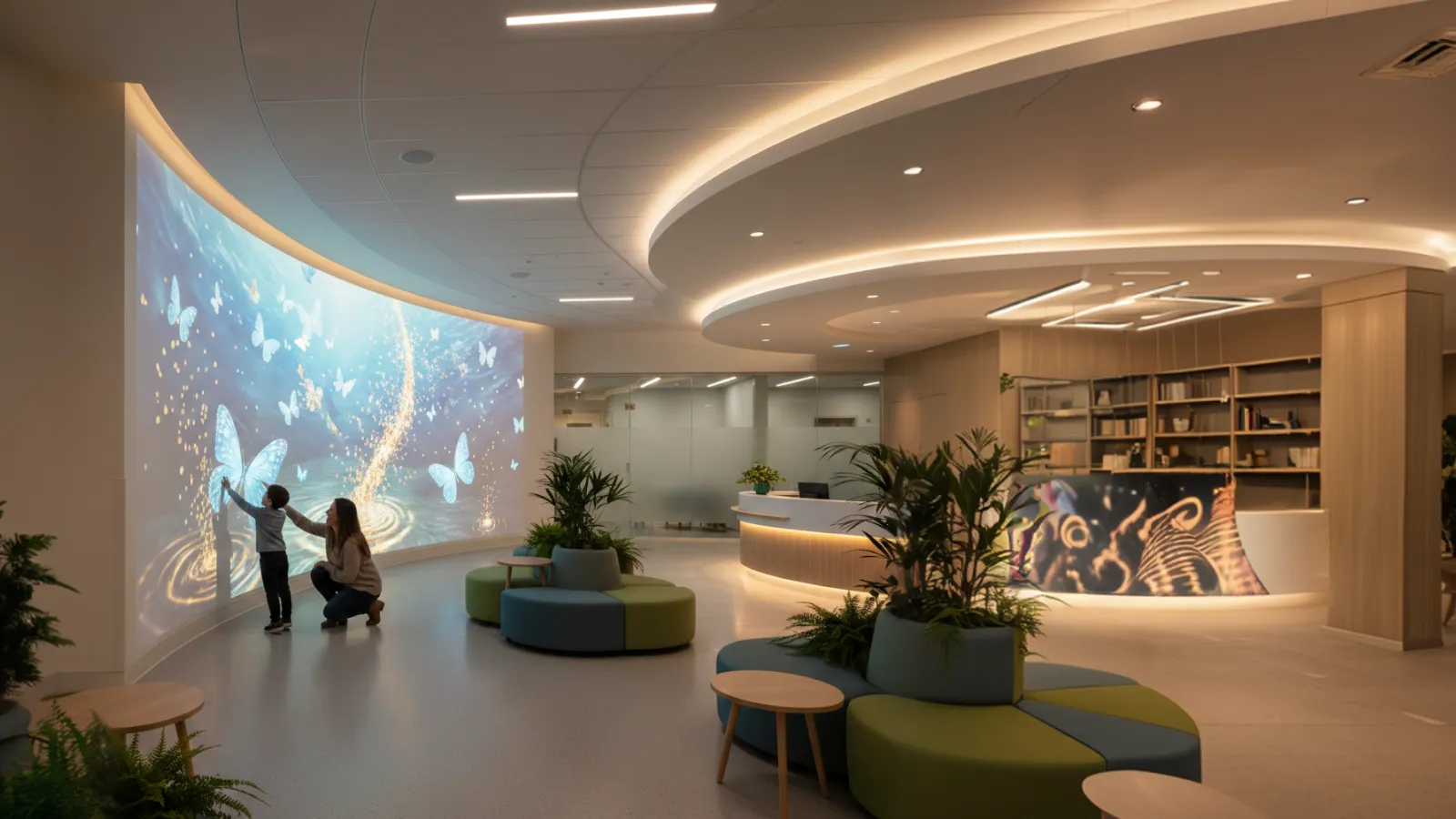
A guide to interactive technology in hospitals and healthcare facilities — what works, what it costs, how to fund it, and how to keep the patient at the center.
A three-year-old in Stockholm sits on her mother's lap inside a CT scanner room. The walls glow with a projected rainforest — toucans perch on virtual branches, a waterfall cascades across the ceiling, and ambient birdsong fills the space. She chose this scene herself on a touchscreen outside the door. The scan takes four minutes. No sedation. No anesthesia. No tears.
This is Karolinska University Hospital's immersive CT suite — one of a growing number of interactive installations proving that hospitals can use technology to reduce clinical stress, not add to it.
But hospitals are fundamentally different from every other venue that installs interactive technology.
Museums want spectacle. Retail wants conversion. Hotels want Instagram moments. Hospitals need something far more precise: technology that works on people who didn't choose to be there, who are scared, in pain, or waiting for news that will change their lives. Every interactive element has to reduce anxiety, improve outcomes, or accelerate recovery — or it doesn't belong.
This guide covers what works, what it costs, and how to build the case internally.
Who this is for: Hospital administrators, patient experience officers, child life specialists, and healthcare facilities managers planning interactive technology for clinical and non-clinical spaces.
Key Takeaways
- Hospital interactive installations range from $50K single-room projections to $2M+ campus-scale systems — funded through capital budgets, foundation grants, and donor campaigns
- Clinical studies show interactive distraction reduces pediatric procedural pain by 47–75% (VAS/FPS-R scores) and can eliminate the need for sedation during imaging
- HCAHPS patient satisfaction scores improve 5–7% in facilities with interactive patient engagement systems, directly affecting Medicare reimbursement rates
- Digital wayfinding installations reduce missed appointments by up to 20% and save staff the equivalent of 4,500+ hours/year in direction-giving at a 300-bed hospital
- Body-tracked and projection-based interactions are replacing touchscreens — critical in clinical environments where infection control and hygiene govern every surface
- Real installations at Karolinska, Cleveland Clinic Children's, and Loma Linda demonstrate measurable outcomes across pediatric, surgical, and ambulatory settings
- The strongest hospital installations reduce clinical stress without adding cognitive load — technology disappears into the environment rather than demanding attention
1. The Clinical Tension — Why Hospitals Are Different
1-1. The involuntary visitor
Every institution that adds interactive technology faces a version of the same question. In zoos, it's "will visitors watch the screen instead of the animal?" In libraries, it's "will technology turn our library into an arcade?" In hospitals, the question is existential:
"Will this technology help a patient who is terrified, in pain, or cognitively impaired — or will it make things worse?"
It's the right question. Hospitals serve the only audience that didn't choose to be there. A museum visitor is curious. A hotel guest is relaxed. A hospital patient is involuntary, often under physical or psychological duress, and operating with reduced cognitive bandwidth. A child about to receive an IV doesn't need entertainment — she needs her attention redirected so completely that she doesn't notice the needle.
That constraint makes hospital installations the hardest to design — and the most clinically valuable when done right.
1-2. When technology helps vs. harms
The difference comes down to clinical design intent:
| Adds clinical stress | Reduces clinical stress |
|---|---|
| Bright, stimulating display in a pre-op waiting area where patients need calm | Immersive nature projection in a CT suite that replaces claustrophobia with wonder |
| Touchscreen kiosk that adds another thing to figure out while anxious | Gesture-tracked wall that responds to a child's movement without instructions |
| VR headset that isolates a patient from their support person | Body-tracked projection that lets parent and child interact together |
| Digital signage showing wait times that amplify anxiety | Generative art wall that makes waiting feel shorter without displaying a clock |
| Interactive wayfinding that requires a smartphone and app download | Walk-up touchscreen kiosk with multilingual turn-by-turn directions |
The installations that work treat technology as an anxiety reducer, not an attention grabber. They make the clinical environment feel less clinical — without requiring anything from the patient except presence.
2. What Works — Proven Installation Types for Hospitals
2-1. Pediatric distraction therapy walls
Gesture-tracked or projection-based walls that redirect a child's attention during painful or frightening procedures.
This is the most clinically validated category. A 2021 JAMA Network Open RCT at Nationwide Children's Hospital found that active VR distraction reduced mean pain scores by 47% during pediatric burn dressing changes (VAS 24.9 vs. 47.1 for standard care). A 2024 multicenter study across three countries (304 children, ages 5–9) found interactive distraction reduced pain by 75% during blood draws (FPS-R 0.93 vs. 3.69 for controls).
Physical installations scale these outcomes beyond individual VR headsets:
- Gesture-controlled coloring walls: children wave their hands to "paint" projected scenes — no touching required, no devices to sanitize. Cleveland Clinic Children's Hospital and CHOC Heart Institute both use this approach
- Interactive lobby ecosystems: large-scale digital environments where children create and release virtual creatures. Loma Linda University Children's Hospital's "Loma Land" features a 60-foot projection screen with kiosk design stations
- AR seek-and-find murals: tablet-triggered 3D animals with educational narration embedded in hospital corridors. Lucile Packard Children's Hospital Stanford uses this to transform waits into discovery
2-2. Immersive clinical environment projections
Full-room projections that transform clinical spaces — CT suites, infusion rooms, pre-op areas — into calming environments patients can control.
Karolinska University Hospital in Stockholm installed Panasonic projectors in their CT suite, offering patients a choice of 10 immersive scenes (rainforest, underwater, cartoon worlds) via a pre-scan touchscreen. Results: many pediatric scans now complete without anesthesia — even for toddlers. The system reduced scan anxiety for adults too, with faster throughput and fewer repeat scans due to patient movement.
Lee Health's Golisano Children's Health Center in Naples uses 270° floor-to-ceiling projection in their chemotherapy infusion room — described as "VR in 3D without goggles." Children select environments (space, beach, underwater) during treatments lasting hours.
This approach works because it transforms the room, not the patient. No headset to wear. No device to hold. The patient remains connected to their caregiver and clinical team while the environment does the therapeutic work.
2-3. Interactive wayfinding systems
Digital kiosks, mobile apps, and AR navigation that reduce the stress of navigating complex hospital campuses.
Getting lost in a hospital isn't just inconvenient — it's clinically significant. Navigation stress elevates cortisol, increases perceived wait times, and contributes to missed appointments. The estimated US cost of healthcare no-shows and late arrivals: $150 billion annually, with navigation confusion as a contributing factor.
Real implementations:
- Atrium Health Kenilworth Medical Plaza (Charlotte, NC): 10 interactive 22Miles kiosks with floor-to-floor routing, "screen-flip" wheelchair accessibility, multilingual support, and QR-code handoff to mobile devices. Part of a $228M facility
- Gold Coast University Hospital (Australia): touchscreen kiosks with 5-language support and companion mobile web app for a multi-building campus
- Grand River Hospital (Canada): Mappedin responsive web app with smart search and real-time map updates across two campuses
- A 2025 AR navigation study at University of Michigan Hospital's Taubman Center found AR wayfinding was 15% faster than paper maps, with 69% fewer errors, 94% willingness to reuse (vs. 31% for paper), and significantly lower cognitive load
2-4. Rehabilitation gamification
Motion-tracked games that transform repetitive physical therapy exercises into engaging experiences.
Seattle Children's Hospital's Therapeutic Gaming Program integrates VR headsets and motion sensors with commercial games (including motion-controlled Fruit Ninja) into PT/OT sessions. Staff report higher therapy engagement, better pain management during dressing changes, improved functional mobility, and patients voluntarily extending therapy sessions.
Rehabilitation gamification works because it exploits the same distraction mechanism as pediatric therapy walls — but in reverse. Instead of distracting from pain, it distracts into movement. Patients achieve greater pain-free range of motion because they're focused on the game, not the exercise.
2-5. Staff wellness and burnout reduction spaces
A less obvious but increasingly important category: immersive environments designed for healthcare workers.
Burnout costs US hospitals an estimated $4.6 billion annually in turnover. Projection-mapped break rooms, biophilic digital walls, and sensory reset spaces offer a low-intervention approach to stress recovery between shifts. West Middlesex University Hospital's "Flow" installation by CW+ Arts in Health transforms a busy corridor into a calming, responsive environment serving both patients and staff.
3. Real Examples — Three Installations That Got It Right
3-1. Karolinska University Hospital — Immersive CT Suite
| Detail | Specification |
|---|---|
| Location | Stockholm, Sweden |
| Category | Procedure anxiety reduction (CT scanning) |
| Key tech | Panasonic Space Player + PT-VMZ71 projectors, touchscreen scene selection (10 environments), spatial audio |
| Clinical impact | Pediatric scans completed without anesthesia (including toddlers); reduced adult anxiety; faster scan throughput; fewer repeat scans from patient movement |
| Budget | Not publicly disclosed |
| Expansion | System adopted at Oslo University Hospital (Norway) |
What makes it work: the patient has agency. Choosing their environment — even a small choice — restores a sense of control in a setting where patients have almost none. The projection transforms the most intimidating part of the hospital (a scanner tube) into the most magical.
3-2. Cleveland Clinic Children's Hospital — Interactive Motion Wall
| Detail | Specification |
|---|---|
| Location | Cleveland, Ohio, USA |
| Category | Pediatric distraction / waiting room experience |
| Key tech | Gesture-tracking sensors, high-end Barco displays, custom visual "paint-mixing" experience by Dimensional Innovations |
| Clinical impact | Reduces overstimulation while encouraging controlled movement; infection-minimizing touchless design; multiple pediatric care awards post-installation |
| Budget | Not publicly disclosed |
What makes it work: the wall responds to gesture, not touch. In a hospital where every surface is an infection control consideration, touchless interaction isn't a nice-to-have — it's a clinical requirement. The experience is calming rather than stimulating, designed for a population that includes children in pain, on medication, or emotionally dysregulated.
3-3. Loma Linda University Children's Hospital — "Loma Land"
| Detail | Specification |
|---|---|
| Location | Loma Linda, California, USA |
| Opened | 2023 |
| Category | Arrival anxiety reduction / lobby transformation |
| Key tech | Three kiosk "design stations" + 60-foot immersive projection screen, spatial audio, custom software by ESI Design and NBBJ |
| Clinical impact | Children create custom animated forest creatures at kiosk stations, then release them onto the shared ecosystem wall — transforming arrival anxiety into creative engagement |
| Budget | Donor-funded |
What makes it work: it turns the most stressful moment of a hospital visit — arrival — into an act of creation. The child's focus shifts from "what's about to happen to me" to "what can I make happen." The shared ecosystem means every child's creature joins a living world, creating a communal experience that reduces isolation.
4. Clinical Outcomes — Making the Mission Tangible
4-1. Distraction therapy reduces procedural pain
The evidence base for interactive distraction in pediatric settings is now substantial:
| Study | Technology | Setting | Key finding |
|---|---|---|---|
| Xiang et al. 2021 (JAMA Network Open) | Active smartphone VR (Virtual River Cruise) | Nationwide Children's Hospital, Columbus, OH | 47% lower mean pain (VAS) during burn dressing changes vs. standard care |
| Czub et al. 2024 (Cyberpsychol Behav Soc Netw) | Samsung Gear VR + interactive game | Multicenter: Poland, Ireland, Spain (n=304) | 75% lower mean pain (FPS-R) during blood draws; large effect size (d=0.948) |
| Gökoğlu & Sukut 2025 (BMC Pediatrics) | Tablet active video games vs. passive cartoons | Istanbul, Turkey (n=105, ages 3–7) | Active distraction superior for pain, anxiety, and fear (p<0.001); exceeds minimum clinically important difference |
| Hoag et al. 2022 (JMIR) | KindVR Aqua (active VR gameplay) | Children's Wisconsin, Milwaukee | State anxiety declined significantly pre-to-post in VR group (p<0.001); 94% active engagement rate |
| Lee-Krueger et al. 2021 (J Pediatr Psychol) | MEDi® humanoid robot | Tertiary pediatric unit, Canada (n=137) | Children 5.04× more likely to complete IV induction without issues (p=0.04) |
The consistent finding: active interactive distraction outperforms passive distraction (watching cartoons, listening to music). Installations that require a child's cognitive engagement — gesturing, creating, choosing — produce stronger pain reduction because they demand more attention.
This matters for installation design. A projection wall that responds to movement is more therapeutically effective than a screen playing calming video, because it requires continuous cognitive engagement.
4-2. HCAHPS score improvements
Patient satisfaction isn't just a feel-good metric — it directly affects hospital revenue. Medicare's Value-Based Purchasing program ties a portion of reimbursement to HCAHPS scores. Interactive patient engagement systems show measurable impact:
- +7.1% medication education scores across 9 US hospitals using SONIFI Health interactive platforms
- +5.36% overall hospital rating in the same multi-site study
- 6 of 9 hospitals moved "hospital recommended" scores above state/national averages within 12 months
- Gains sustained over a 5-year follow-up period
A postpartum-unit study found interactive education systems reduced average length of stay by more than 8 hours, driven by faster education completion workflows.
4-3. Environmental design reduces perceived wait times
A 2021 study on waiting-room media (Fryburg, Journal of Patient Experience) found nature videos and images in waiting rooms were superior to news or neutral content, decreasing anxiety, negative emotions, and physiological stress indicators (heart rate, blood pressure, sympathetic activity). Interactive and immersive elements amplify this effect by adding agency and engagement.
5. Budget & ROI — What Hospital Installations Cost
5-1. Budget tiers
| Tier | Budget range | What you get | Example |
|---|---|---|---|
| Single-room refresh | $50K–$200K | Projection mapping in one procedure room or waiting area, basic gesture interaction | Nature projection in a CT or MRI suite |
| Department-scale digital | $200K–$500K | 2–5 interactive stations, immersive environment, wayfinding kiosks | Pediatric wing with distraction wall + interactive lobby |
| Signature installation | $500K–$2M | Full experiential zone with integrated interactives, immersive projections, custom hardware | "Loma Land"-style lobby transformation with design stations + 60-ft projection |
| Campus-scale wayfinding | $100K–$500K+ | 10+ interactive kiosks, mobile integration, multilingual routing, analytics | Atrium Health-style 22Miles deployment across a medical plaza |
Digital and AV components typically represent 15–30% of total renovation costs in new hospital construction. Interactive technology added during a build-out costs 40–60% less than retrofitting an existing space.
5-2. Funding sources
| Source | Typical contribution | Notes |
|---|---|---|
| Hospital capital budget | $100K–$2M+ | Standard for facility upgrades; strongest path for wayfinding and lobby installations |
| Hospital foundation / donor campaigns | $50K–$7M | Most common for pediatric and patient-experience installations. Townsville Hospital's children's ward digital wall: ~$7M via foundation |
| Philanthropic gifts | Project-specific | Children's Healthcare of Atlanta: $200M Arthur Blank Family Foundation gift included interactive elements |
| Patient experience ROI | Indirect | HCAHPS improvements → higher Medicare reimbursement. Interactive engagement systems can pay back through value-based purchasing within 2–3 years |
| Pharmaceutical sponsors | Limited | More common for patient-education modules within engagement platforms than for artistic installations |
| Grant programs | $50K–$500K | Arts-in-health foundations (CW+, Bloomberg Philanthropies), NEA, local community health grants |
Key insight: Unlike museums or libraries, hospitals rarely use government grants as a primary funding source. The typical path is capital budget for infrastructure (wayfinding, patient engagement systems) and donor/foundation funding for experiential installations (pediatric walls, immersive rooms).
For a deeper dive on installation budgets across venue types, see our complete budget guide.
5-3. ROI metrics that matter for healthcare
Hospital ROI goes beyond visitor satisfaction:
- HCAHPS improvement → direct Medicare reimbursement increase via Value-Based Purchasing
- Length of stay reduction → one interactive engagement platform study showed 8+ hour LOS reduction in postpartum units
- Sedation/anesthesia avoidance → Karolinska's immersive CT suite eliminates sedation costs ($500–$2,000 per pediatric case) while reducing clinical risk
- Missed appointment reduction → 20% reduction within 6 months in one wayfinding implementation; each no-show costs $200–$400 in lost revenue
- Readmission prevention → interactive patient education linked to $2,140 saved per prevented 30-day readmission
- Staff efficiency → wayfinding systems save 4,500+ staff-hours/year in direction-giving at a 300-bed hospital
- Recruitment and retention → facilities with strong patient experience scores attract clinicians; burnout-reduction spaces support retention
An economic decision analysis for VR pain therapy at a 15,000-admission hospital estimated net savings of $5.39 per patient (or $98.49 per eligible patient), with cost-saving outcomes in 89.2% of Monte Carlo simulations.
6. Compliance & Safety — Infection Control, HIPAA, and ADA
6-1. Infection control — the IPC framework
Touchscreens in hospitals are classified as high-touch surfaces under CDC environmental cleaning guidelines. This is why body tracking and projection-based interaction are gaining ground — they eliminate the infection vector entirely.
For any touch-based installation:
- Clean and disinfect at least daily in general areas, twice daily in ICUs/high-risk zones
- Use EPA-registered or manufacturer-approved disinfectants compatible with the display surface
- Include disinfection in Environmental Services (EVS) daily rounds
- Consider antimicrobial coatings as a supplement (not a replacement) for cleaning protocols
The design implication: wherever possible, choose touchless interaction modes. Body tracking, gesture control, and projection-based systems avoid the infection control burden of shared touchscreens entirely. This isn't just a hygiene preference — Joint Commission accreditation surveys evaluate environmental cleaning alignment with CDC/HICPAC guidelines.
6-2. HIPAA considerations
Interactive installations trigger HIPAA requirements only when they handle electronic protected health information (ePHI). A wayfinding kiosk that doesn't access patient records? Not a HIPAA concern. A patient check-in system that captures demographics? Full HIPAA compliance required.
For ePHI-handling installations:
- Privacy screens or angled placement to prevent bystander viewing
- Auto-logoff after inactivity
- Session isolation (no residual data from previous users)
- Encryption of data in transit and at rest
- Business Associate Agreements with all vendors
- Audit logging of interactions
For most experiential installations (distraction walls, immersive projections, nature environments): HIPAA does not apply because no patient data is collected or displayed. Anonymous usage analytics are fine.
6-3. ADA accessibility
Hospitals receiving federal funding must comply with both ADA Title III (public accommodations) and HHS Section 504. HHS's 2024 Section 504 rule requires WCAG 2.1 Level AA for web content and mobile apps by May 11, 2027 (recipients with 15+ employees) or May 10, 2028 (fewer than 15), after a one-year extension HHS announced on May 7, 2026; the same rule requires kiosks to be accessible but sets no technical standard for them.
Every interactive installation must provide:
- Reach ranges: operable parts at 15–48 inches for forward/side wheelchair approach
- Knee/toe clearance under kiosk units
- Non-visual access: screen reader compatibility, audio descriptions, tactile alternatives
- Visual contrast: minimum 4.5:1 ratio
- Multiple interaction modes: not exclusively touch-dependent
- Cognitive accessibility: clear instructions, minimal steps, multilingual support
For a complete accessibility framework for interactive installations, see our accessibility guide.
6-4. Practical constraints for tech in hospitals
| Constraint | What it means for installation design |
|---|---|
| Infection control | Every surface is evaluated for cleaning protocol. Touchless interaction eliminates the problem. If using touchscreens, specify medical-grade enclosures rated for daily disinfection |
| 24/7 operation | Hospitals never close. Equipment must run continuously with remote monitoring, automated restart, and no scheduled downtime during patient hours |
| Sound in clinical areas | Patients sleep, recover, and receive news nearby. Use directional speakers, haptic feedback, or silent interaction. Zone audio carefully |
| Power and network | Medical-grade power with UPS backup. Network on hospital IT infrastructure with appropriate security segmentation |
| Patient population | Design for ages 0–100, varying cognitive states, mobility limitations, and emotional distress. No assumed tech literacy. No required apps or accounts |
| Staff workflow | Installations must not impede clinical workflow. No equipment blocking corridors. No audio that interferes with announcements or alarms |
For detailed guidance on acoustic design in clinical spaces, see our sound design guide.
7. Technical Requirements — Hardware That Survives a Hospital
7-1. Environmental considerations
Hospitals present a unique combination of challenges:
| Challenge | Solution |
|---|---|
| 24/7 operation | Commercial-grade displays rated for continuous operation; redundant media players with automatic failover |
| Infection control cleaning | IP65-rated or medical-grade enclosures; surfaces compatible with hospital-grade disinfectants (quaternary ammonium, hydrogen peroxide) |
| High daily traffic (1,000–10,000+ visitors/day in large hospitals) | Commercial-grade displays, tamper-proof mounting, polycarbonate glazing over screens |
| Diverse patient populations | Wheelchair-accessible heights, multiple interaction modes, large text, high contrast, multilingual |
| Clinical adjacency | IEC 60601-1 certification for electrical safety near patients; EMI shielding to avoid interference with medical equipment |
| Staff workflow integration | Installations positioned to not obstruct stretchers, wheelchairs, or emergency routes |
7-2. Clinical-grade durability
- No exposed cables — all routing through conduit or behind walls (trip hazard + cleaning obstruction)
- Medical-grade enclosures — rated for daily cleaning with hospital disinfectants without degradation
- Touchless where possible — body tracking and projection eliminate the highest-maintenance component
- Auto-restart capability — media players that recover from crashes without staff intervention
- Remote monitoring — dashboard for all AV systems with automated alerts to facilities or AV vendor
7-3. Maintenance and uptime
| Requirement | Recommendation |
|---|---|
| Uptime target | 99%+ during all hours (hospitals operate 24/7/365) |
| Remote monitoring | Dashboard with automated alerts; 4-hour response SLA for critical failures |
| Content management | CMS for updating visuals, scenes, and messaging without on-site technician |
| Spare parts | On-site stock of critical components (media players, cables, projector lamps) |
| Service contract | Annual maintenance agreement with installation studio or AV integrator |
| Staff training | Basic troubleshooting guide for facilities team (restart procedures, escalation contacts) |
8. Common Pitfalls
1. Designing for the healthy visitor, not the patient The most common mistake: installations optimized for the lobby visitor or family member, not the person in clinical distress. Solution: test every interaction with someone who is scared, in pain, or cognitively impaired. If it requires reading instructions, downloading an app, or standing at a specific distance — redesign.
2. Ignoring infection control from day one Touchscreens installed without IPC-approved cleaning protocols become liability risks. Solution: choose touchless interaction modes wherever possible. When touch is unavoidable, specify medical-grade enclosures and add the installation to the EVS cleaning schedule before opening day.
3. Overstimulating clinical spaces Bright, fast-moving visuals in a pediatric ward where children are medicated, post-operative, or sleep-deprived. Solution: design for the lowest-energy patient in the room. Offer user-controlled intensity. Default to calm, not spectacle. See the neuroscience behind this in our psychology of digital awe guide.
4. Building without clinical staff input Facilities teams and vendors who design installations without consulting nurses, child life specialists, and therapists. Solution: these staff members know which moments are most stressful, which corridors have the most anxious patients, and which procedures benefit most from distraction. Their input is more valuable than any market research.
5. No measurement plan Installing interactive technology with no plan to measure clinical outcomes, patient satisfaction, or operational impact. Solution: build anonymous usage analytics and outcome tracking into the installation from day one. Connect to HCAHPS reporting workflows. Without data, the installation can't justify its existence at the next budget cycle.
6. Treating wayfinding as a signage problem Static digital signs that replicate the same confusing floor plan already on the wall. Solution: interactive wayfinding must provide personalized, step-by-step routing with accessibility options, multilingual support, and mobile handoff. The standard is turn-by-turn directions, not a better map.
9. How to Get Started — From Internal Pitch to Opening Day
9-1. Typical timeline
| Phase | Duration | Key activities |
|---|---|---|
| Internal pitch & budget approval | 2–4 months | Build the clinical and financial case; identify HCAHPS impact areas; secure capital budget or foundation commitment |
| Design development | 3–6 months | Clinical needs assessment, tech selection, AV engineering, IPC review, accessibility audit, staff input sessions |
| Fabrication & build | 3–6 months | Hardware procurement, software development, custom content creation |
| Installation & commissioning | 1–3 months | On-site install, integration testing, IPC protocol training, staff training |
| Soft opening & iteration | 1–2 months | Patient feedback, clinical outcome tracking setup, adjustments |
Total: 12–18 months from concept to public opening, depending on scale. A single-room projection refresh can be completed in 6–8 months. Campus-scale wayfinding: 8–14 months.
9-2. Your first steps
- Identify the highest-stress moments — which spaces cause the most patient anxiety? Pre-op waiting, imaging suites, pediatric procedure rooms, and long-stay infusion areas are common starting points.
- Define the clinical outcome — every interactive should answer: "What measurable patient outcome does this improve?" Pain scores, anxiety reduction, HCAHPS improvement, missed appointments, or sedation avoidance.
- Engage child life specialists and nursing — they know the pain points better than anyone. Build the clinical case from the ward, not the boardroom.
- Set a realistic budget — include 5–15% annual maintenance and a content refresh cycle. Factor in IPC compliance costs.
- Brief a studio — see our guide to briefing an interactive installation studio for a template that works for healthcare contexts.
Context:
- Facility type: [children's hospital / general hospital / ambulatory care / rehabilitation center]
- Annual patient volume: [number]
- Target space: [CT suite / pediatric waiting / lobby / infusion room / rehab gym / staff break room]
- Current state: [describe what's there now]
- Budget range: [estimate, or "seeking foundation support"]
- Timeline: [when do you need it open?]
- Primary clinical goal: [pain reduction / anxiety reduction / wayfinding / HCAHPS improvement / rehab compliance]
Please help me:
- Define 3 measurable clinical outcomes tied to the installation
- Identify the best interaction type for our space, patient population, and clinical goal
- Build the HCAHPS and financial ROI case for administration
- Create a phased timeline with clinical milestones
- Draft an IPC compliance checklist
- List questions to ask potential studio partners
10. About Utsubo
Utsubo is an interactive creative studio specializing in body-tracked installations, real-time 3D experiences, and WebGPU-powered visual systems.
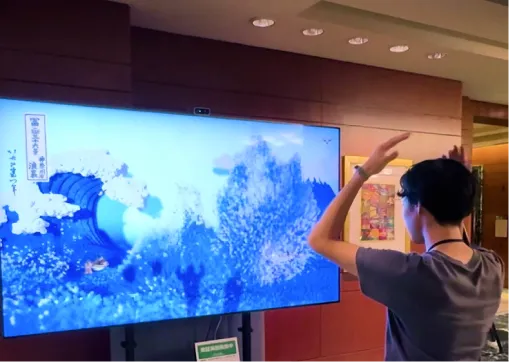
Our Waves of Connection installation at Expo 2025 Osaka — a body-tracked piece where visitors moved a million-particle Great Wave using their gestures — demonstrated the kind of touchless, high-impact interaction that translates directly to hospital environments:
- No touchscreen, no controller — visitors interact with their body, eliminating infection control concerns
- Multi-user — up to 6 people tracked simultaneously, allowing patient and caregiver to interact together
- All ages — children and elderly patients engage intuitively, without instructions
- Durable — no moving parts, no surfaces to clean or break
- Silent operation — compatible with clinical noise requirements
- Calming by default — particle systems and generative visuals can be tuned for therapeutic calm, not spectacle
We combine Three.js and WebGPU expertise with physical installation design to create experiences that work in demanding clinical environments.
11. Let's Talk
Planning a patient experience upgrade with interactive technology? We work with hospitals on immersive experiences that reduce clinical stress and improve measurable outcomes.
If you're exploring a partnership, let's discuss your project:
- What you're building and the clinical constraints you're working with
- Which technical approach makes sense for your patient population and spaces
- Whether we're the right fit to help you execute
Checklist: Interactive Installation for Hospitals
- Clinical outcome defined for each interactive element (pain reduction, anxiety, HCAHPS, wayfinding)
- Clinical staff consulted (child life specialists, nurses, therapists, facilities)
- IPC/infection control review completed — touchless interaction prioritized
- HIPAA assessment completed (ePHI handling determination)
- ADA Title III / Section 504 / WCAG 2.1 AA compliance plan in place
- Joint Commission alignment verified for environmental cleaning protocols
- Budget includes 5–15% annual maintenance allocation
- Content management system specified for non-technical staff updates
- Anonymous usage analytics built in for outcome tracking and HCAHPS reporting
- Acoustic design reviewed — sound isolation from patient care areas confirmed
- 24/7 operation plan with remote monitoring, auto-restart, and failover
- Staff training plan included in project scope
FAQs
How much does an interactive installation cost for a hospital?
Budgets range from $50K for a single-room projection (CT suite, waiting area) to $2M+ for a department-scale transformation. A typical pediatric wing installation with 2–3 interactive stations runs $200K–$500K. Wayfinding systems run $100K–$500K depending on campus size. Digital and AV components usually represent 15–30% of total renovation cost. Funding typically comes from hospital capital budgets, foundation grants, or donor campaigns.
Do interactive installations actually reduce patient pain and anxiety?
Yes — and the evidence base is now substantial. A 2024 multicenter RCT (304 children) found interactive VR distraction reduced pain scores by 75% during blood draws. A 2021 JAMA Network Open study found 47% lower pain during burn dressing changes with active VR. Karolinska University Hospital's immersive CT suite allows many pediatric scans without sedation. Active interactive distraction consistently outperforms passive distraction (watching videos, listening to music) across multiple studies.
What about infection control for touchscreens?
Touchscreens in hospitals are classified as high-touch surfaces requiring daily disinfection per CDC guidelines (twice daily in ICUs). This is why touchless interaction — body tracking, gesture control, projection — is preferred in clinical settings. When touch is unavoidable, use medical-grade enclosures rated for hospital disinfectants and add the installation to the EVS cleaning schedule. Antimicrobial coatings can supplement (but never replace) cleaning protocols.
Does HIPAA apply to interactive installations?
Only if the installation handles electronic protected health information (ePHI). Wayfinding kiosks, distraction therapy walls, immersive projections, and nature environments typically don't process ePHI and aren't subject to HIPAA. Patient check-in kiosks, portal access points, and education systems that access records require full HIPAA compliance: privacy screens, auto-logoff, encryption, audit logging, and Business Associate Agreements with vendors.
How long does it take to develop a hospital interactive installation?
From concept to opening, expect 12–18 months depending on scale. A single-room projection refresh (CT suite, waiting room) can be completed in 6–8 months. Campus-scale wayfinding: 8–14 months. Factor in internal approval timelines — building the clinical and financial case for hospital administration typically takes 2–4 months before design begins.
What's the ROI case for hospital administration?
Multiple pathways: HCAHPS score improvements directly increase Medicare reimbursement through Value-Based Purchasing (one multi-site study showed +5–7% gains). Sedation avoidance saves $500–$2,000 per pediatric imaging case. Wayfinding systems reduce missed appointments by up to 20% ($200–$400 lost revenue each). Interactive education systems reduced postpartum LOS by 8+ hours in one study. Staff-hour savings from wayfinding: 4,500+ hours/year at a 300-bed hospital.
What's the best interactive technology for pediatric areas?
Body tracking and projection are ideal — they create immersive experiences without touchscreens to sanitize, devices to charge, or headsets to fit on different-sized heads. Gesture-controlled walls (like Cleveland Clinic's motion wall) let children interact without instructions. For procedure rooms, immersive projection (like Karolinska's CT suite) transforms the clinical environment itself. Avoid VR headsets for children under 13 in unsupervised settings. See our children's museum guide for age-appropriate design frameworks.
How do we ensure 24/7 reliability in a hospital environment?
Specify commercial-grade hardware rated for continuous operation, with redundant media players and automatic failover. Require remote monitoring dashboards with automated alerts and a 4-hour response SLA for critical failures. Build auto-restart capability into every component. Keep critical spare parts on-site. Schedule preventive maintenance during lowest-traffic hours (not "downtime" — hospitals don't have downtime). Budget 5–15% of project value annually for maintenance and support.


 Osaka Interactive Installation Studio