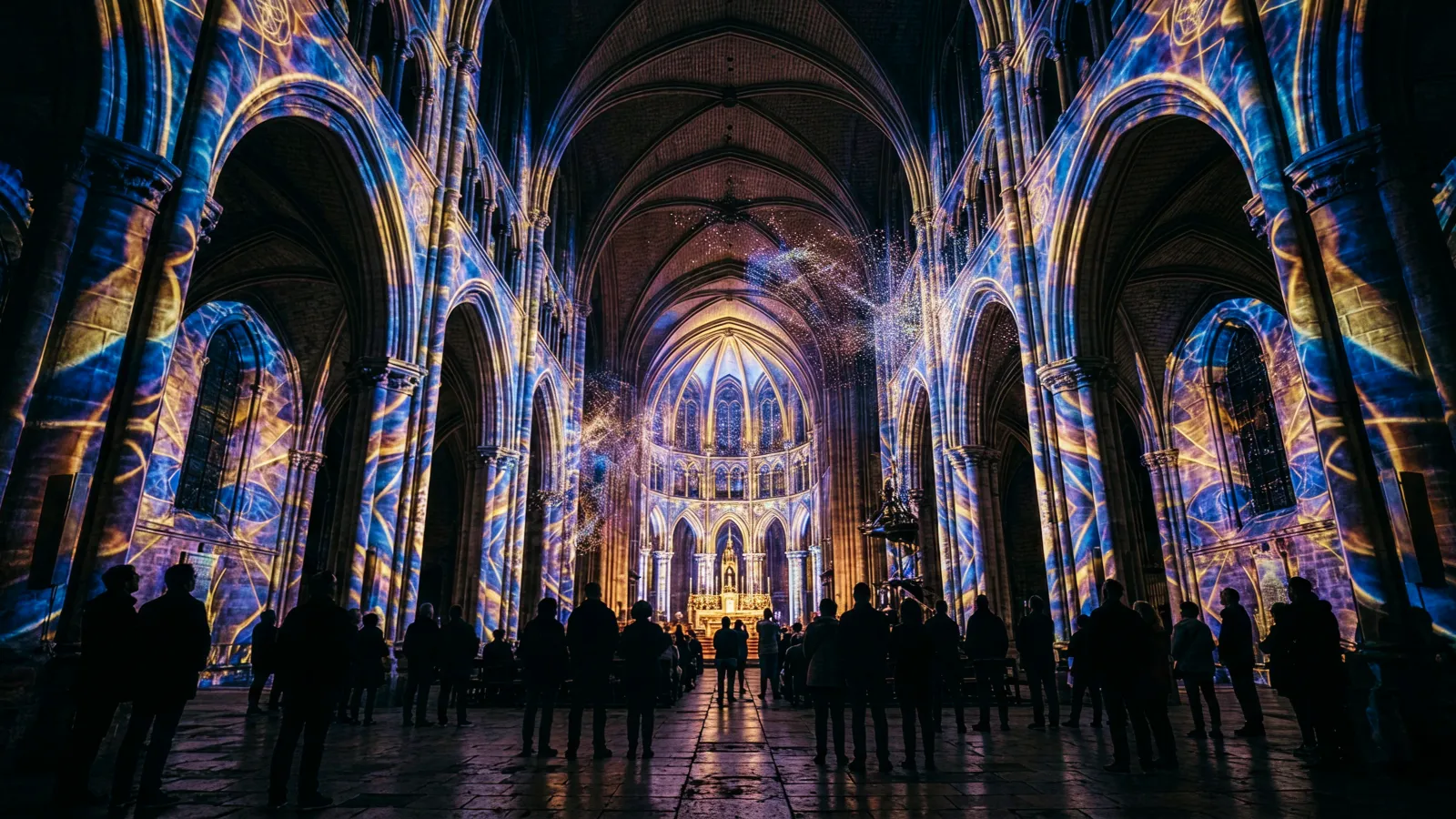
A guide to interactive technology in sacred spaces — what works across faiths, what it costs, and how to honor tradition while engaging modern congregations.
In a 400-year-old Zen temple in Kyoto, an android modeled after the Buddhist Goddess of Mercy delivers a 25-minute sermon on the Heart Sutra. Behind it, 360-degree projection mapping transforms the meditation hall into a cosmos of swirling galaxies and blooming lotus flowers. The audience — mostly under 40 — sits in rapt silence. When it ends, some are crying.
This is Mindar at Kodai-ji Temple, a $1 million android monk created by Professor Hiroshi Ishiguro at Osaka University. It was designed to solve a problem that religious institutions worldwide share: how do you reach a generation that stopped walking through the door?
The answer, increasingly, is interactive technology. But worship spaces are not museums, not retail stores, not stadiums. They carry centuries of tradition, deep emotional weight, and faith-specific sensitivities that make every design decision a theological one as much as a technical one.
This guide covers what works across faiths, what it costs, and the sensitivity frameworks that separate a meaningful sacred experience from an expensive distraction.
Who this is for: Religious institution administrators, church tech directors, temple renovation committees, and AV integrators designing for sacred spaces.
Key Takeaways
- Interactive installations in worship spaces range from $5K LED walls to $400K+ permanent projection mapping — the house of worship AV market exceeds $1 billion annually
- 87% of churches already stream services; interactive installations are the logical next step beyond broadcast
- 85% of churches reported increased congregation engagement after adding LED display panels (Church Production Magazine, 2023)
- Sensitivity varies dramatically by faith: mosques typically restrict content to still geometric imagery; churches freely use animation; Buddhist temples in Japan embrace cutting-edge digital art
- The strongest examples — AURA at Notre-Dame (2M+ visitors), teamLab at Shimogamo Shrine, Sheikh Zayed Grand Mosque projection (44 projectors) — treat technology as a lens for the sacred, not a replacement
- Memorial walls, meditation rooms, and interactive prayer stations are the fastest-growing categories for smaller congregations
- Start with a pilot ($5K–$15K) before committing to a $100K+ permanent installation — test congregation response first
1. Why Worship Spaces Are Adopting Interactive Technology
1-1. The numbers driving the shift
The adoption curve is already steep. According to Subsplash's 2025 church technology report:
- 87% of churches stream services online
- 45% of church leaders use AI tools (an 80% year-over-year increase)
- 94% use digital giving platforms
- 52% increased their technology budgets in 2025
- Approximately 90% now operate hybrid in-person/online worship models
These numbers are predominantly from Christian churches in North America, but the trend is global. Buddhist temples in Japan are experimenting with AI-powered robotic monks. Mosques in the Gulf States commission world-record projection mapping. Hindu temples deploy VR experiences and AI-guided tours in 10 languages.
1-2. The sacred-secular tension
Every worship space that adopts interactive technology faces the same internal debate: does this enhance the sacred, or does it compete with it?
The tension is real, but it is not new. Multi-sensory worship has roots in the earliest sacred traditions — the tabernacle's precise visual design, incense as a metaphor for prayer ascending, stained glass as narrative technology, Islamic geometric patterns as expressions of the infinite. Every generation has used the most advanced available technology to create environments that evoke awe.
The question is not whether to use technology. It is whether the technology serves the experience of the sacred — or distracts from it.
As Samford University's worship arts program frames it: the goal is not a bigger screen, but a deeper encounter.
2. What Works — Proven Installation Types
2-1. Projection mapping on sacred architecture
Projection mapping is the most spectacular application of interactive technology in worship spaces — and it has the strongest track record of commercial and spiritual success.
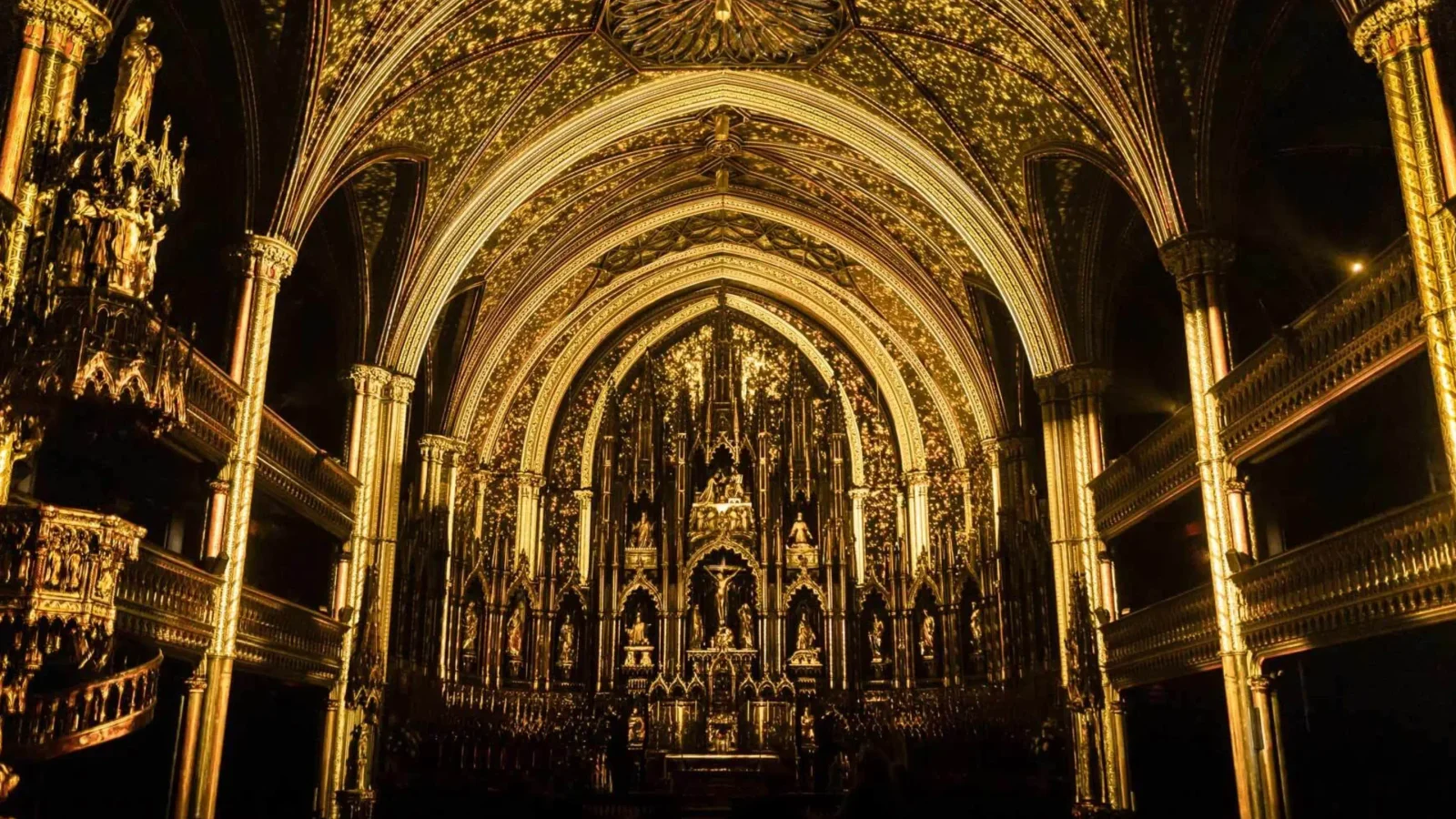
AURA by Moment Factory at Montreal's Notre-Dame Basilica is the benchmark. Launched in 2017, the installation uses 21 projectors, 140 intelligent lights, and 20 mirrors to transform the basilica's interior into a pixel-by-pixel luminous experience. Over 2 million visitors and 400+ sold-out performances later, AURA has expanded to Grace Cathedral in San Francisco and the Dome des Invalides in Paris.
Other landmark projects:
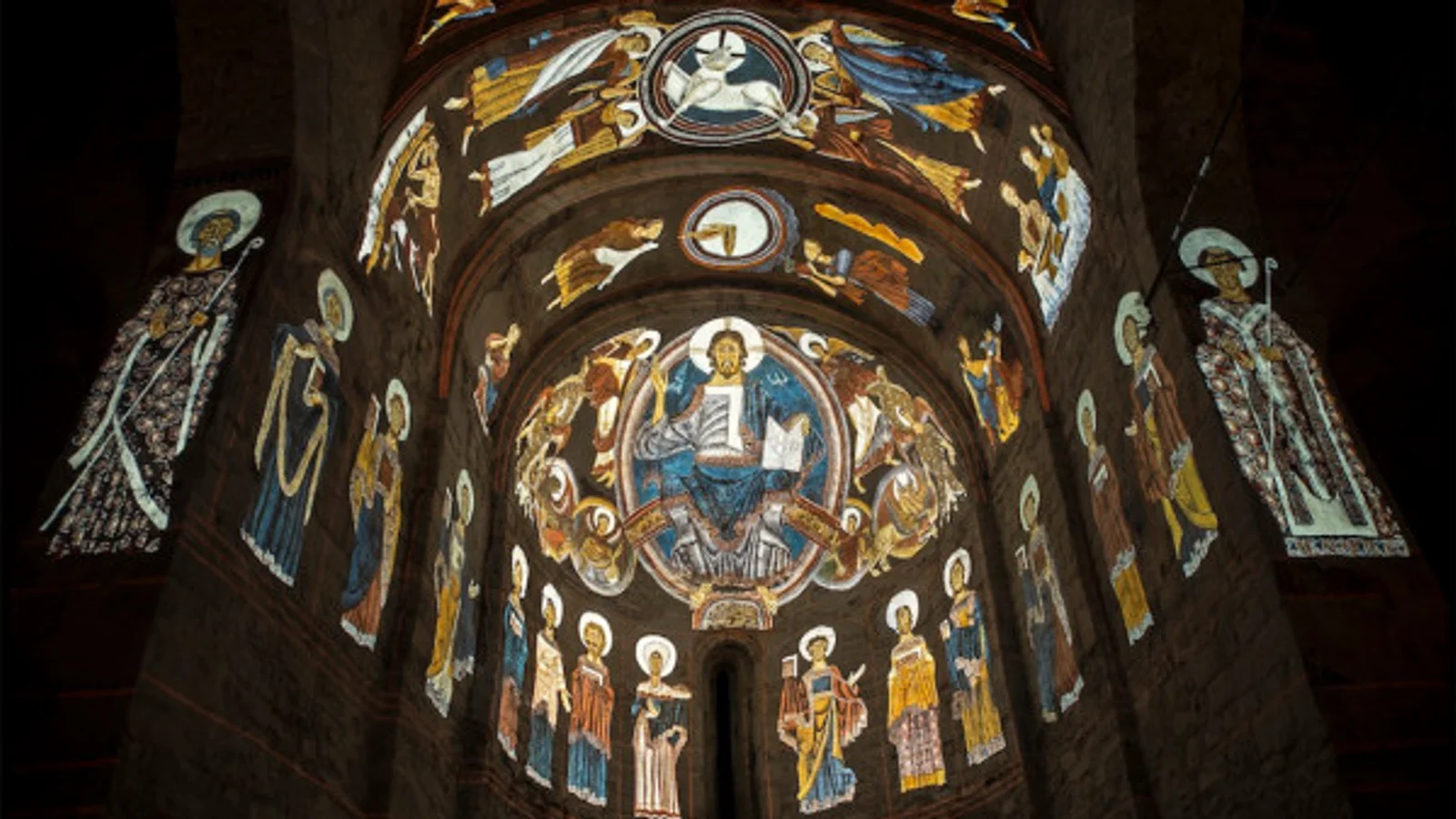
- Sant Climent de Taull, Spain — the first permanent projection mapping in a church, using six Christie projectors to restore 12th-century Romanesque wall paintings via projected light. Investment: $400,000+. The installation is now a UNESCO World Heritage attraction
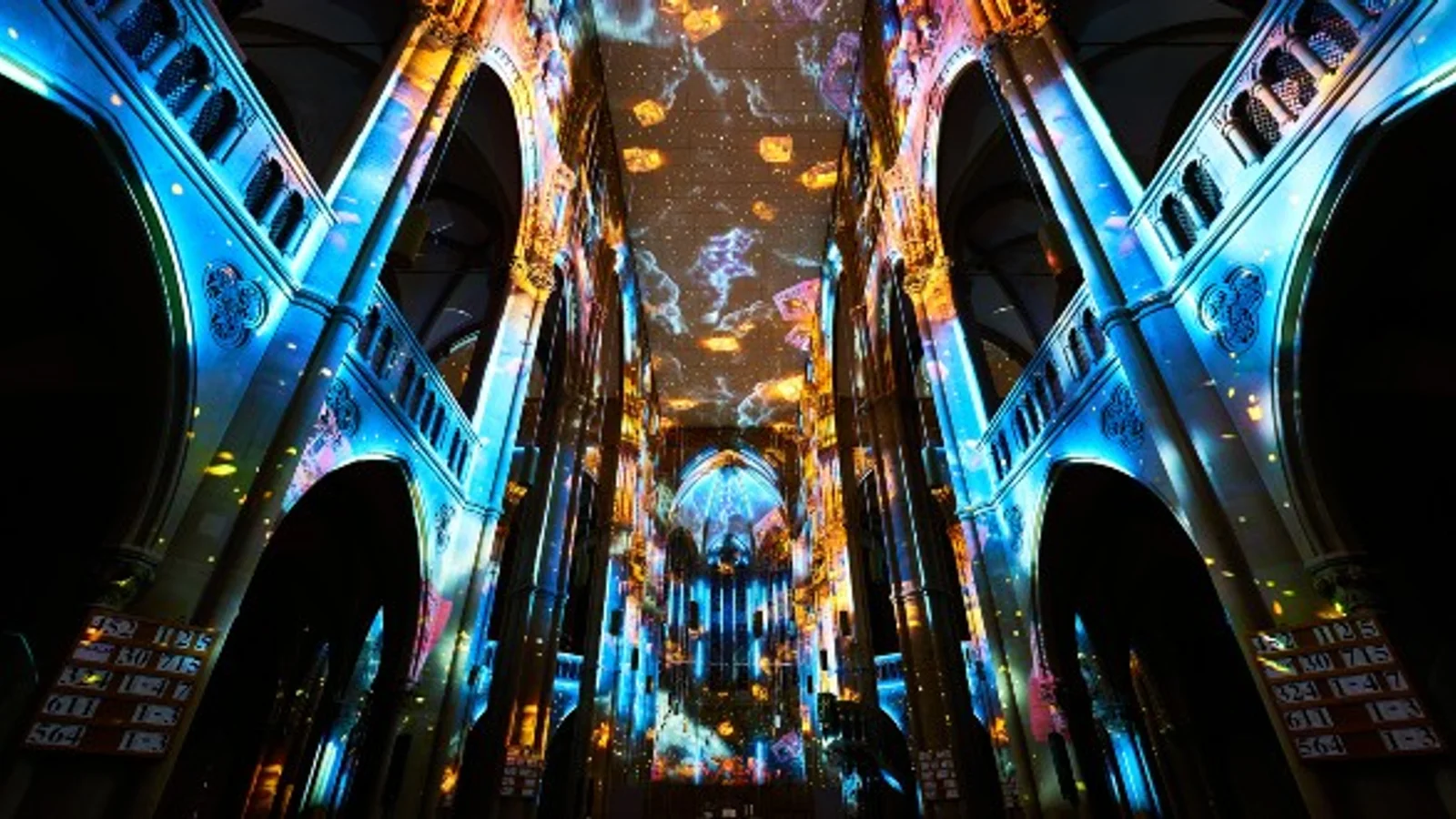
- Eonarium — a touring immersive experience visiting 30 churches across Europe (Madrid, Liverpool, Hamburg, Marseille, Geneva, Lyon), using 8–16 projectors per venue with d&b audiotechnik spatial audio for 30–45 minute shows
- Bordeaux Cathedral "Luminiscence" — a Barco projection installation that sold approximately 100,000 paid tickets during its run, paired with live orchestral music
- MASARY Studios at Grace Church, Providence — five Epson 15,000-lumen 4K laser projectors with vocal ensemble and digital audio, drawing 1,000+ visitors in December 2023
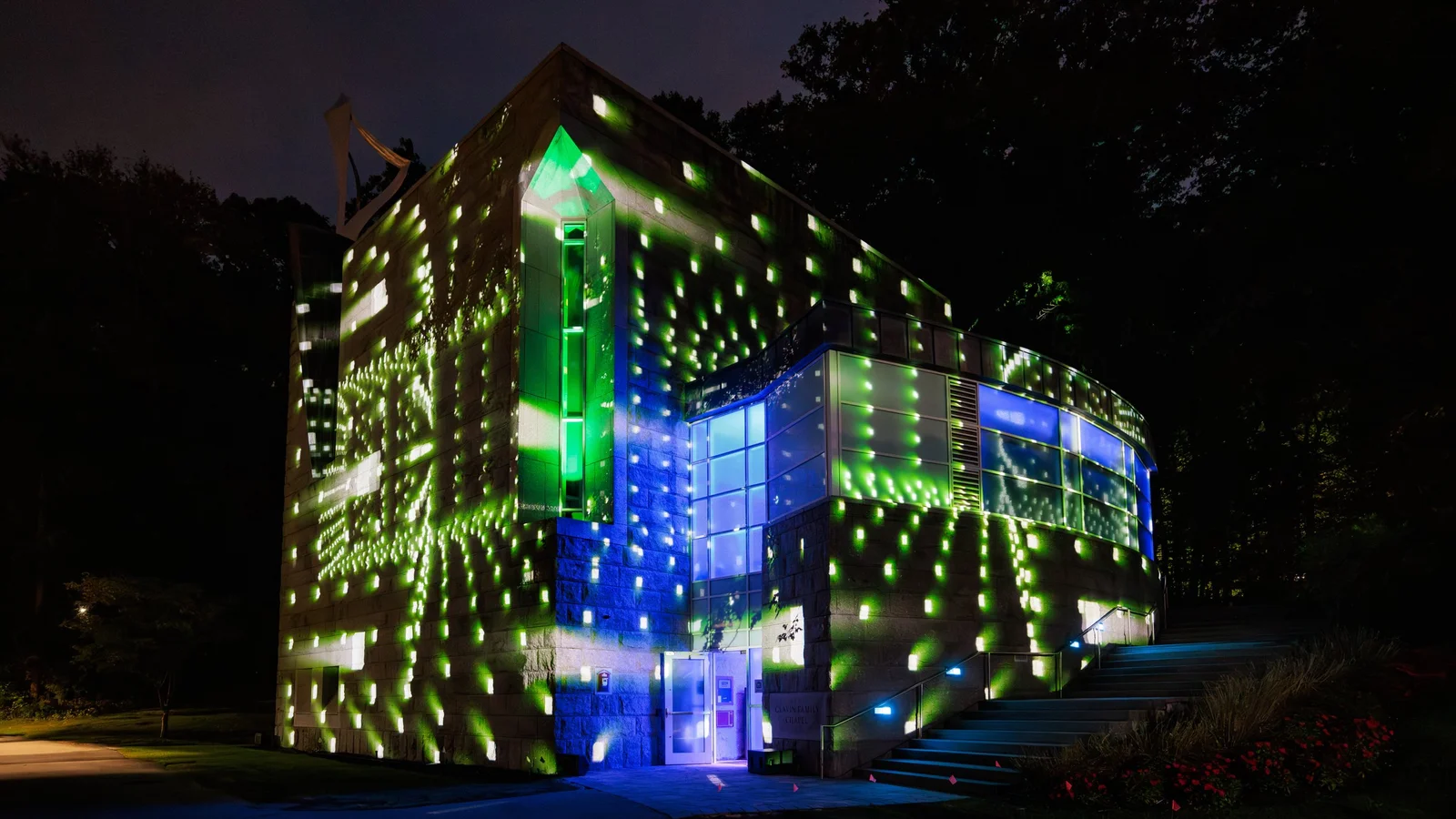
For historic buildings, projection mapping has a critical advantage: it is completely non-invasive. No drilling, no mounting, no alteration to heritage surfaces. The installation can be removed without a trace.
2-2. LED walls and digital backdrops
LED walls are the workhorse of modern worship technology — less dramatic than projection mapping but far more practical for weekly services.
Megachurches have led adoption: Hillsong uses a 180 sqm LED wall at the O2 Arena in London. Lakewood Church in Houston operates 228 LED lights plus a multi-panel video wall. First Baptist Dallas installed a 142-inch curved screen with seven Barco projectors. Elevation Church uses LED backdrops that change dynamically with each worship segment.
Budget ranges for LED walls in worship spaces:
| Size | Dimensions | Cost Range |
|---|---|---|
| Small | ~10 x 6 ft | $6,000–$8,000 |
| Medium | ~16 x 10 ft | $12,000–$18,000 |
| Large | ~20 x 13 ft | $20,000–$35,000 |
| Extra Large | 20+ ft wide | $35,000–$100,000+ |
The impact is measurable: 85% of churches reported increased congregation engagement after installing LED display panels, according to a 2023 Church Production Magazine survey.
2-3. Interactive prayer and memorial walls
This is the fastest-growing category for smaller congregations that cannot justify a $50K+ installation but want meaningful digital engagement.
Digital prayer walls use touchscreen interfaces or smartphone integration for submitting prayer requests to a community display. Platforms like ChurchTrac provide software; hardware ranges from a single mounted tablet to a purpose-built kiosk.
Interactive missionary displays (via Digital Missions Display and similar platforms) offer touchscreen systems showing missionary updates, prayer letters, images, and videos — replacing the traditional cork-board-and-pushpin approach.
Memorial and donor recognition walls blend physical design with digital interactivity — visitors tap names to see stories, photos, and tributes. These have particular resonance in worship contexts where remembrance is part of the spiritual practice.
2-4. Immersive sound design
Sound is arguably more important than visuals in worship — and immersive spatial audio is transforming what is possible.
City Harvest Church in Singapore installed L-Acoustics L-ISA Hyperreal Sound, increasing spatial audio coverage from 8% to 48% of the seating area. The system creates a three-dimensional sound field where music and spoken word feel like they surround the listener rather than emanating from a single point.
Mount Paran Church in Atlanta became the world's first house of worship to install a full L-ISA immersive sound system, creating what the congregation describes as "being inside the music."
For a deeper dive on spatial audio technology for installations, see our sound design guide.
2-5. AI and robotics in sacred spaces
The most forward-looking — and controversial — category.
Kodai-ji Temple's Mindar (2019) was a $1 million android monk that delivered Heart Sutra sermons with projection mapping. In 2026, the temple upgraded to an AI-powered "Buddharoid" that can engage in real-time dialogue about Buddhist philosophy — a move explicitly designed to reach younger Japanese who rarely visit temples.
Akshardham Temple in Delhi uses AI-guided tours in 10 languages, alongside animatronics, giant-screen films, and a multimedia water show with lasers and underwater flames.
These examples remain exceptional, but they signal a trajectory: AI as spiritual guide, not replacement for human clergy.
3. Faith-Specific Sensitivity Framework
This is where worship space installations diverge most sharply from any other venue type. What works in a Baptist megachurch would be deeply inappropriate in a mosque. What delights visitors at a Kyoto temple may unsettle a European cathedral preservation committee.
| Consideration | Christian | Buddhist / Shinto | Islamic | Jewish |
|---|---|---|---|---|
| Figurative imagery | Freely used (varies by denomination) | Common in Japan; varies elsewhere | Prohibited in sacred contexts | Context-dependent |
| Animation / motion | Standard in contemporary worship | Embraced in Japan (teamLab, etc.) | Typically still imagery / geometric only | Case-by-case |
| Sound design | Music is central to worship | Bells, chanting, natural sound | Adhan, Quran recitation | Cantorial tradition |
| Light symbolism | Stained glass tradition, candles | Lanterns, candles, moonlight | Geometric patterns, calligraphy | Menorah, eternal flame |
| Heritage constraints | Varies (some buildings 1,000+ years old) | Often national treasures | Often government-protected | Varies widely |
| Congregation approval | Board/committee vote | Temple committee | Imam/community consensus | Board/rabbi approval |
The Sharjah example
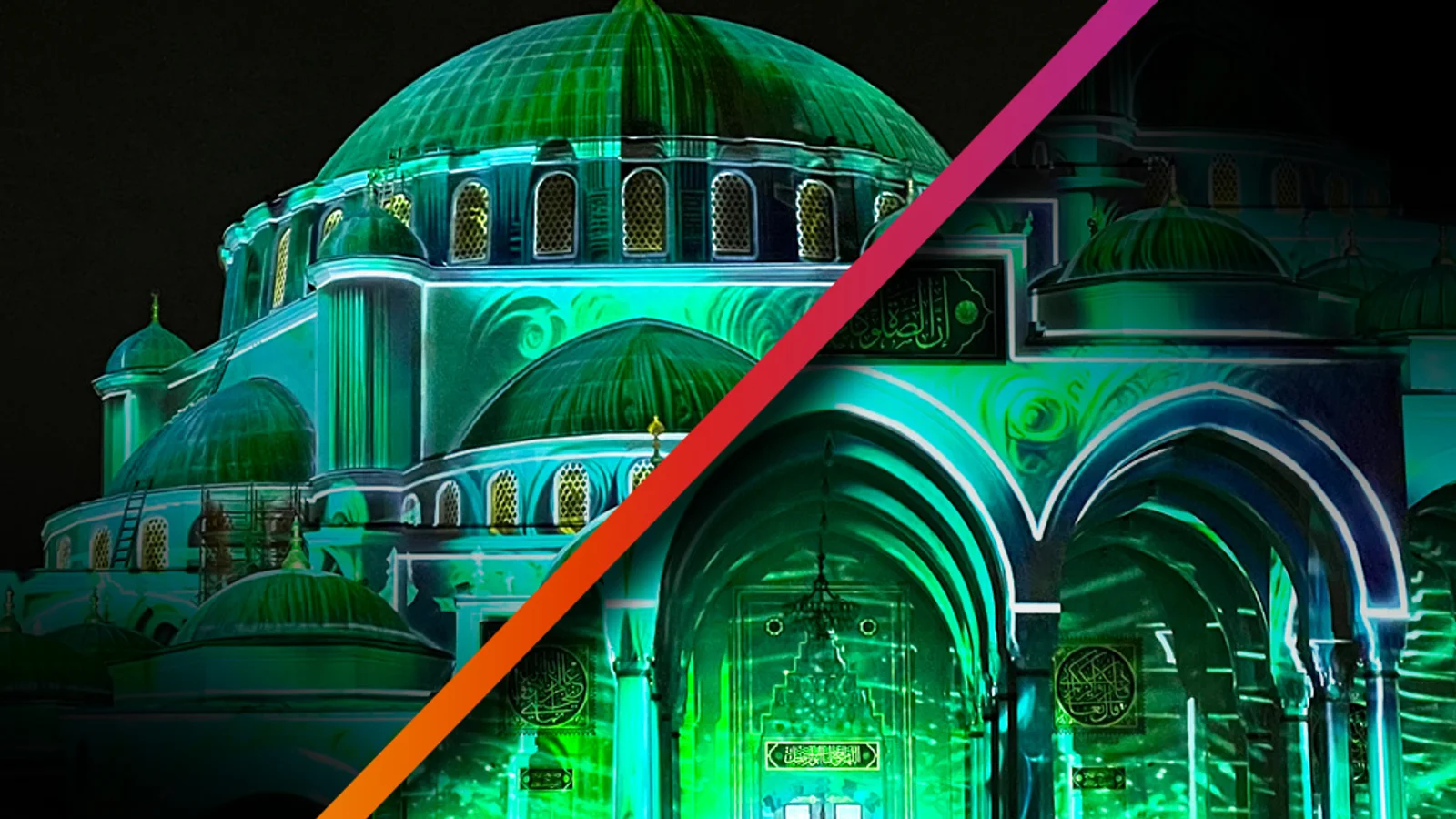
The annual Sharjah Light Festival in the UAE illustrates how sensitivity works in practice. While animated projection mapping is used freely on government buildings and cultural landmarks, projections on the Sharjah Mosque are limited to still images — geometric patterns and calligraphic designs that respect Islamic traditions against figurative representation. The festival uses 21 TITAN Laser 37000 WU projectors for the mosque installations, but the content is fundamentally different from what appears on secular buildings.
This is not a limitation — it is a design constraint that produces some of the most striking work in the entire festival. Islamic geometric art has explored mathematical infinity for centuries; digital technology simply gives it a new medium.
Zarah Hussain, a British-Kuwaiti artist, has built an entire practice around this intersection. Her works — "Numina" (Barbican, 2016), "Infinite Light" (Bradford, 2025), "Paradise Carpet" (Wakefield, 2025) — use C++ programming to generate Islamic geometric patterns that evolve and shift in real time. The result is deeply respectful of tradition while being unmistakably contemporary.
4. Case Studies Across Faiths
AURA — Notre-Dame Basilica, Montreal
- Creator: Moment Factory
- Technology: 21 projectors, 140 intelligent lights, 20 mirrors
- Year: 2017 (ongoing)
- Impact: 2M+ visitors, 400+ sold-out performances, THEA Award winner
- Budget: Not disclosed (estimated $2M+ for permanent installation)
- Why it works: Treats the existing architecture as the canvas — every surface is mapped pixel by pixel. The basilica's own beauty is amplified, not replaced.
teamLab at Shimogamo Shrine, Kyoto
- Creator: teamLab
- Technology: Interactive egg-shaped LED installations, real-time rendering
- Year: 2019 (recurring)
- Impact: Extended shrine visiting hours, attracted younger demographic
- Why it works: Installations are placed in the 120,000 sqm Tadasu Forest surrounding the shrine — the sacred buildings themselves are untouched. Artwork responds to human presence: touch a sphere and it changes color, emitting a musical tone that ripples through neighboring spheres.
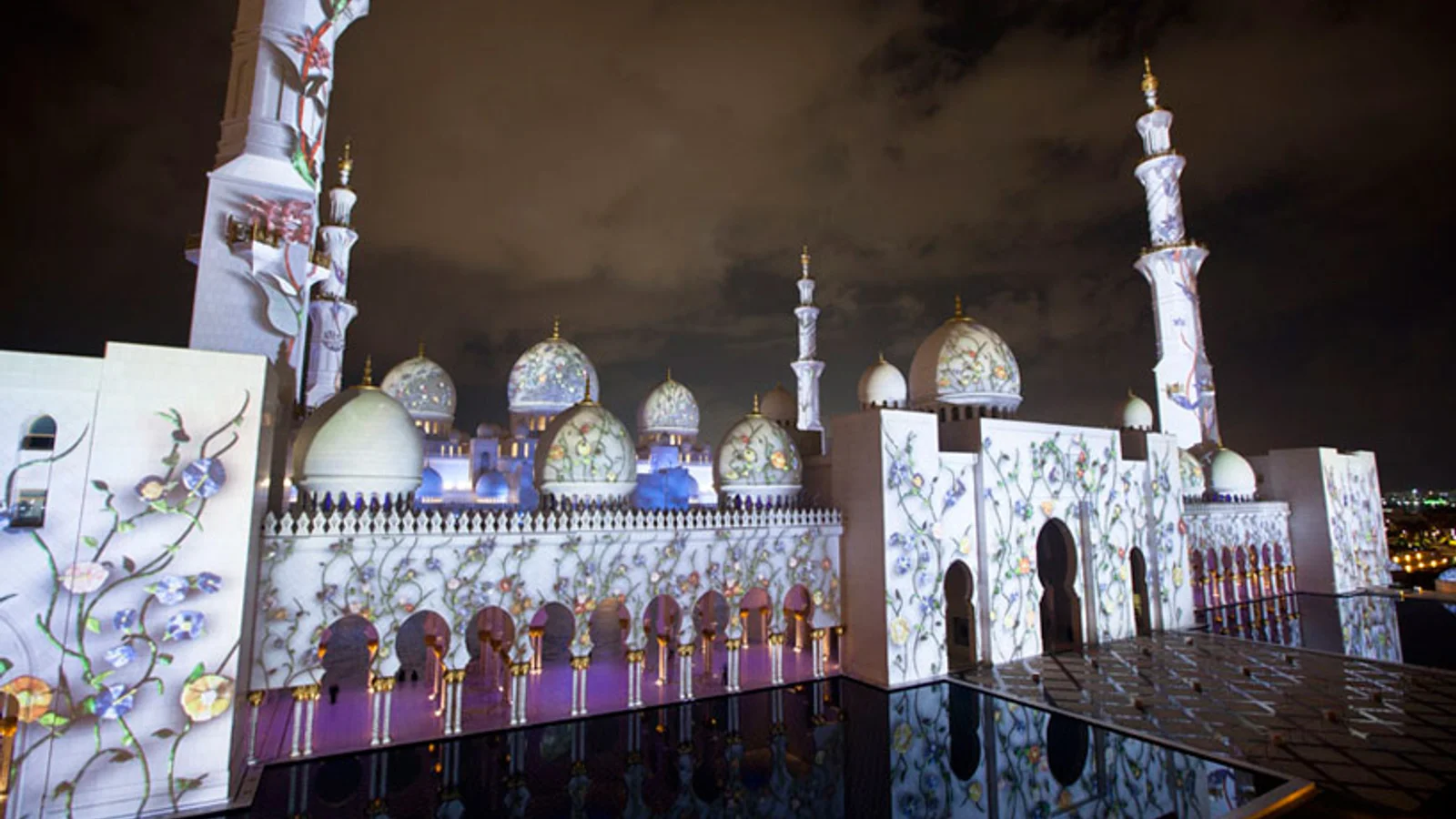
Sheikh Zayed Grand Mosque Projection, Abu Dhabi
- Creator: Obscura Digital
- Technology: 44 projectors, 840,000 lumens combined
- Year: 2011
- Surface: 600 x 351 ft (facade, 4 minarets, 12 domes)
- Content: Palms, pentagonal geometry, gardens of paradise, qibla wall, mehrab, lunar cycles
- Why it works: Content was developed in deep consultation with Islamic scholars. Every visual references Quranic imagery — gardens, geometry, celestial patterns. No figurative representation. The 17-minute show replayed every 30 minutes for five days.
Sant Climent de Taull, Spain
- Technology: Six Christie projectors, 100 sqm coverage
- Investment: $400,000+
- Status: Permanent (first church with permanent projection mapping)
- Why it works: Restores 12th-century Romanesque wall paintings that had been removed to museums. Visitors see the paintings as they would have appeared 900 years ago — in context, on the walls they were painted for.
Famen Temple, China
- Technology: 24 laser projectors across 7,300 sqm
- Status: China's largest fixed laser projection installation
- Why it works: The scale matches the ambition of the Buddhist site, creating an experience that feels proportional to the spiritual significance of the Famen Temple complex.
Eonarium — Touring European Churches
- Creator: Eonarium
- Technology: 8–16 projectors per venue, PIXERA media server, d&b audiotechnik spatial sound
- Scope: 30 churches and cultural sites across Europe (Madrid, Liverpool, Hamburg, Marseille, Geneva, Lyon)
- Format: 30–45 minute immersive shows, temporary (2–4 months per city)
- Why it works: Brings world-class immersive art to churches that lack the budget for permanent installations. The touring model makes premium projection mapping accessible to smaller institutions.
MASARY Studios at Grace Church, Providence
- Technology: Five Epson 15,000-lumen 4K laser projectors
- Year: 2023
- Format: Projection mapping + vocal ensemble + digital audio
- Impact: 1,000+ visitors in December 2023
- Why it works: Combines live musical performance with real-time projected visuals, creating a hybrid experience that is neither concert nor service — something entirely its own.
5. Budget Tiers and Planning
Installation cost tiers
| Tier | Investment | What You Get | Timeline | Best For |
|---|---|---|---|---|
| Starter | $5K–$15K | Single LED wall or basic projection setup | 2–4 weeks | Small churches, prayer rooms, memorial displays |
| Mid-Range | $15K–$50K | Multi-surface projection or LED wall + custom content | 4–8 weeks | Medium congregations, event-based installations |
| Premium | $50K–$200K | Architectural projection mapping + immersive sound | 8–16 weeks | Large churches, cathedral one-off events |
| Flagship | $200K–$1M+ | Full permanent installation (Sant Climent level) | 16–52 weeks | Heritage sites, destination experiences, megachurches |
Per-seat AV benchmarks
For complete audio-video-lighting systems (not just interactive installations), The Penn Group provides per-seat cost benchmarks:
| Seating Capacity | Cost Per Seat |
|---|---|
| 0–100 | $200 |
| 101–300 | $350 |
| 301–500 | $425 |
| 501–750 | $600 |
| 751–1,000 | $700 |
| 1,000+ | $800+ |
Budget allocation typically breaks down as: audio 50–70%, video 20–30%, lighting and infrastructure the remainder.
Annual maintenance: Budget 5–10% of your total AVL system cost annually for filter cleaning, software updates, content management, and emergency support.
For a comprehensive breakdown of interactive installation costs across all venue types, see our budget guide.
6. Common Pitfalls
6-1. Technology that competes with the sacred
The single most common mistake: installing a screen so impressive that the congregation watches the screen instead of engaging with the worship experience. The test is simple — does the technology make the sacred space feel more sacred, or does it feel like a concert venue? If visitors comment on the technology rather than the experience, the design has failed.
6-2. Ignoring acoustics
Historic worship spaces — stone cathedrals, wooden temples, tiled mosques — have acoustic characteristics that modern AV systems were not designed for. Reverb times of 4–8 seconds are common in stone churches. Installing a standard PA system without acoustic treatment produces unintelligible speech and muddy music. Work with an acoustician before committing to audio hardware.
6-3. Heritage building restrictions
UNESCO sites, nationally registered historic buildings, and structures under archaeological survey protection (like India's ASI regulations, which require 100m standoff for projections at Khajuraho) impose strict constraints. Always consult heritage authorities before specifying any installation — even non-invasive projection mapping may require permits.
6-4. Volunteer-dependent maintenance
Most worship spaces rely on volunteers for AV operation. Complex systems that require trained technicians for routine operation will fail within months. Design for the least technical person who will operate it — not the most technical person on the selection committee.
6-5. Ignoring faith-specific sensitivities
An animated projection that delights a contemporary evangelical church may deeply offend in a mosque or Orthodox church. The sensitivity framework in Section 3 is a starting point, but there is no substitute for direct consultation with religious leaders from the specific tradition and community you are designing for.
7. How to Get Started — A Roadmap
Step 1: Audit your space
Before contacting any vendor or studio, document:
- Physical dimensions — ceiling height, wall surfaces, floor area, window positions
- Acoustic characteristics — reverb time, ambient noise, existing sound treatment
- Electrical infrastructure — available power, circuit capacity, cable routing options
- Heritage status — is the building listed, registered, or protected?
- Light conditions — natural light patterns throughout the day and seasons
Step 2: Define the purpose
Interactive installations in worship spaces serve fundamentally different purposes. Clarify yours before investing:
- Worship enhancement — visuals and sound that deepen the weekly service experience
- Outreach and attraction — destination experiences that draw new visitors (the AURA model)
- Memorial and remembrance — interactive walls and displays honoring community members
- Education and storytelling — immersive experiences that teach history, scripture, or tradition
- Meditation and contemplation — ambient installations for prayer rooms and quiet spaces
Step 3: Pilot small
A $5K–$15K pilot — a single LED panel, a temporary projection test during a special service, or an interactive prayer kiosk — gives you real congregation feedback before committing six figures. Many AV integrators offer rental options for exactly this purpose.
Step 4: Brief a studio or integrator
When you are ready to move beyond a pilot, a clear brief prevents wasted time and budget. For guidance on writing an effective brief, see our studio briefing guide.
Key elements for worship spaces: faith tradition and specific sensitivities, heritage constraints, typical service flow, volunteer vs. professional operation, and content update frequency.
Step 5: Plan for maintenance and content refresh
Budget content refresh from day one. Most worship installations benefit from seasonal content updates (Christmas, Easter, Ramadan, Obon, High Holidays) — budget $5,000–$20,000+ per refresh cycle depending on complexity.
About Utsubo
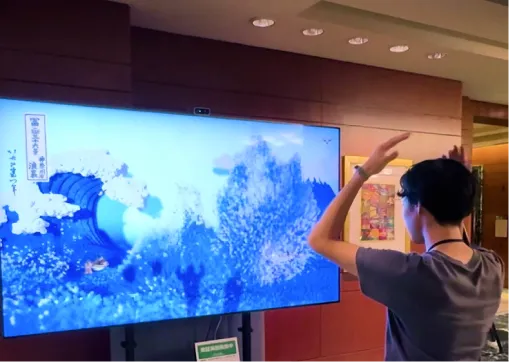
Utsubo is an interactive installation and creative web studio based in Osaka, Japan. Our work includes Waves of Connection — a body-tracked interactive installation at Expo 2025 Osaka where visitors moved Hokusai's Great Wave using their gestures, with a million particles responding in real time via WebGPU. We design installations that treat technology as invisible scaffolding for human experience — not the experience itself.
Ready to Explore Interactive Technology for Your Worship Space?
Whether you are a church administrator considering your first LED wall, a temple renovation committee exploring projection mapping, or an AV integrator looking for creative partners — we would welcome a conversation about what is possible.
Learn about our interactive installation services
Checklist: Getting Started with Worship Space Installations
- Audit your space (dimensions, acoustics, electrical, heritage status, light conditions)
- Define the primary purpose (worship enhancement, outreach, memorial, education, meditation)
- Research faith-specific sensitivity requirements for your tradition
- Consult heritage authorities if your building has protected status
- Set a realistic budget range using the tier guide above
- Run a pilot installation ($5K–$15K) to test congregation response
- Brief a studio or integrator with your requirements, constraints, and sensitivities
- Plan content refresh schedule and annual maintenance budget (5–10% of CAPEX)
- Get congregation/board buy-in before committing to a permanent installation
- Designate a technology champion — even volunteer-operated systems need an owner
FAQs
How much does a church interactive installation cost?
Costs range from $5,000–$15,000 for a basic LED wall or projection setup to $200,000–$1,000,000+ for a flagship permanent installation like Sant Climent de Taull's projection-mapped heritage restoration. The most common mid-range investment for a 300–500 seat church is $15,000–$50,000, which covers a quality LED wall or multi-surface projection with custom content. Budget an additional 5–10% annually for maintenance.
Can projection mapping damage historic church walls?
No. Projection mapping is completely non-invasive — projectors are mounted on stands or temporary structures, and light cannot damage stone, wood, or plaster surfaces. This is one reason projection mapping is the preferred technology for heritage buildings. However, mounting equipment (projector brackets, cable runs) may require heritage permits even if the projection itself is non-contact.
How do you handle religious sensitivity in digital installations?
Start with direct consultation with religious leaders from the specific tradition. Key principles: Islamic installations typically use geometric and calligraphic patterns only (no figurative imagery or animation of living beings). Orthodox Christian and some Catholic contexts may restrict imagery to approved iconographic traditions. Buddhist temples in Japan have been most open to experimental digital art. There is no universal rule — every faith community has its own boundaries.
What maintenance do worship space installations require?
Budget 5–10% of your initial capital expenditure annually. This covers projector filter cleaning and lamp/laser maintenance, software updates, content management, and emergency support. Laser phosphor projectors (20,000-hour lifespan) significantly reduce replacement costs compared to older lamp-based models. The biggest ongoing cost is usually content refresh — budget $5,000–$20,000+ per update cycle.
Are interactive installations appropriate for mosques?
Yes, with careful content design. The Sharjah Light Festival projects onto mosques annually using 21 high-powered projectors, and Obscura Digital mapped the entire Sheikh Zayed Grand Mosque facade with 44 projectors. The key constraint is content: mosque installations typically use still imagery, geometric patterns, calligraphic art, and abstract representations of Quranic themes — never figurative imagery or animated depictions of living beings. Artists like Zarah Hussain have built acclaimed practices at exactly this intersection.
How do I get congregation buy-in for technology in our worship space?
Run a pilot first. A temporary installation during a special service or holiday event lets the congregation experience the technology before voting on a permanent investment. Present specific examples from comparable institutions. Address the "distraction" concern directly by showing how the best installations enhance rather than compete with worship. Finally, involve skeptics in the selection process — people who help choose the technology are far more likely to champion it.
Can we start with a small pilot before committing to a permanent installation?
Absolutely — and we strongly recommend it. Many AV integrators offer rental packages for exactly this purpose. A $5,000–$15,000 pilot — a single LED panel, a temporary projection during a holiday service, or an interactive prayer kiosk — gives you real data on congregation response, operational requirements, and spatial compatibility before committing to a $50,000–$200,000+ permanent installation. The pilot also helps you write a much better brief for the permanent project.


 Osaka Interactive Installation Studio