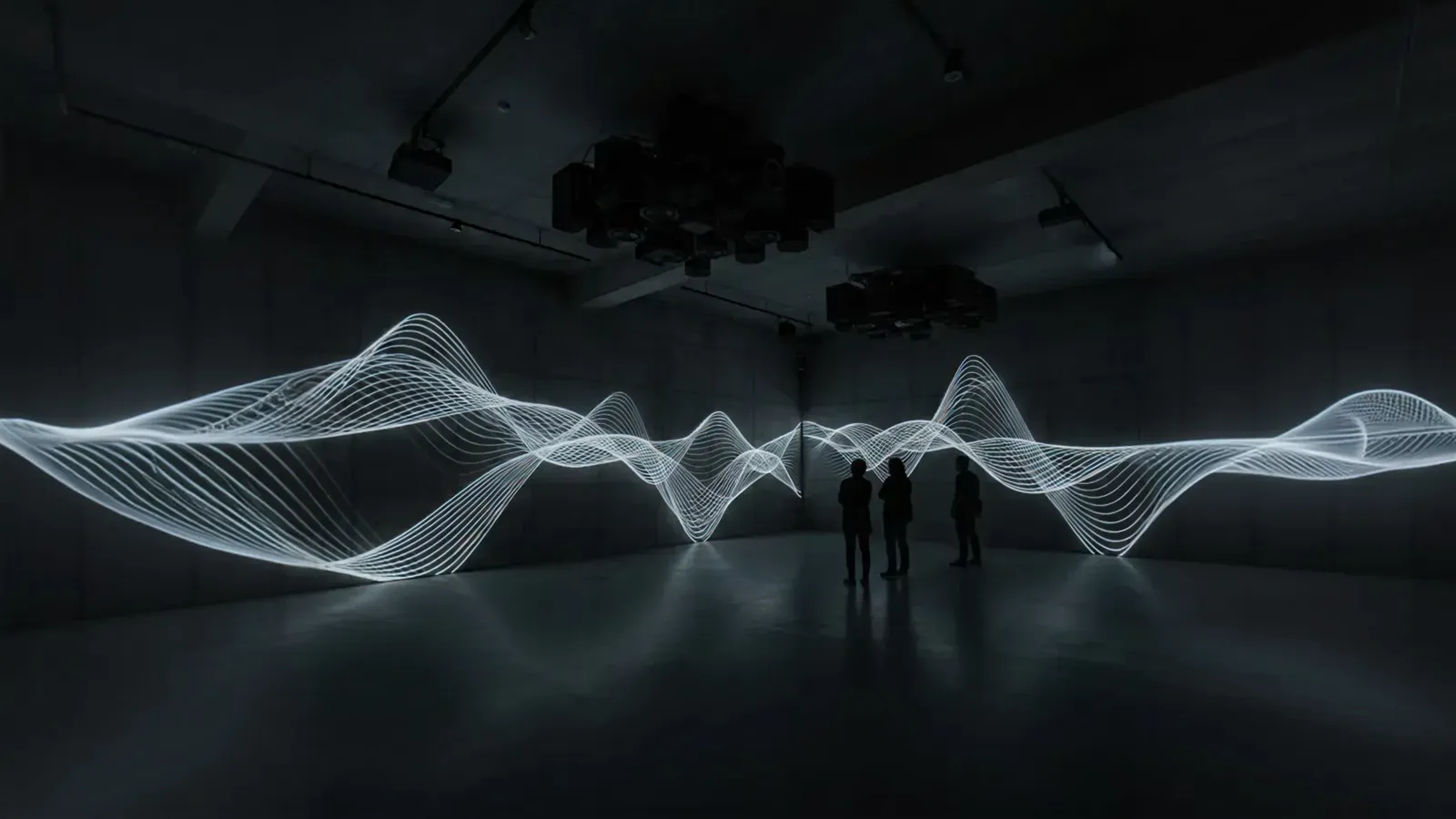
You spent $150,000 on stunning visuals — and visitors walk through in 30 seconds.
The difference between an installation people linger at and one they pass through often comes down to something you can't see: sound.
Sound design is the most underbudgeted element in interactive installations. Yet research shows it drives 30–40% of perceived immersion, extends dwell time by 15–18%, and lifts brand recall by up to 46%. When done well, sound turns a visual spectacle into a full-body experience visitors remember and share. When ignored — or bolted on at the last minute — it's the gap everyone feels but nobody can name.
This guide is for the people who buy interactive installations, not the people who build them. We'll cover what sound design adds, what it costs, and how to include it in your next project brief.
Who this is for: Museum directors, hotel experience leads, retail brand managers, event producers, and anyone commissioning an interactive installation who wants to understand what sound design adds — and what it costs.
Key Takeaways
- Sound is the most underbudgeted element in interactive installations — yet it drives 30–40% of perceived immersion
- 3 technology tiers: ambient soundscapes ($5K–$10K), reactive audio ($10K–$30K), spatial audio ($30K–$50K+)
- The #1 mistake: treating sound as an afterthought, added in the last 2 weeks of a project
- Directional speakers and spatial audio containment solve the "noise complaint" problem — sound stays in the installation zone
- Sometimes silence IS the right answer — deliberate no-sound design is a valid (and powerful) choice
- Always include sound design in your initial brief and budget — allocate 5–15% of total project cost
1. Why Sound Is the Most Overlooked Element in Interactive Installations
1-1. The visual-first bias
Most installation briefs focus 95% on visuals. Sound gets a single line — "add some ambient music" — or nothing at all. This happens because:
- Decision-makers evaluate proposals by looking at renderings and mockups, which are silent
- Budgets are built around screens, projectors, sensors, and fabrication — audio is an afterthought
- The vendor selection process often prioritizes studios with strong visual portfolios, not audio expertise
The result? Beautiful installations that feel strangely flat once visitors step inside.
1-2. What visitors actually experience
Humans process sound faster than visuals. Audio reaches the brain in 8–10 milliseconds compared to 20–40 ms for visual stimuli. This means sound sets the emotional tone of an experience before the eyes fully process the scene.
Research from 2020–2026 backs this up:
| Metric | Impact of Sound Design | Source |
|---|---|---|
| Perceived immersion | 30–40% of total immersion attributed to audio | Acoustical Society of America, 2023 |
| Dwell time | 15–18% increase with well-designed audio | International Journal of Hospitality Management, 2020 |
| Brand recall | Up to 46% increase with sonic branding elements | Rebellion Group / SoundOut, 2025 |
| Emotional engagement | 44% lift in emotional response with integrated audio | Hit Productions, 2025 |
| Visitor preference | 58% prefer congruent sounds over silence in exhibitions | Acoustical Society of America, 2023 |
These numbers matter because they translate directly to the outcomes installation buyers care about: longer visits, stronger memories, and measurable ROI.
1-3. The cost of getting it wrong
Bad sound — or no sound plan — shows up in predictable ways:
- Volume complaints from adjacent spaces or staff who hear the same 30-second loop for 8 hours
- Sound bleeding between zones, creating an incoherent experience
- Generic playlists on consumer Bluetooth speakers — the "we'll figure it out later" approach
- Accessibility gaps — no hearing loop, no captions, no alternative for visitors with hearing impairments
Poor acoustics can reduce visitor satisfaction by 20%, effectively undermining the investment you made in every other aspect of the installation.
2. What Is Sound Design for Interactive Installations?
Sound design for installations is not music production. It's the design of how sound behaves in a physical space, responds to visitors, and supports the overall experience.
Think of it as the audio equivalent of lighting design: you wouldn't install a $200K projection without planning the lighting around it. Sound deserves the same attention.
2-1. The 4 layers of installation sound
Professional sound design typically works across four layers:
| Layer | What It Does | Example |
|---|---|---|
| Ambient base | Sets the emotional atmosphere, always present | A warm, low-frequency drone in a museum gallery — felt more than heard |
| Reactive | Responds to visitor actions (movement, touch, proximity) | A chime or tonal shift triggered when someone approaches a display |
| Spatial | Positions sound in 3D space, creates movement | Audio that follows a visitor through a corridor, or emanates from a specific point |
| Functional | Serves wayfinding, accessibility, or informational purposes | Audio descriptions for visually impaired visitors, or subtle cues directing foot traffic |
Not every installation needs all four. The right combination depends on your venue, audience, and budget.
2-2. Sound design vs. music composition vs. AV integration
These are three different roles that buyers often conflate:
- Sound designer: Designs how audio behaves in the space — placement, triggers, layering, spatial behavior. Thinks about the experience.
- Music composer: Creates the musical content — melodies, textures, ambient compositions. Thinks about what you hear.
- AV integrator: Installs and configures hardware — speakers, amplifiers, wiring, control systems. Thinks about the infrastructure.
A complete audio strategy involves all three. The sound designer typically leads, specifying what the composer creates and what the AV team installs.
3. The 3 Technology Tiers (and What They Cost)
3-1. Tier 1: Ambient Soundscapes ($5K–$10K)
Pre-composed audio loops played through standard speakers with basic zoning. No interactivity — the sound stays the same regardless of visitor behavior.
What you get:
- Custom ambient compositions (or licensed music curation)
- 2–6 speaker zones
- Basic scheduling (time-of-day changes)
Best for: Retail environments, hotel lobbies, simple exhibitions, and installations where audio supports but doesn't drive the experience.
Limitations: Can feel generic over time. Staff and repeat visitors may notice the loop. No response to visitor presence.
3-2. Tier 2: Reactive / Interactive Audio ($10K–$30K)
Sound that responds to visitor presence, movement, or input. Uses sensors (cameras, depth sensors, pressure mats, proximity detectors) to trigger audio events in real time.
What you get:
- Sensor-triggered sound events
- Multiple audio layers that mix dynamically
- Middleware integration (Max/MSP, TouchDesigner, custom software)
- Content management for updating triggers and sounds
Best for:Museums, brand activations, retail flagships, and any installation where the experience should feel responsive.
Technology: Audio middleware connects to the same sensors driving the visual system. When a depth camera detects a visitor approaching, the visual and audio layers respond simultaneously. This is where sound goes from decoration to part of the interaction.
3-3. Tier 3: Spatial Audio Systems ($30K–$50K+)
Full 3D sound positioning using object-based audio. Sound sources can be placed anywhere in the room and moved in real time — following visitors, creating phantom sound sources, or simulating environments.
What you get:
- Object-based audio rendering (each sound source positioned independently in 3D)
- Speaker arrays (typically 8–64+ channels)
- Professional spatial audio processors
- Real-time control via show control or sensor integration
Leading systems:
| System | Manufacturer | Typical Entry Cost | Strengths |
|---|---|---|---|
| Soundscape | d&b audiotechnik | $40K–$80K+ (processor + speakers) | Scalable licensing, strong in museums and theaters |
| L-ISA | L-Acoustics | ~$30K+ (processor only) | Cinema-quality imaging, large-scale experiences |
| Spacemap Go | Meyer Sound | Included with Galaxy processors (~$12K) | iPad-controlled, free firmware, lower barrier to entry |
Best for: Flagship immersive experiences, large-scale museum galleries, corporate showrooms, and any project where audio IS the experience, not just a complement.
Budget comparison
| Tier | Audio Budget | Interactivity | Spatial Precision | Best For |
|---|---|---|---|---|
| 1: Ambient | $5K–$10K | None | Zone-based | Background atmosphere |
| 2: Reactive | $10K–$30K | Trigger-based | Trigger zones | Responsive experiences |
| 3: Spatial | $30K–$50K+ | Full 3D | Object-based 3D | Immersive environments |
These ranges cover the audio-specific costs (sound design, content creation, hardware, integration). They don't include the broader installation budget. For context, if your total project budget is $100K–$200K, audio typically represents 5–15% of the total.
Sound containment: Directional speakers
One of the biggest concerns buyers raise is sound bleeding into adjacent spaces. Directional speaker technology solves this by creating tight beams of audio — sound is audible in a defined zone and nearly silent outside it.
Holosonics Audio Spotlight is the most established system, used in thousands of museum, retail, and exhibition installations worldwide. Their parametric technology delivers audio ten times more isolated than conventional speakers.
Use cases for directional speakers:
- Individual exhibit stations in museums (each station has its own audio without headphones)
- Retail point-of-sale audio (product information that only the nearby shopper hears)
- Hotel lobby zones (ambient audio in one area, silence in the adjacent lounge)
- Multi-station installations where each position has different content
4. When Silence Is the Right Design Choice
Not every interactive installation needs sound. In fact, sometimes the absence of designed audio is the most powerful choice.
4-1. Case study: Utsubo's Hokusai installation at Expo 2025
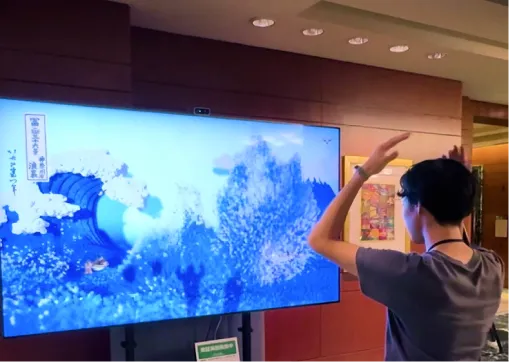
Our Waves of Connection installation at Expo 2025 Osaka deliberately used no sound design. Visitors controlled Hokusai's Great Wave using their body movements — up to a million particles responded in real time to gestures captured by depth cameras.
The design choice was intentional: without programmed audio, the visitors themselves became the soundscape. Their spontaneous reactions — laughter, gasps of surprise, "Wow!", clapping — created an authentic, communal atmosphere that no pre-composed soundtrack could match.
Key observations from 10,000+ visitors over 7 days:
- One visitor began dancing in front of the screen without any prompt. Other visitors started clapping along.
- Children queued repeatedly to "make the biggest wave" — the social competition and excitement was the experience
- Adults who initially stood still would tentatively raise one hand. The moment the wave reacted, their "Oh!" of surprise was more powerful than any designed sound effect
4-2. When no-sound or minimal-sound works
Consider a silent or minimal-sound approach when:
- Crowded spaces where ambient crowd noise IS the atmosphere (festivals, expos, trade shows)
- Body/movement-driven installations where visitor reactions create organic sound
- 24/7 environments where staff fatigue from repetitive audio is a real concern (hotel lobbies often default to silent for this reason)
- Sound-sensitive neighbors — adjacent galleries, meeting rooms, or residential spaces
- Budget constraints — a well-designed silent installation is better than a poorly executed sound design
4-3. The "silence test"
A practical framework for your planning:
- Imagine your installation running with no sound. Does it still create the intended emotional impact?
- If the installation feels complete without audio, you may not need it — and that's a valid, budget-efficient decision.
- If the installation feels empty, flat, or unfinished without sound, audio design is essential and should be budgeted from day one.
5. Sound Design by Venue Type
5-1. Museums and galleries
Museums have unique audio challenges: multiple exhibitions in adjacent rooms, diverse visitor demographics, strict accessibility requirements, and long operating hours.
Key considerations:
- Sound containment between galleries — directional speakers or ceiling-mounted speaker arrays with tight coverage
- Accessibility — hearing induction loops, audio descriptions, captioned alternatives (see our accessibility guide)
- Visitor pacing — audio that subtly guides flow through exhibition spaces
- Congruent sound design — audio that matches the exhibit theme increases visitor focus and reduces distractions (58% of visitors prefer this over silence)
Research shows museums with well-designed audio see 10–15% higher satisfaction scores compared to silent exhibitions of similar quality.
Related: Interactive Museum Installations: ROI, Costs & Real Examples
5-2. Hotels and hospitality
Hotels need audio that enhances the guest experience without becoming intrusive — a difficult balance in spaces that operate 24/7.
Key considerations:
- 24/7 ambient reliability — systems must run continuously without staff intervention
- Guest comfort — no intrusive audio; silent or ambient is the default (hotel installation guide)
- Sonic branding — custom soundscapes that reinforce brand identity (slow-tempo music can boost lobby dwell time by 18%)
- Time-aware scheduling — quieter at night, livelier during events, different energy for morning vs. evening
- Sound zoning — the lobby lounge should feel different from the reception desk
5-3. Retail and brand activations
Retail environments use sound as an attractor — something that draws visitors in and keeps them engaged long enough to convert.
Key considerations:
- Short attention spans — sound needs to hook within seconds
- UGC enhancement — audio that makes the shareable moment richer (reactions, playful sounds)
- Portable solutions — temporary installations need quick setup and teardown
- Sales correlation — appropriate music can extend dwell time by 8–15% and drive 3–10% sales uplift
5-4. Corporate lobbies and events
Corporate installations require a professional, understated approach to audio.
Key considerations:
- Background vs. foreground balance — audio should enhance, not dominate
- Meeting-adjacent spaces — sound containment is critical near conference rooms
- Brand expression — sonic branding for visitor-facing spaces (lobby, showroom)
- Event flexibility — ability to shift audio profiles for corporate events, client visits, or all-hands meetings
6. How to Include Sound Design in Your Project Brief
Most installation briefs have zero mention of sound. This means the studio either guesses, deprioritizes it, or adds it last — none of which produce great results.
6-1. The 5 questions every brief should answer about sound
- What emotional tone should the sound create? (Calm and ambient? Energizing and dynamic? Mysterious and immersive?)
- Are there physical constraints? (Noise-sensitive neighbors? High ambient noise? Hard reflective surfaces?)
- Should sound be ambient, reactive, or spatial? (Refer to the 3 tiers above)
- What's the separate budget allocation for audio? (5–15% of total project cost)
- Who is responsible for sound design on the team? (In-house, studio-provided, or third-party specialist?)
6-2. Red flags in vendor proposals
Watch for these signs that a studio isn't taking audio seriously:
- Sound is not mentioned at all in the proposal
- "We'll add music later" — treating audio as a post-production polish
- No speaker specification or placement plan in the technical drawings
- Sound budget is lumped into "production" without a clear breakdown
- No mention of sound containment or how audio interacts with adjacent spaces
If your brief includes sound requirements and the proposal doesn't address them, that's a signal to ask follow-up questions — or consider a studio with stronger audio capabilities.
Related: How to Brief an Interactive Installation Studio
Context:
- Venue type: [museum / hotel / retail / corporate / event]
- Total project budget: [approximate range]
- Installation footprint: [size and number of zones]
- Adjacent spaces: [describe noise sensitivity]
- Audience: [visitor demographics and expected behavior]
- Desired emotional tone: [calm, energizing, immersive, playful, etc.]
Help me write a sound design section for the brief that covers:
- Audio objectives and emotional tone
- Interactivity requirements (ambient, reactive, or spatial)
- Sound containment needs
- Accessibility requirements
- Content refresh and maintenance expectations
- Budget allocation recommendation
7. Common Mistakes and How to Avoid Them
7-1. Adding sound in the last 2 weeks
This is the single most common mistake. Sound design needs to be integrated with visual and interaction design from the start — not patched in during final testing. When audio is added late:
- There's no time to test in the actual space
- Speaker placement conflicts with visual hardware
- The audio doesn't sync with interaction triggers
- Budget has already been spent on other line items
Fix: Include sound design as a line item in your initial scope and timeline. Budget for it in the discovery phase, not the polish phase.
7-2. Using consumer-grade speakers
Bluetooth speakers, soundbars, and computer speakers aren't built for continuous commercial use. They overheat, distort at volume, and fail within weeks of heavy operation.
Fix: Specify commercial-grade speakers in the proposal. For 24/7 environments, this is non-negotiable.
7-3. Ignoring sound bleed between zones
Open floor plans, hard surfaces (concrete, glass, marble), and high ceilings all amplify sound bleed. Two installations in adjacent spaces can create a muddled, distracting experience.
Fix: Require a sound containment plan in the proposal. Directional speakers, acoustic treatment, and careful volume mapping solve most cases.
7-4. No plan for content refresh
A 90-second audio loop played 8 hours a day, 7 days a week becomes unbearable for staff within days. Visitors may not notice (they hear it once), but staff morale and complaints are real costs.
Fix: Specify minimum loop length (aim for 30+ minutes of non-repeating content), and plan for seasonal or quarterly content refreshes.
7-5. Forgetting accessibility
Audio-only information excludes visitors with hearing impairments. This isn't just an ethical issue — it's increasingly a legal requirement under ADA, WCAG 2.1 AA, and regional accessibility standards.
Fix: Every audio element should have a visual or tactile alternative. Budget for hearing loops, captioned displays, or audio description tracks from the start.
8. Measuring the Impact of Sound Design
Sound design's value is often felt intuitively but measured poorly. Here's how to quantify it.
8-1. Dwell time comparison
The most direct metric. Compare average time spent in the installation zone with audio on vs. off (during setup/testing) or before vs. after audio is added.
Benchmark: Well-designed audio typically adds 15–18% to dwell time in hospitality and retail settings. Museum increases depend on content type but commonly range from 10–20%.
8-2. Visitor satisfaction surveys
Add a question about sound to post-visit surveys: "How did the audio contribute to your experience?" or "Did you notice the sound design?" (Not noticing often means it worked perfectly — it felt natural.)
8-3. Social sharing correlation
Monitor whether posts from your installation include audio references ("the sound was incredible," "so immersive," descriptions of specific audio moments). Video shares inherently capture audio — higher video share rates may correlate with stronger sound design.
8-4. Brand recall studies
For brand activations and retail, sonic branding elements (custom audio logos, branded soundscapes) can be tested pre/post-campaign through recall surveys. Research suggests sonic elements improve brand recall by 38–46% when used consistently.
9. About Utsubo
Utsubo is a creative studio specializing in interactive installations and immersive digital experiences for museums, hotels, retail, and public spaces.
We approach sound design the way we approach every element: with intention. Our Hokusai installation at Expo 2025 Osaka deliberately used no sound — because silence was the right design choice for that experience. That kind of nuanced thinking is what separates a considered installation from a checkbox exercise.
Whether your project needs full spatial audio or a carefully designed silence, we bring the same rigor to the audio strategy as we do to visuals and interaction.
10. Let's Talk
Building something ambitious with interactive installations? We work with teams on immersive experiences where every element — including sound — is designed with purpose.
If you're exploring a partnership, let's discuss your project:
- What you're building and the constraints you're working with
- Which technical approach makes sense for your goals
- Whether we're the right fit to help you execute
Sound Design Checklist
- Sound design is included in the initial project brief (not added later)
- Budget for audio is allocated separately (5–15% of total project)
- Venue acoustics have been assessed (ambient noise, reverb, adjacent spaces)
- Speaker type and placement are specified in the proposal
- Sound containment strategy is defined (directional speakers, zoning, acoustic treatment)
- Interactive/reactive audio needs are identified (triggers, sensors, middleware)
- Accessibility requirements are addressed (hearing loops, captions, tactile alternatives)
- Content refresh plan exists for audio (seasonal, event-based updates)
- Sound has been tested at actual venue volume levels
- 24/7 operation is considered (staff fatigue, loop variety, auto-recovery)
FAQs
How much does sound design add to an interactive installation budget?
Plan for 5–15% of your total project budget for audio, depending on the tier. For a $100K installation, that means $5K–$15K. Tier 1 (ambient) starts around $5K. Tier 2 (reactive) runs $10K–$30K. Tier 3 (spatial audio) starts at $30K and can exceed $50K for large-scale systems. These costs cover sound design, content creation, hardware, and integration — not ongoing maintenance.
What's the difference between spatial audio and surround sound?
Surround sound uses fixed channels (5.1, 7.1) where each speaker plays a pre-mixed signal. Spatial audio uses object-based rendering — each sound source is positioned independently in 3D space and rendered in real time based on the speaker array. This means sounds can move, follow visitors, or be precisely located in a specific spot. It's more flexible, more immersive, and more expensive.
Can sound design be added after the installation is built?
Technically yes, but the results are almost always worse than planning audio from the start. Retrofitting means working around existing hardware placements, cable routes, and power supplies. Speaker positions may be suboptimal, and there's no time to test and iterate. If budget forces a phased approach, design the audio strategy upfront and install it in a later phase — but don't skip the design work.
How do you prevent sound from bleeding into adjacent spaces?
Three main approaches: directional speakers (Holosonics Audio Spotlight, Focusonics) that create tight beams of sound audible only in specific zones; acoustic treatment (absorptive panels, baffles) that reduce reflections; and volume mapping (careful calibration of each speaker's output so sound decays before reaching adjacent areas). Most professional installations use a combination of all three.
Do interactive installations always need sound?
No. Our Hokusai installation at Expo 2025 is a case in point — 10,000+ visitors over 7 days with no designed audio at all. The visitors' own reactions became the soundscape. Use the "silence test" in Section 4: if the experience works emotionally without sound, you may not need it. If it feels flat or incomplete, audio is essential.
What should I ask a studio about their sound design capabilities?
Key questions: (1) Do you have a sound designer on your team, or do you subcontract? (2) Can you show examples of installations where audio was a core part of the experience? (3) How do you handle sound containment in open or shared spaces? (4) What's your approach to accessibility for visitors with hearing impairments? (5) Is sound design included in your initial proposal, or added as an extra?
How often should installation audio content be refreshed?
For permanent installations, plan for quarterly minor updates (seasonal adjustments, new ambient layers) and annual major refreshes (new compositions, restructured interaction triggers). For temporary installations (3–6 months), the initial content usually suffices. The key metric is staff satisfaction — if the people working near the installation are complaining about the audio, it's time for a refresh.
What accessibility requirements apply to installation audio?
Under ADA, WCAG 2.1 AA, and equivalent regional standards, all audio information must have a visual or tactile alternative. This includes: hearing induction loops (T-coil compatible loops in the floor or ceiling), captioned displays for spoken content, audio description tracks for visual content, and adjustable volume where applicable. Our accessibility guide covers these requirements in depth for museum contexts.


 Osaka Interactive Installation Studio