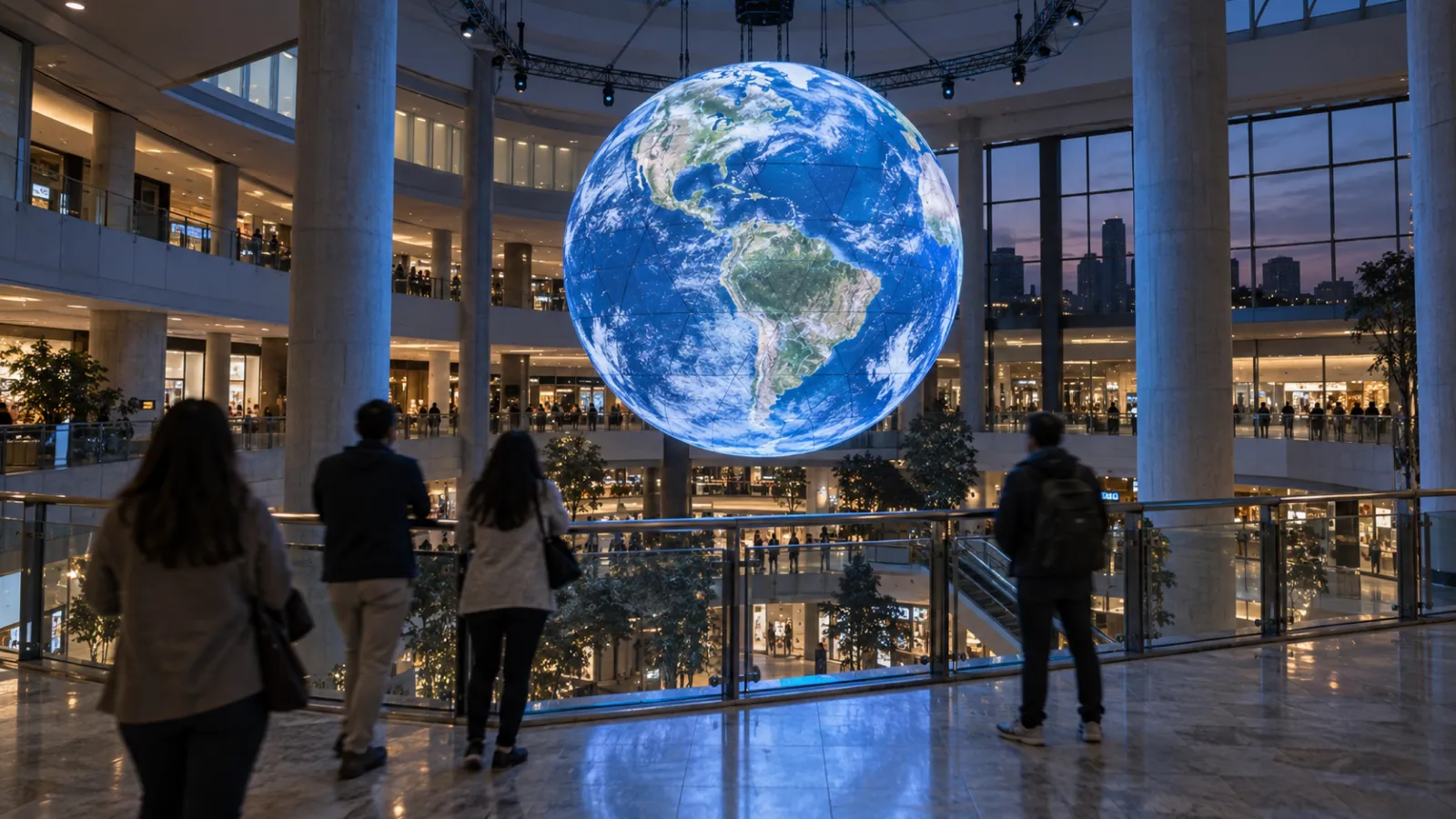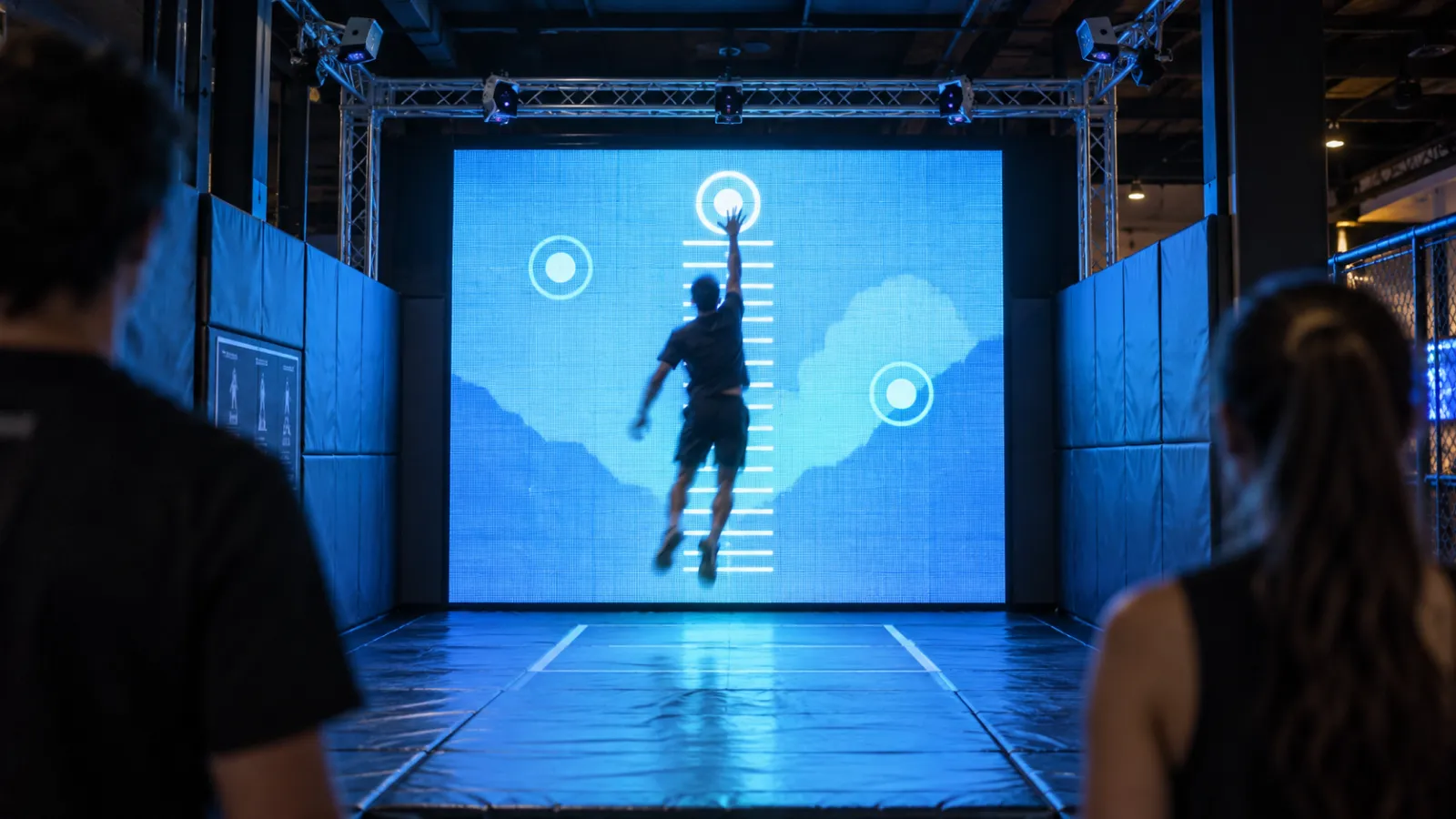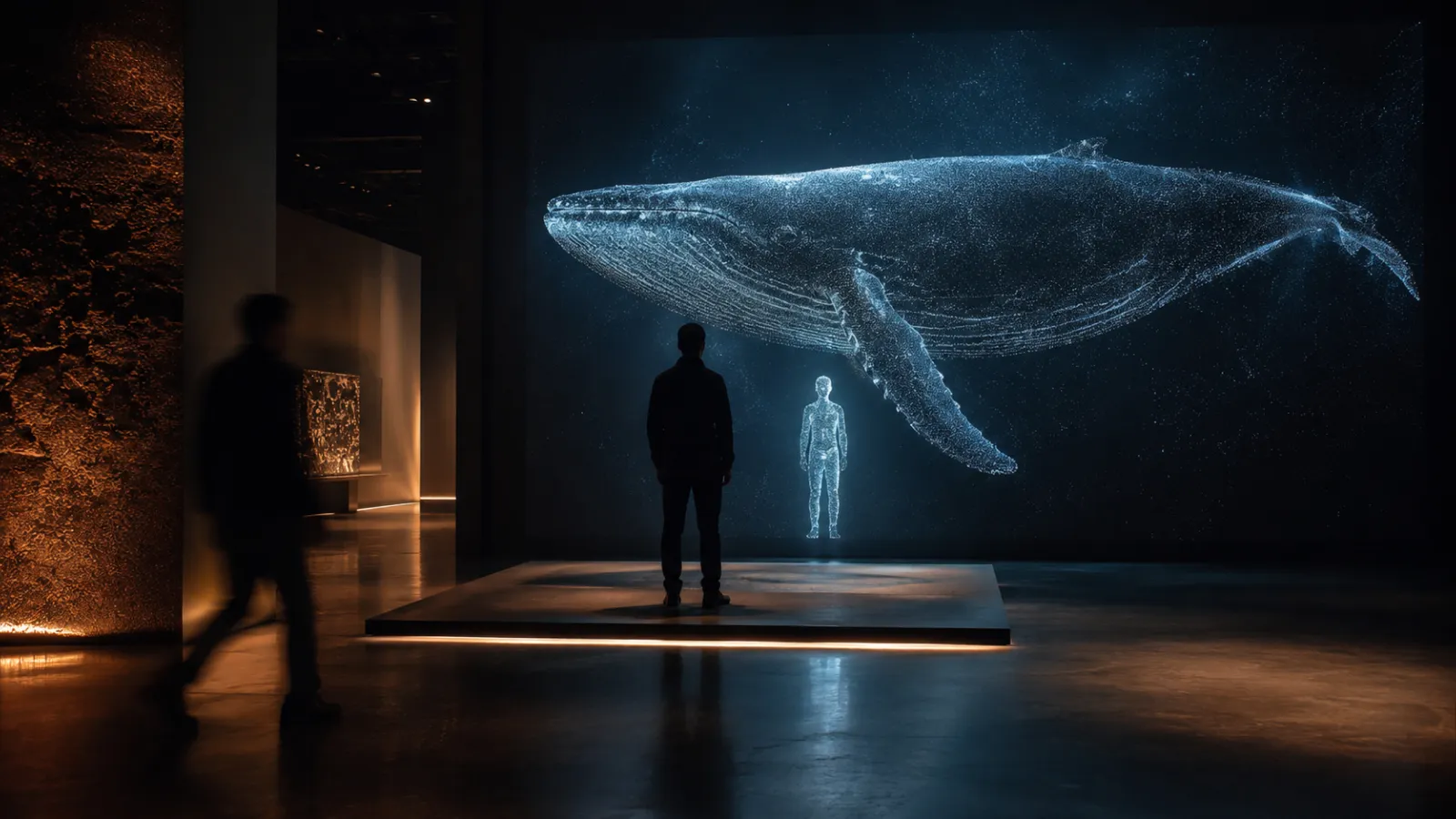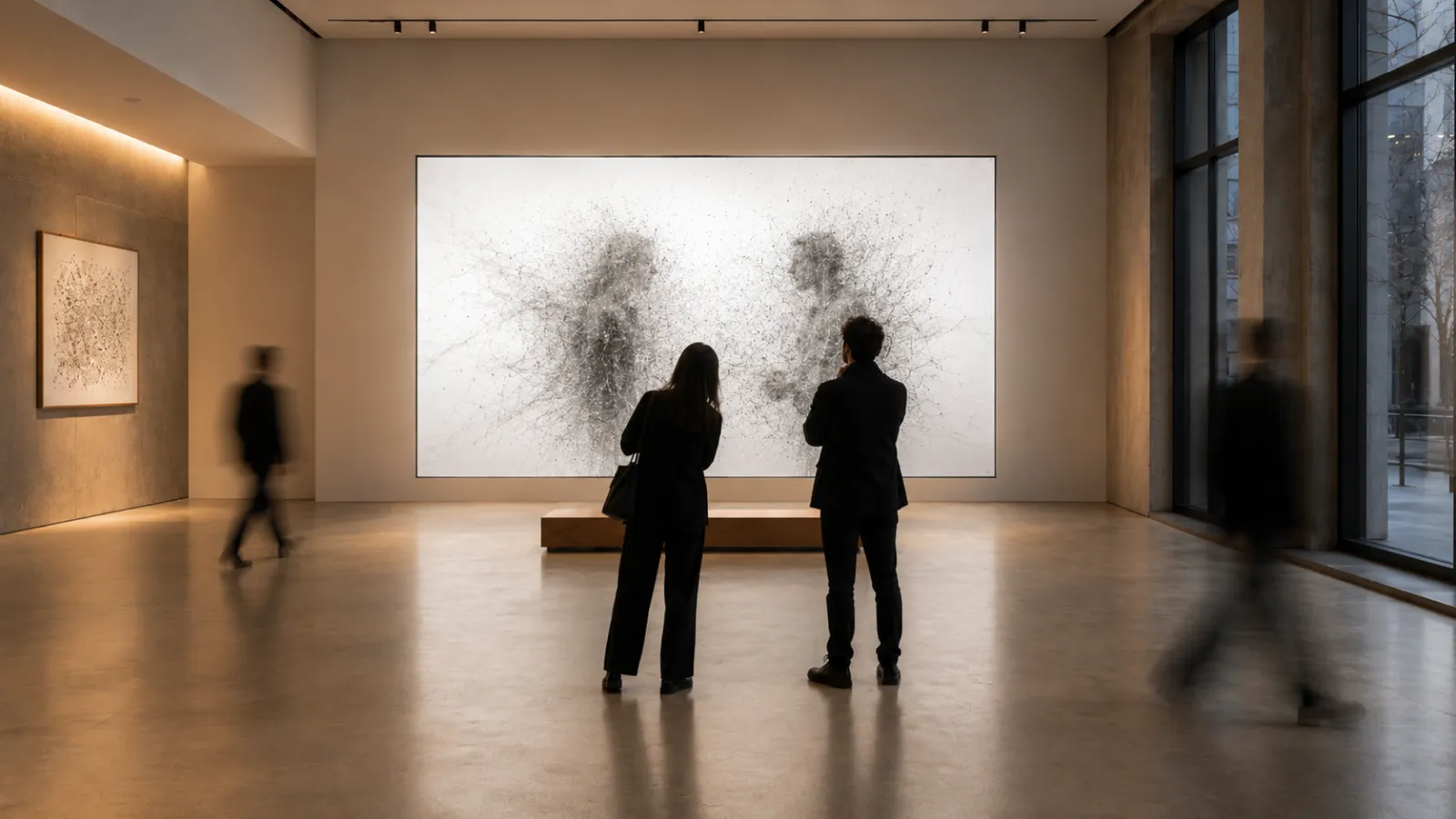
We build interactive installations for a living. We also turn briefs away. When a foundation is naming a memorial garden, when a hotel is filling a presidential suite, when a museum is deepening its permanent collection — sometimes the right answer is a painter, a sculptor, or a muralist, not a tech studio. Not because interactive is inferior, but because it's the wrong medium for that brief. This guide is the case for hiring a permanent art commission instead of an interactive installation — and the honest counter on when interactive is the better call. We're going to argue ourselves out of work. That's the point.
Who this is for: Museum directors, gallery curators, foundation boards, cultural-institution trustees, hotel art advisors, corporate art programs, and architects briefing permanent commissions for cultural and luxury spaces.
Key Takeaways
- An oil painting or bronze can outlive your institution. An interactive installation outlives one hardware cycle — typically 5–10 years before significant refresh costs hit.
- A $150K painting commission costs roughly $10K–$25K in conservation over 30 years. A $150K interactive installation costs $200K–$500K+ over the same span (refresh, software porting, sensor replacement).
- For 7 brief types — memorials, donor walls, blue-chip lobbies, heritage buildings, luxury suites, permanent collections, outdoor monuments — a permanent art commission is almost always the right call.
- For 6 brief types — temporary exhibits, brand activations, learning labs, data capture, sponsor-driven work, narrative spaces — interactive earns its premium.
- Provenance and resale value asymmetrically favor traditional commissions. There is no Sotheby's secondary market for a 2018 Kinect-based installation.
- The contrarian move for cultural institutions in 2026 is not to default to either medium. It's to brief by use case and decade.
1. Two Categories, Two Contracts
The decision is not "art vs tech." It's "asset vs experience" — two different kinds of contract, with different lifespans, different vendors, different insurance treatment, and different outcomes for your audience.
1-1. What a Permanent Art Commission Actually Is
A permanent art commission is a singular work, made by an artist (or studio bearing the artist's name and mark), in a traditional medium: oil or acrylic on canvas, bronze, marble, mural fresco, mosaic, ceramic, blown glass, woven textile, hand-cut paper, photogravure print. The work is delivered, installed, and from that moment forward exists as an asset on your books. It is insured under fine-art riders. It can be loaned, accessioned, deaccessioned, conserved, and — eventually — resold or gifted.
Commission fees vary by tier. For an emerging artist, $5K–$30K. For mid-career, $30K–$200K. For established, $200K–$2M. For blue-chip names, $2M–$50M+. Material costs (foundry casting, framing, installation rigging) sit on top.
1-2. What an Interactive Installation Actually Is
An interactive installation is a system: displays or projectors, sensors (touch, depth, lidar, RFID, computer vision), compute hardware, custom software, content authored against that software, and a service relationship with the studio that built it. It is more like commissioning a small custom product than commissioning a painting. It exists in time as much as in space — it runs, updates, breaks, gets patched, and eventually needs to be ported or replaced.
For a deeper breakdown of what these projects cost end-to-end, see our interactive installation cost guide. For how to brief one, see how to brief an interactive installation studio.
1-3. Quick Comparison
| Dimension | Permanent Art Commission | Interactive Installation |
|---|---|---|
| What you buy | A singular object | A running system |
| Typical lifespan | 50–300+ years | 5–10 years (hardware) / 3–7 years (software) |
| Vendor relationship | Artist + conservator (decades) | Studio + service contract (years) |
| Insurance | Standard fine-art rider | Custom electronics + IP coverage |
| Audience mode | Contemplation | Engagement |
| Data capture | None | Granular (per visitor, per choice) |
| Resale value | Established secondary market | Almost none |
| Provenance | Clear chain (CoA, signed) | Complicated (code, hardware, IP) |
| Failure mode | Conservation (slow, scheduled) | Outage (sudden, embarrassing) |
| Initial fee range | $5K–$50M+ | $40K–$2M+ |
2. The Lifespan Asymmetry Nobody Quotes
This is the number that vendors selling interactive don't put on their decks. It is the single most important fact in the comparison.
2-1. Traditional Lifespans
- Oil paintings: 100–500+ years with periodic conservation. Major museum collections routinely show works from the 15th–17th centuries.
- Bronze sculpture: 1,000+ years outdoors. Roman bronzes survive after two millennia. The Cloud Gate ("The Bean") in Chicago will still be there long after the websites announcing it are gone.
- Mosaic and marble: 2,000+ years. Ravenna's 6th-century mosaics still pull tourists.
- Mural fresco: 500+ years with proper substrate and conservation.
- Hand-cut woodblock prints, photogravure, ceramic: 200+ years easily.
These media are boringly stable. They don't need a power outlet, a software update, a CMS, a network, a vendor on retainer, or a developer who still remembers the codebase.
2-2. Interactive Installation Lifespans
Commercial-grade interactive installations have two clocks running at once:
- Hardware clock: 5–10 years. Commercial displays (60K–80K hour panels), depth cameras, projectors, touch foils, edge compute boxes. After this window, parts go end-of-life and replacements cost as much as the original.
- Software clock: 3–7 years. This is the one that bites. Operating systems deprecate, drivers stop being maintained, third-party libraries go out of support, framework versions break compatibility. Microsoft killed the Kinect SDK in 2017 and a generation of Kinect-based installations effectively died with it. WebGL features get deprecated. Custom shaders break on new GPU drivers. The studio that built it may no longer exist, or may charge enterprise rates for a port.
2-3. "Permanent Installation" Is a Marketing Word, Not a Contract
When a vendor says "permanent installation," what they almost always mean is "we're not designing for a 6-month run." It does not mean the work will last for the institutional life of the building. Read your service contract carefully: it likely covers 1–3 years of support and explicitly excludes hardware refresh and software porting.
The question to ask any interactive vendor is not "is this permanent?" It's: "What does year 11 look like, and who pays for it?"
3. The 30-Year TCO Math
Let's price it out. We'll compare a $150K commission tier — a realistic mid-career painting commission against a mid-range interactive installation.
3-1. Painting Commission TCO Over 30 Years
| Cost | Year 0 | Years 1–30 | Total |
|---|---|---|---|
| Commission fee | $150K | — | $150K |
| Framing, installation, lighting | $5K–$15K | — | $5K–$15K |
| Conservation (1 minor intervention every 20 years) | — | $2K–$8K | $2K–$8K |
| Annual insurance (fine-art rider, ~0.1–0.3% of value) | — | $4.5K–$13.5K | $4.5K–$13.5K |
| Climate / lighting upgrades | — | $1K–$5K | $1K–$5K |
| 30-year total | ~$162K–$192K |
The painting appreciates in many cases. A mid-career artist who is later collected by major institutions can take a $150K commission to $400K–$1M+ on the secondary market within a decade. This is not guaranteed, but it is a possibility that interactive simply does not offer.
3-2. Interactive Installation TCO Over 30 Years
| Cost | Year 0 | Years 1–30 | Total |
|---|---|---|---|
| Build (design, software, hardware) | $150K | — | $150K |
| Year 1–3 service contract | $15K–$30K | — | $15K–$30K |
| Annual maintenance / support (Years 4+) | — | $90K–$180K | $90K–$180K |
| Hardware refresh (Years 7, 14, 21, 28) | — | $200K–$400K | $200K–$400K |
| Software porting / re-platform (Years 7, 14, 21) | — | $90K–$240K | $90K–$240K |
| Content refresh (every 2–3 years to stay relevant) | — | $50K–$150K | $50K–$150K |
| Insurance (electronics + IP coverage) | — | $15K–$30K | $15K–$30K |
| 30-year total | ~$610K–$1.18M |
The asset depreciates to zero. By year 30, the installation has either been replaced multiple times (in which case "permanent" is a fiction) or it's a dark wall. There is no resale market. The IP, the source code, and the content might still belong to the studio, not to you.
3-3. Side-by-Side at Three Tiers
| Commission tier | Painting 30-yr TCO | Installation 30-yr TCO | Painting savings |
|---|---|---|---|
| $50K | ~$60K–$75K | ~$280K–$520K | $220K–$445K |
| $150K | ~$162K–$192K | ~$610K–$1.18M | $450K–$988K |
| $500K | ~$540K–$620K | ~$1.8M–$3.5M | $1.26M–$2.88M |
These are not cherry-picked. They are derived from public conservation rate cards, commercial display lifecycle data, and standard service-contract pricing in the museum installation industry.
3-4. Where the Lines Cross (and Where They Never Do)
There is one scenario where the math flips toward interactive: when the engagement and data the installation generates have an annual revenue impact greater than its annual cost. A retail flagship that converts dwell time into sales, or a sponsor-funded museum lab that pays its own freight, can rationally absorb the lifecycle cost. For pure asset thinking — collection, lobby, memorial — the lines never cross.
For a deeper TCO breakdown, see our interactive installation cost guide.
4. Where a Painter Beats a Studio (7 Brief Types)
This is the contrarian section. These are the briefs where, if you put us in the room, we will recommend you hire a traditional artist instead.
4-1. Memorials and Sacred Space
The 9/11 Memorial does not flicker. It does not have a "tech support" page. The names are carved into bronze parapets. The team reviewed dozens of interactive proposals during planning and chose the medium they did very deliberately: stillness, weight, permanence, and zero failure modes.
A memorial that crashes is worse than no memorial at all. A meditation room with a touchscreen breaks the contract with the visitor. Sacred and commemorative space asks for stillness over stimulus, and a painter, sculptor, or stone-carver delivers that natively.
4-2. Donor Walls and Named-Gift Acknowledgements
A donor who has just given $5M to your foundation does not want their name displayed on a screen that might be a pixel-sub-pixel issue away from "TEMPORARILY UNAVAILABLE" three years later. They want their name in bronze, brass, etched glass, or carved stone, where it will be when their grandchildren visit. Permanence is the gratitude.
The interactive donor wall has been tried and re-tried for 20 years. The ones that endure are hybrid: a permanent etched substrate for the names, with an optional adjacent digital layer for stories. Lead with the permanent layer.
4-3. Blue-Chip Lobbies and Boardrooms
A fund manager, a luxury hotel group, a law firm — these audiences read art as a status signal. The signal is provenance: a named artist with a market, a CoA, an auction record. An interactive installation, no matter how technically impressive, does not yet read as a peer to a Wool, a Bradford, an Anatsui, a Murakami in the same room.
This is a market reality, not a value judgment. If the brief is "make this lobby feel like the firm has $20B AUM," buy the painting.
For the private/collector angle on this, see our collecting interactive art for private spaces guide.
4-4. Heritage Buildings with Conservation Constraints
If the building is listed, protected, or registered with a heritage body, you may not be allowed to drill into the substrate, run new power, cut a network drop, or alter the lighting without committee approval. Interactive installations need all of these. A commissioned painting needs a hook and a picture light.
This is also true in religious spaces, historic government buildings, and listed hotels. The path of least friction is the medium that doesn't need infrastructure.
4-5. Luxury Suites and Private Quarters
A presidential suite, a private dining room, a residential gallery wall — these spaces ask for contemplation, not engagement. The guest is not there to interact with art. They are there to live near it. A touch wall in a presidential suite is a gimmick. A commissioned painting or photograph is an experience the guest absorbs without effort.
The same logic applies to CEO offices, private collections, and high-end residential buildouts. Quiet wins.
4-6. Permanent Collection Acquisitions
If the work is going into your accessioned permanent collection — the one your registrar tracks, your conservator inspects annually, your loan program circulates — you are buying for the canon, not the campaign. Permanent collection means it has to fit the conservator's mental model, the registrar's database, and the curator's program for the next century.
Interactive installations can be accessioned (the Whitney, MoMA, and Tate have all done it), but the conservation and re-installation overhead is high enough that most institutions reserve those slots for landmark works by recognized digital artists, not vendor-built experiences.
4-7. Outdoor Monuments
Bronze beats Wi-Fi every time. Outdoor sculpture has been the right answer for 4,000 years. Weather, vandals, lightning, salt air, freeze-thaw cycles — bronze and stone shrug. Electronics do not. Even projection mapping outdoors has a 5-year practical lifespan and requires constant lens cleaning, recalibration, and ambient-light management.
If the brief is "a permanent landmark in this plaza," the answer is almost always traditional sculpture.
5. Where a Studio Beats a Painter (Honest Counter)
Now the counter. These are the briefs where we'll happily quote, and where interactive is genuinely the better tool. The honest counter is what makes the contrarian piece useful — without it, this is just a sermon.
5-1. Temporary Exhibits (3–18 Months)
If the show is temporary, the lifespan asymmetry vanishes. A 6-month touring exhibit doesn't care that the hardware will be obsolete in 8 years. Within the run, interactive delivers higher dwell, better recall, and shareable moments — all the things that drive a successful temporary show.
This is the natural home of interactive. For museum exhibit ROI specifically, see our interactive museum installations guide.
5-2. Brand Activations and Pop-Ups
A pop-up that runs for 4 weeks needs to generate impressions, social shares, and lead capture. A painting can't do any of those things. Interactive can do all three. The medium fits the brief.
5-3. Education and Museum Learning Labs
Learning labs need adaptive content, multi-user input, branching paths, and feedback loops — all things a static work cannot provide. A children's museum that wants to teach the water cycle needs a touch table, not a watercolor.
5-4. Visitor Data Capture and Personalization
If the institution needs to know who its visitors are, what they explore, where they pause, and what they share — the only medium that captures this is interactive. The 9/11 Memorial doesn't need this data. A donor-funded science center absolutely does.
5-5. Sponsor-Driven, Measurable ROI Work
If a sponsor is paying for the installation and wants quarterly engagement reports, interactive is the only medium that produces the numbers. A painter cannot file a campaign report. A studio can.
5-6. Story-Led Narrative Spaces
Some stories only work at scale, in motion, with sound, across a room. The story of a city's water supply, a brand's heritage, a wildlife corridor under threat — these are interactive briefs. They need movement, multi-modal sensing, and immersion that no single canvas delivers.
For the broader case on when experience itself is the product, see our experience economy guide.
6. The Hybrid Brief: Permanent Anchor + Interactive Layer
The most successful cultural-institution projects we've seen in the last five years are not "all interactive" or "all permanent." They are hybrid: a permanent anchor work commissioned from a traditional artist, with an interactive layer that activates on opening night, on tour days, or during programmed events.
6-1. Examples in the Wild
- A commissioned mural with an optional projection-mapped opening-week activation, then it lives as a static mural for the next 50 years.
- A bronze sculpture in a plaza, with a sensor-activated soundscape that engages at dusk only.
- A donor wall in etched glass with an adjacent touchscreen that loads each donor's story when their name is touched. The names persist; the screen can be replaced every decade.
- An interactive media wall opening into a permanent gallery of commissioned works on canvas. The interactive draws the crowd; the canvases hold them.
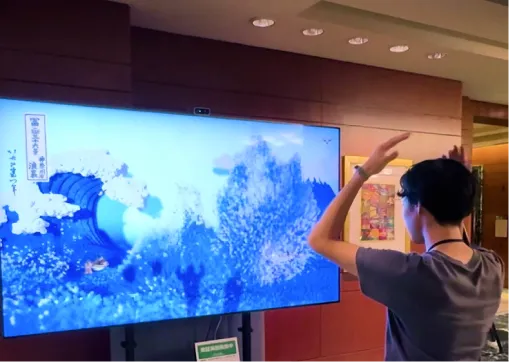
Our own Hokusai interactive installation case study is exactly this pattern: a permanent artistic legacy (Hokusai's Great Wave) reactivated through an interactive layer that institutions can rent or commission for runs.
6-2. Budget Split Heuristic
For hybrid briefs in cultural institutions, a useful rule of thumb:
| Brief weight | Permanent anchor | Interactive layer |
|---|---|---|
| Collection-led | 70–85% | 15–30% |
| Exhibit-led | 30–50% | 50–70% |
| Activation-led | 10–25% | 75–90% |
6-3. When "Hybrid" Is Two Budgets Pretending to Be One
The failure mode of hybrid is when neither side gets enough money. A $100K hybrid budget will buy you a mediocre painting and a mediocre interactive layer, and both will disappoint. The threshold for hybrid is roughly $300K combined — below that, pick one medium and execute it well.
7. Decision Framework: Brief-Type Decision Matrix
Use this matrix to triangulate before you write the RFP. The recommendations below are defaults, not laws — but they are what we'd recommend if the brief landed on our desk.
| Brief type | Default recommendation |
|---|---|
| Memorial / commemorative space | Painter / sculptor |
| Donor wall / named gift | Painter / sculptor (etched, cast, or carved) |
| Blue-chip lobby (status signal) | Painter / sculptor |
| Heritage building (constraints) | Painter / sculptor |
| Luxury suite / private quarters | Painter / sculptor |
| Permanent collection acquisition | Painter / sculptor (or named digital artist) |
| Outdoor monument | Painter / sculptor |
| Temporary exhibit (3–18 mo) | Studio (interactive) |
| Brand activation / pop-up | Studio (interactive) |
| Children's / learning lab | Studio (interactive) |
| Visitor data capture | Studio (interactive) |
| Sponsor-driven measurable | Studio (interactive) |
| Hybrid: collection + activation | Hybrid (anchor + layer) |
Five questions to ask before issuing the RFP:
- What does year 11 look like for this work, and who pays for it?
- Does this brief need engagement, or contemplation?
- Does the audience expect to interact, or to absorb?
- Is there a measurable revenue or grant report that depends on visitor data?
- If the building owns this for 50 years, what medium will still be working in year 50?
If the honest answers to 2, 3, and 5 point at "stillness / contemplation / still working," brief a painter. If 1 and 4 point at "we have a budget for refresh and we need data," brief a studio.
8. How to Brief a Painter (vs How to Brief a Studio)
Briefing a permanent commission is a different document than briefing an interactive studio. If you've only ever written one of the two, here's the shape of the other.
We have a separate, deep guide on how to brief an interactive installation studio — if interactive is the right call, start there.
For a painter or sculptor commission, the brief is shorter but more demanding on intent. It should cover:
- Medium and scale. Oil on linen 60×80", bronze cast 1.8m height, mosaic 4m × 2m wall section.
- Site and lighting. Wall, plinth, niche, plaza. Available picture light, ambient lux, direct sun exposure.
- Subject and intent. What the work is about. What it must not be about. Reference works (with respect to the artist's own practice).
- Conservation plan. Who will care for the work, on what schedule, with what budget.
- Framing, mounting, installation logistics. Including riggers, insurance during transit, climate during installation.
- Deed of gift / contract terms. Including reproduction rights, exhibition rights, loan rights, deaccession rules.
- Timeline. Most commissions take 4–18 months from contract to delivery for mid-career artists; longer for established artists with waitlists.
- Studio visit. Almost always essential. The brief is a starting point, not a specification.
The short version: a painter brief is a contract with an artist about intent. A studio brief is a contract with a system about behavior. Don't confuse them.
9. Common Mistakes
9-1. Buying Tech Because the Donor Wants "Innovation"
A donor who insists on "innovation" usually means "make this feel current." That can be answered with a contemporary painter, a mid-career sculptor working in unconventional materials, or a hybrid layer — not necessarily with a touch wall. Push back on the medium assumption before committing the budget.
9-2. Buying a Painting Because "It's Cheaper"
It is not cheaper if the brief is a learning lab, a brand activation, or a sponsor-driven space. A $40K mural in a children's discovery center will under-deliver against a $40K interactive installation in the same space. Cheap-on-day-one is not the same as cheap-on-day-three-thousand.
9-3. Mistaking Interactivity for Engagement
A touchscreen is not an experience. A motion sensor is not an experience. The medium does not produce engagement; the design does. Many interactive installations under-deliver because the team confused the technology budget with the experience-design budget.
9-4. Mistaking Permanence for Relevance
A 30-year-old commissioned painting can feel utterly current if the artist is still recognized by the next generation of curators. A 30-year-old interactive installation almost always feels embarrassingly dated within 7 years. Permanence is not the same as relevance — but for the right artist, the painting outpaces the technology.
9-5. Letting the Vendor Define "Permanent"
If a vendor says "permanent installation," ask: "What does year 11 look like, who pays for the refresh, and what's the porting cost?" If they don't have a written answer, the work is not permanent. It's a fixed-term experience that will end on a date the vendor hasn't told you yet.
For a related comparison on screens vs experiences, see our digital signage vs interactive installations guide.
10. About Utsubo
Utsubo is a creative studio specializing in interactive installations and immersive web experiences, based in Osaka with clients across Japan, the US, and Europe. We build sensor-driven, real-time 3D experiences for museums, retail brands, hotels, corporate spaces, and cultural institutions.
We also keep a network of traditional artist partners — painters, sculptors, muralists, ceramicists, foundry studios — and we route briefs to them when that's the right call. Our goal is the right medium for the brief, not the most expensive option in our stack. If that means we don't bill the project, we don't bill the project. That's a long-term play, and it's the only way to be a trusted advisor to a cultural institution rather than a vendor.
11. Ready to Decide?
If you're standing in front of a brief and you don't know whether you need a painter or a studio, we'll talk through it with you for free. We will tell you which way we'd lean and why — even if the answer is "hire someone else."
Book a 30-minute project discussion
Decision Checklist
- Defined the brief's primary intent: contemplation, engagement, or hybrid
- Mapped the brief against the decision matrix in Section 7
- Asked: "What does year 11 look like, and who pays for it?"
- Calculated 30-year TCO for both medium options at the same headline budget
- Identified the conservation plan (or service contract) before signing
- Determined whether the work will be accessioned, insured, and loaned
- Confirmed the building's constraints (heritage, power, network, climate)
- Decided who owns the IP, the source code, and the content (interactive only)
- Briefed the right kind of vendor for the medium chosen
FAQs
Is an interactive installation considered "fine art"?
Yes — increasingly so. Major institutions including MoMA, the Whitney, Tate, and the Centre Pompidou have accessioned interactive and software-based works into permanent collections. However, the conservation and re-installation overhead is significantly higher than for traditional media, and most institutions reserve these slots for landmark works by recognized digital artists rather than vendor-built experiences. For a permanent collection acquisition, the bar is the artist's standing in the field, not the technical novelty of the work.
Will a digital installation still work in 20 years?
Honestly? Probably not in its original form. Hardware will need to be replaced at least twice (every 7–10 years), and the software will need to be ported at least once and likely twice (every 7 years on average). The cost of those refreshes typically exceeds the original build cost over a 20-year window. If you need a work to "still be there" in 20 years with no further investment, choose a traditional medium.
Can I get a painting commission for the same budget as a 65" touch wall?
Yes, easily. A 65" commercial-grade interactive touchpoint with custom software typically lands in the $40K–$80K range. A commission from an emerging or early mid-career painter for a 60×80" oil work usually lands in the $15K–$50K range, and you also get an asset that may appreciate. The interactive will likely depreciate to zero within 10 years; the painting will likely hold or grow in value.
How do insurance and provenance differ between the two?
Traditional fine art is insured under standard fine-art riders (~0.1–0.3% of value annually), with mature actuarial tables and clear chain-of-custody documentation (CoA, gallery records, auction history). Interactive installations require custom electronics + IP coverage, which is harder to underwrite, and provenance is split across hardware, source code, content, and the studio's IP rights — making the chain of custody much harder to prove or transfer. If the work changes ownership or location, the interactive is significantly more complicated to move.
What about NFTs and blockchain provenance?
NFT provenance is real for the token, but it doesn't solve the underlying problem: the interactive system itself (hardware, software, content) still ages out on the same 5–10 year cycles. The blockchain proves you own a record; it doesn't keep your sensors driver-compatible. NFTs are most useful for born-digital works that exist as files (images, videos, generative outputs), not for physical interactive installations.
Can a painter and an interactive studio collaborate?
Yes, and these are some of the strongest projects in the field. A typical collaboration looks like a permanent commissioned anchor (painting, sculpture, mural) with an interactive layer that activates on opening week, during programmed events, or through visitor input — while the anchor work persists for the lifetime of the building. Budget split varies, but for cultural institutions a useful default is 60–80% to the anchor and 20–40% to the interactive layer. Below a combined budget of about $300K, hybrid is usually a mistake — pick one medium.
How do I know which my brief actually needs?
Apply the five questions in Section 7. If your honest answers point at contemplation, year-50 stability, and no data requirement, brief a painter. If they point at engagement, measurability, and a willingness to budget for refresh, brief a studio. If they point at both, you're looking at hybrid — and you need a combined budget large enough to do both well.
What's the resale value of an interactive installation?
Almost none, with rare exceptions for landmark works by recognized digital artists at major auction houses. The secondary market for vendor-built interactive installations is essentially zero. By contrast, a commissioned work by a mid-career painter or sculptor has an active secondary market and may appreciate. This is the single largest financial asymmetry between the two media, and it should be priced into any decision where the work might one day be deaccessioned.
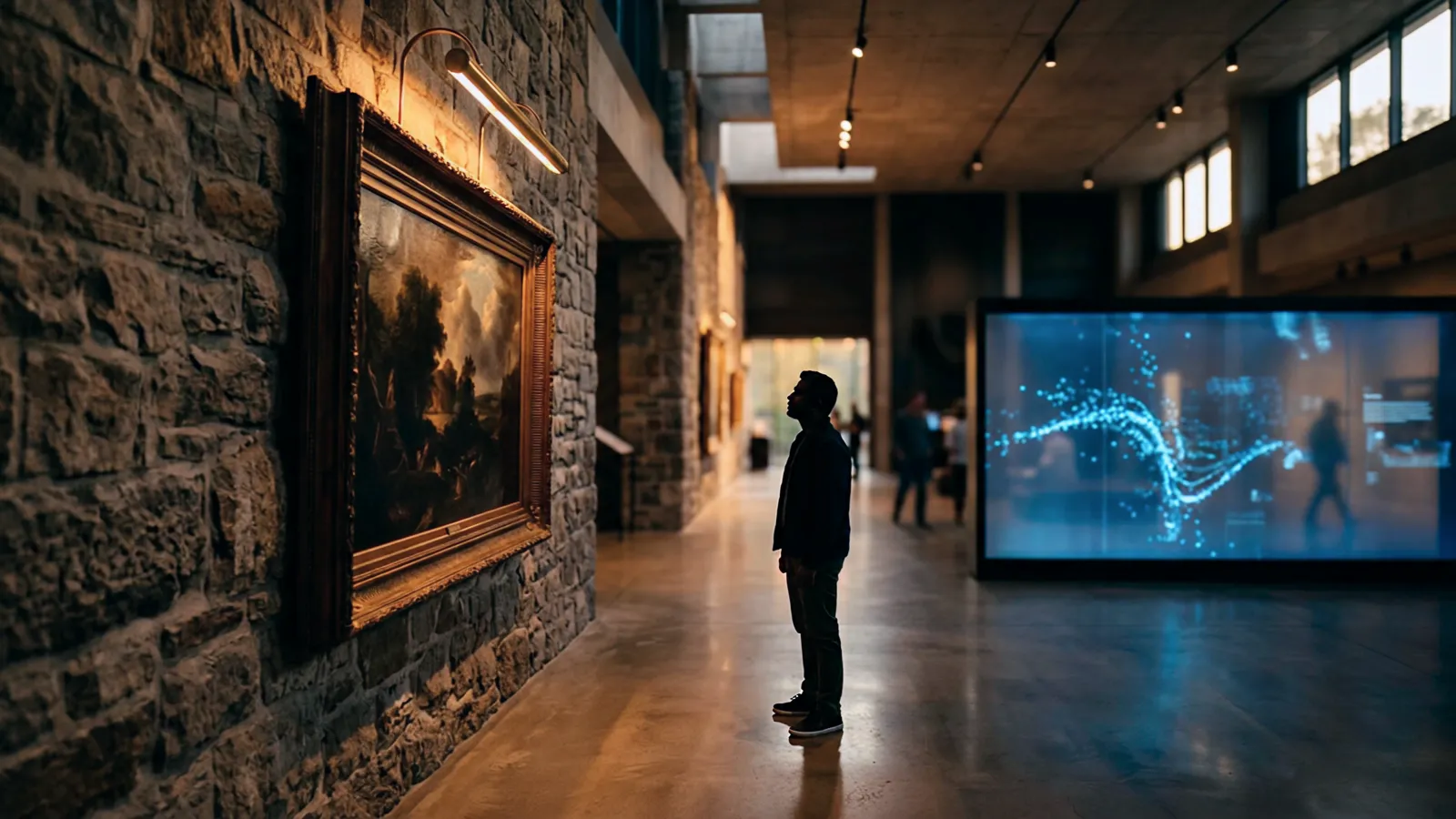
Hero image prompt: A museum gallery interior at golden hour. Foreground: a large framed oil painting on a textured stone wall, lit by a brass picture light, warm tungsten glow, rich shadows. In the soft-focus middle distance: an interactive touch wall glowing cool blue with faint particle trails, slightly out of focus. A single visitor in silhouette stands between them, facing the painting. Polished concrete floor, high ceilings, architectural museum interior. High-end editorial photography, cinematic depth of field, photorealistic. --width 1600 --height 900


 Interactive Installations for Museums