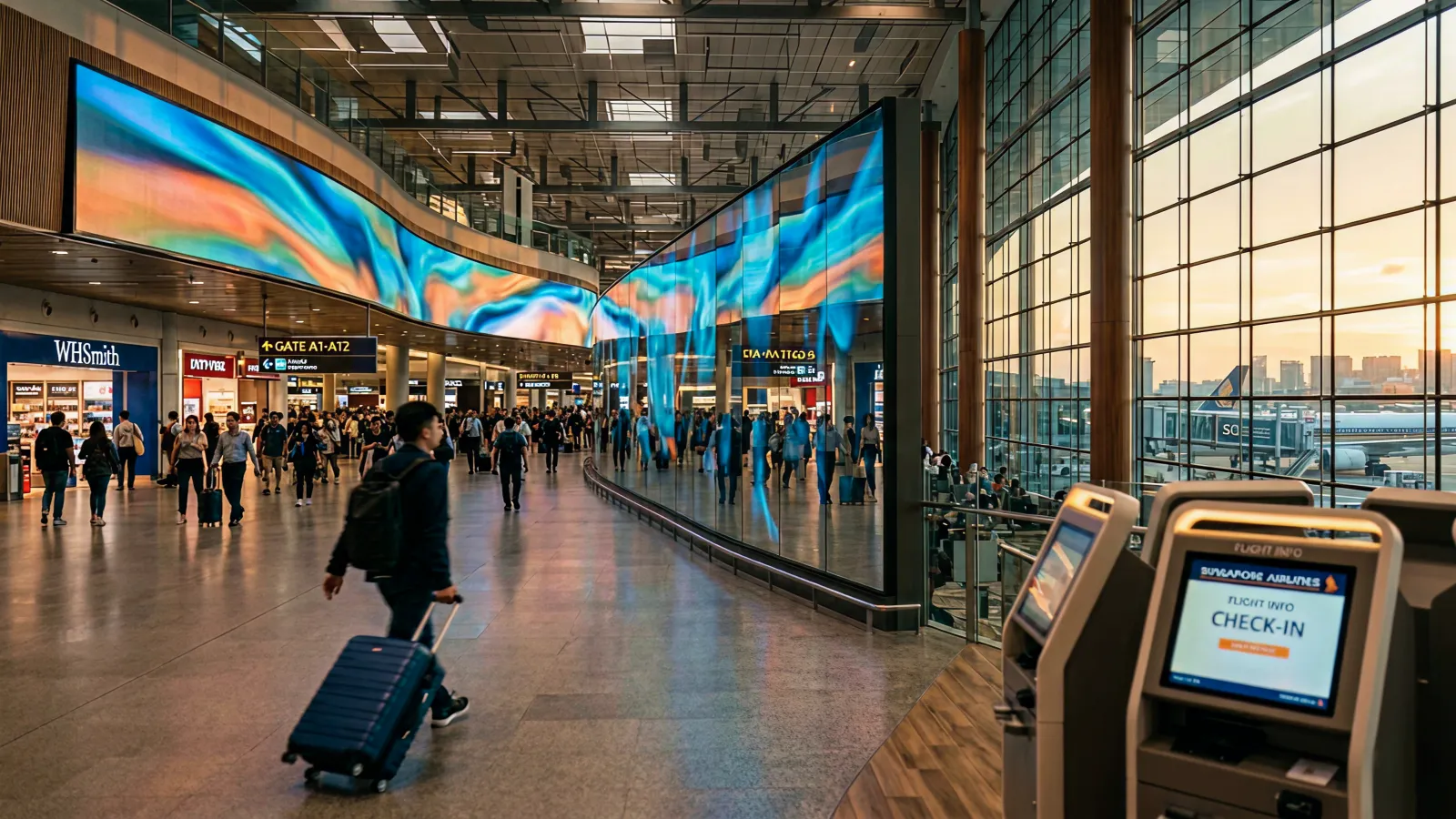
Airports and transit hubs are the hardest interactive installation environment on the planet. Try to imagine another venue that runs 24/7/365 with no maintenance windows, moves 50–100 million people a year, must clear security and fire authorities, and locks vendors into 5–10 year operational contracts before the first screen ships.
That brutal operating envelope is exactly why the projects that do land here become flagship references — and why the procurement cycle takes 12 to 36 months. This guide is for the people on the buyer side of that table: airport authority procurement leads, transit passenger experience directors, and brand activation teams chasing concession-zone slots in the world's busiest terminals.
Who this is for: Airport authority procurement and capital projects teams, transit agency passenger experience directors, station modernization leads, terminal concession and brand activation directors, and the vendor selection committees that sit between them.
Key Takeaways
- Permanent airport and transit installations cluster in three budget tiers: $200K–$500K (pilot), $500K–$2M (standard permanent), and $2M–$5M+ (flagship) — with maintenance contracts adding 15–25% per year for the next 5–10 years.
- Procurement cycles run 12–36 months from RFP issue to first kilowatt — far longer than any retail, museum, or stadium installation.
- The dominant vendor for transport-hub experiential media is Moment Factory, which delivered Singapore Changi Terminal 2's Wonderfall and Dreamscape (2023) and Seoul Incheon Terminal 2's 16K megacanvas (2024).
- The field is still emerging: most major airports (LAX, JFK, LHR, DXB, HKG, AMS, Haneda, Narita) do not yet operate permanent interactive installations, even as the ADA Title II web-accessibility rule (WCAG 2.1 AA, now due April 2027 or 2028) reshapes accessibility requirements.
- 24/7/365 operation forces commercial-grade hardware, redundant power and network, low-smoke zero-halogen cabling, and MTBF targets above 50,000 hours — none of which apply in shorter-cycle venues.
- The real strategic asset isn't the screen — it's the long-term operating contract that ties content, telemetry, and refresh cycles to the same vendor for the lifetime of the terminal.
1. Why Airports & Transit Hubs Are Different
1-1. The 24/7/365 reliability bar
Most interactive installations get a maintenance window. Museums close at 6 PM. Retail flagships shutter at midnight. Stadiums dim between events. Airports and major transit hubs don't. A 4 AM red-eye terminal is just as live as a 6 PM rush hour, and a single dark screen on the front page of a passenger's social feed becomes a brand story the airport will remember.
That changes every component decision. Consumer-grade displays that quote 30,000-hour MTBF look fine on a museum spec sheet but burn out inside three years of continuous operation. LED panels chosen for retail brightness curves bake their own backplane in a sun-facing terminal. Sensors that tolerate a museum's 21°C ambient drift and fail at the 12°C-to-32°C swing of a curbside arrivals hall in summer.
Every spec on an airport project is set by the worst day, not the average day. That's why LED has 40–60% lower 5-year TCO than alternatives in this environment — and why most installations that look similar to a shopping-mall activation cost 3–5x more.
1-2. Footfall scale
Singapore Changi handles 65+ million passengers per year. Dubai DXB tops 87 million. Tokyo Haneda 85 million. Even mid-tier hubs like Amsterdam Schiphol or Seoul Incheon move 60–70 million people through gates, walkways, and concession zones every twelve months.
That's a different design problem from any other venue. A museum installation is engineered for a single attentive viewer. A retail activation is built for someone walking past with shopping bags. An airport installation has to work for: the rushing connection passenger who has 4 minutes, the layover family who has 4 hours, the elderly traveller who needs accessible interaction, the duty-free shopper, the meeter-and-greeter at arrivals, and the airport employee passing it for the 4,000th time. Most of them don't speak the local language. None of them came to see the installation.
This is the experience economy in its hardest form: every interaction has to deliver in seconds, in dozens of languages, across every demographic segment simultaneously.
1-3. Security, fire, and compliance constraints
Public-space installations in transportation venues clear regulatory bars no other vertical sees:
- Fire and life-safety: low-smoke zero-halogen (LSZH) cabling, fire-rated enclosures, cable management that doesn't compromise sprinkler coverage or smoke curtains
- Security: every powered device near a sterile area is a security review. Cameras and depth sensors trigger additional scrutiny. Network segregation from operational systems is non-negotiable
- Accessibility: the U.S. Department of Justice's ADA Title II rule (WCAG 2.1 AA for web content and apps by April 26, 2027 for entities of 50,000+ people and April 26, 2028 for smaller entities and special districts, including transit agencies and many airport authorities) makes WCAG 2.1 AA the benchmark for digital touchpoints; kiosks have no separate standard but fall under Title II's effective-communication duty
- Aviation/transport authority approval: in the U.S., FAA review for anything in airfield-adjacent zones; in Japan, MLIT approval; in the EU, EASA-aligned national regulators
- Procurement law: state and local agencies often run public RFP processes with mandatory comment periods, vendor protest windows, and minority-business participation thresholds
None of this exists in a museum brief. All of it exists in an airport brief. The vendors who can deliver in transportation venues are the ones who built compliance fluency before they built aesthetic ambition.
2. What Counts as an "Interactive Installation" in a Transit Hub
The category is broader here than in any other venue. In a museum, an interactive installation is a discrete exhibit. In an airport, it spans wayfinding, brand activation, art commission, and passenger amenity — sometimes all in the same physical zone.
2-1. Wayfinding and navigation
The functional baseline. Touch and touchless kiosks, dynamic flight information displays that respond to a passenger's boarding pass, and AR-overlaid floor or wall guidance for the high-volume connection corridors. The distinction from digital signage is whether the system responds to who is in front of it or just broadcasts a schedule.
2-2. Brand and sponsor activations
Concession-funded experiences in duty-free, lounges, and pre-security retail zones. These are typically sponsor-funded but airport-approved — the brand pays for the installation, but the airport authority controls placement, content review, and the operating contract. Average concession-zone activations run 12–36 months and align with the brand's flight or retail promotion calendar.
2-3. Permanent art commissions
The marquee category. Long-term digital art programs commissioned by the airport authority itself, often as part of a terminal expansion or renovation budget. Singapore Changi Terminal 2 (Wonderfall and Dreamscape, 2023) and Seoul Incheon Terminal 2 (the 16K curved megacanvas, 2024) are the two clearest current examples — both delivered by Moment Factory under multi-year programs with the respective airport groups. The MTA's Grand Central Madison digital art program at Grand Central Terminal in NYC (2024) is the rail-side equivalent, commissioning artists to populate five LED screens on a rotating two-minute schedule.
2-4. Passenger experience zones
The newest category. Quiet rooms, kids' play installations, layover meditation zones, and family interactive areas. These are usually low-traffic individual installations rather than central showpieces, but they drive hard KPIs: passenger satisfaction surveys, complaint reduction, and the willingness of premium travellers to choose the hub for layovers.
3. Real Projects: What Has Actually Shipped
A candid note before the list: the field is still emerging. Most of the world's largest airports don't yet have permanent interactive installations matching this brief. JFK's New Terminal One has digital art elements phasing in through 2026 but nothing fully delivered as of this writing. LAX's last major Moment Factory work was the Sepulveda Tunnel media experience, and most of LAX's recent interactive spend has gone into temporary art installations rather than permanent commissions. Heathrow, Dubai, Hong Kong, Amsterdam Schiphol, Tokyo Haneda, Tokyo Narita, and Shanghai Hongqiao do not currently operate publicly documented permanent interactive installations of the kind covered here.
That makes the projects that have shipped into reference architectures for the entire category.
3-1. Singapore Changi Airport — Terminal 2 (2023)
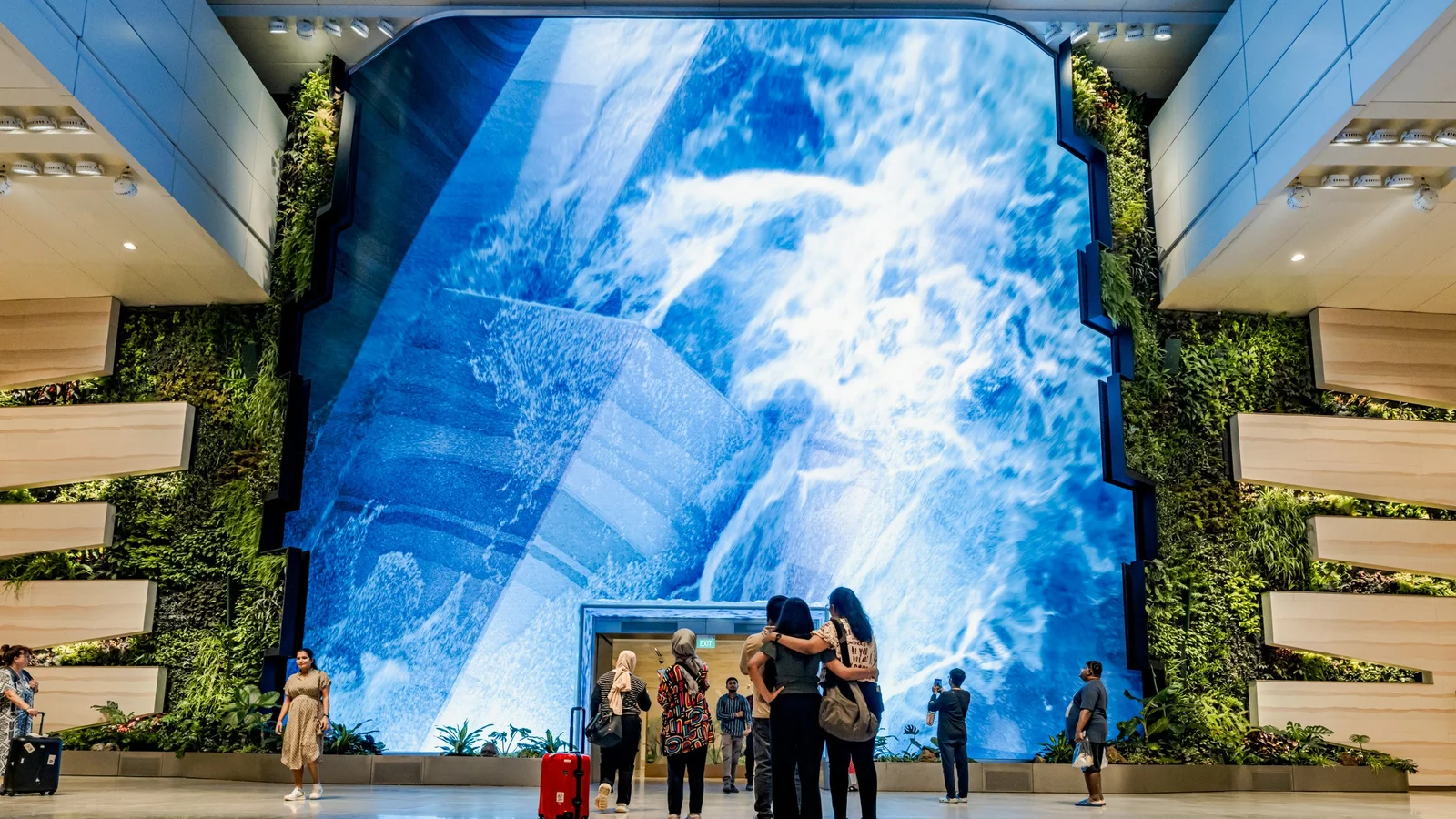
Image: Moment Factory / Singapore Changi Airport Terminal 2.
Vendor: Moment Factory (with design studio BOIFFILS) Type: Two permanent multimedia installations integrated into a Terminal 2 refresh
The Wonderfall is a four-storey curved LED waterfall in the Departure Hall, set inside vertical gardens. It runs a roughly 3.5-minute show several times per hour, with the water choreographed to an original piano score and a dramatic reversing-flow sequence.
The Dreamscape is an airside garden capped by a digital sky ceiling that mirrors real-time external weather conditions. It periodically transforms — a clear sky shifts into an underwater scene, and the ambient soundscape (built from roughly 100 local wildlife recordings) evolves throughout the day.
Both installations integrate with the airport's weather data systems and use spatialized multi-channel audio. Together they're part of Changi Airport Group's third Moment Factory partnership, and they helped Terminal 2 win Skytrax World's Best New Airport Terminal 2024, plus Digital Signage Awards (Large-format Digital Canvases), Digital Signage Experience Awards (Transportation & Overall), Prix Versailles, MONDO-DR (Transport & Built Environment), and MIPIM Awards (Best Refurbished Building – Gold).
Budget: Not publicly disclosed (typical of airport-authority commissions of this scale).
3-2. Seoul Incheon International Airport — Terminal 2 (2024)
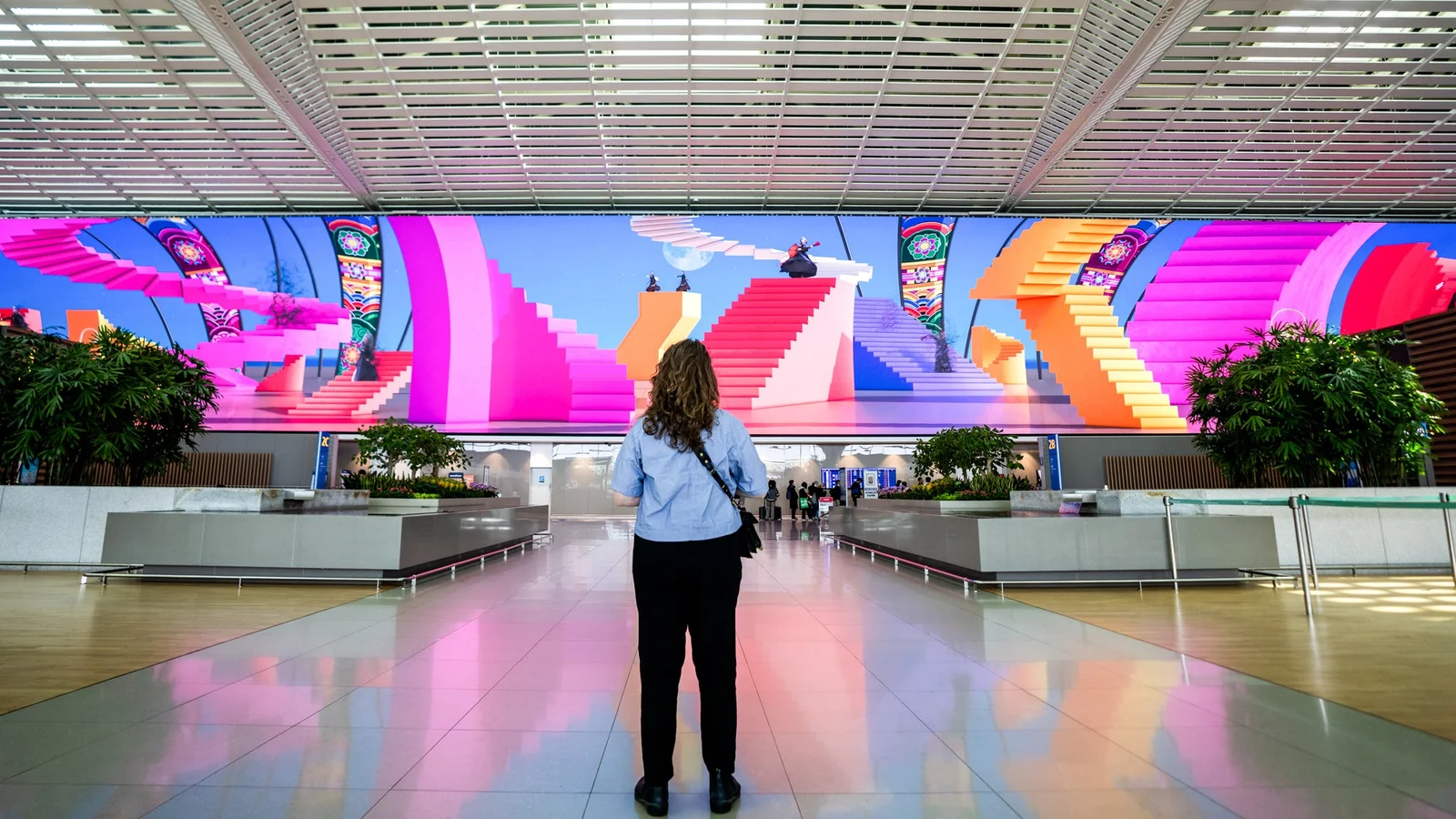
Image: Moment Factory / Incheon International Airport Terminal 2.
Vendor: Moment Factory (with SIGONGtech for integration, Vinyl-I as project manager) Type: Permanent digital megacanvas in the Terminal 2 Departure Hall expansion
Two large curved 16K LED screens form a single digital canvas viewable from multiple angles. Five custom "content capsules" mix 3D animation and live-action performance to immerse passengers in Korean cultural heritage, natural landscapes, and sustainability themes. It serves as the focal "sense of place" element for the expanded terminal, and won Digital Signage Experience Awards – Digital Signage Content of the Year 2025.
Budget: Not publicly disclosed.
3-3. Grand Central Madison / Grand Central Terminal — NYC (2024)
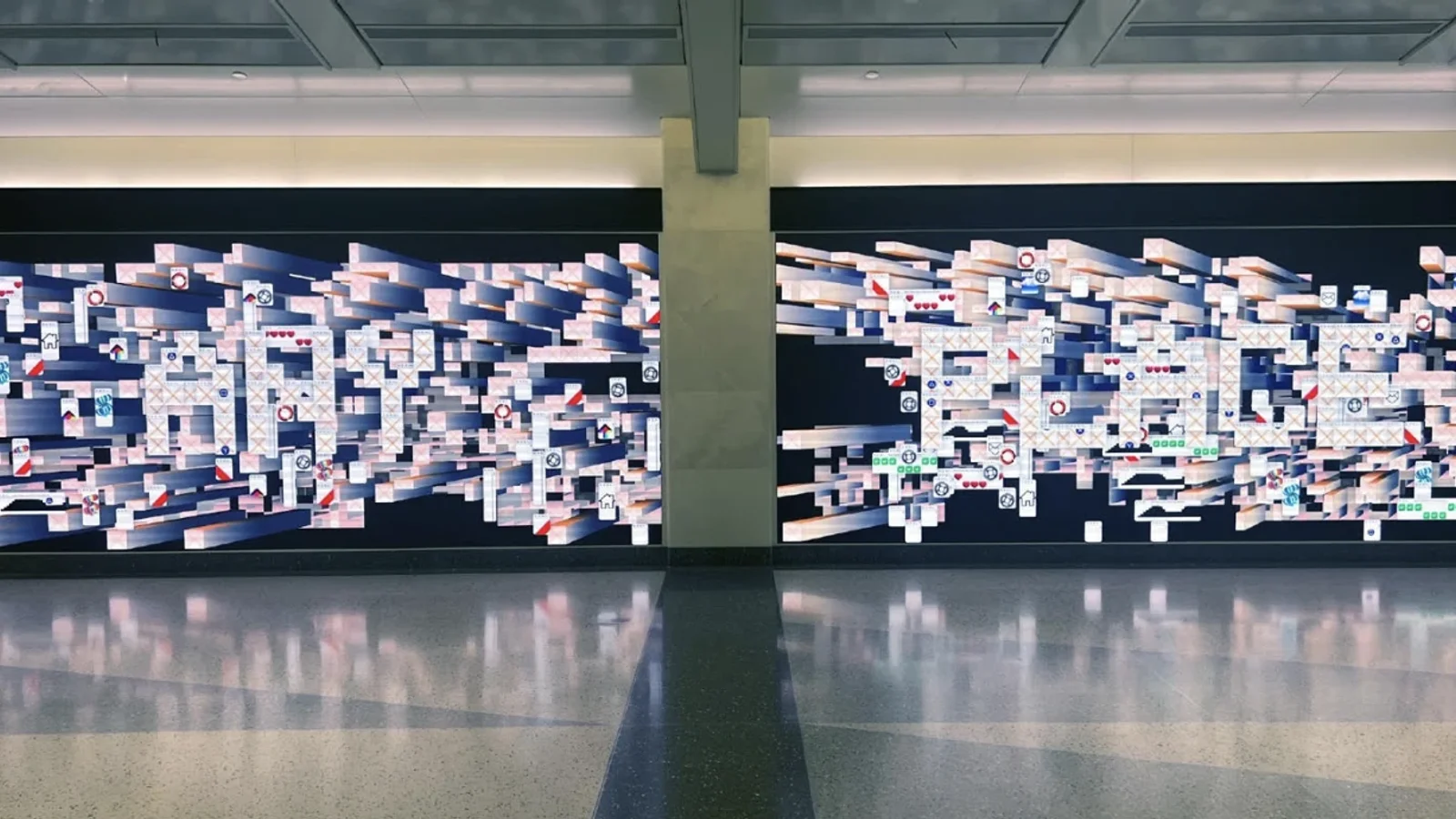
Image: MTA Arts & Design / Yehwan Song, "Anyplace, Anytime, Anywhere" at Grand Central Madison (via Time Out New York).
Commissioner: MTA Arts & Design (Digital Art Program) Artists: Monika Bravo, Yehwan Song Type: Long-term commissioned digital art program
Five LED screens near the 47th Street entrance to the LIRR concourse display rotating two-minute artworks. Ouranos, Above Us Only Sky by Monika Bravo is a collaged surreal cityscape exploring time and futurist architecture; Anyplace, Anytime, Anywhere by Yehwan Song features dynamic digital icons (emojis, browser windows, AI references) bouncing along subway-track-like paths before forming poetic phrases.
This is the third commission cycle for the space and forms part of MTA Arts & Design's broader 40+ year public art legacy and the 10th anniversary of its digital art program. It's a model for how transit authorities can run long-term digital programs that turn one of the world's busiest rail hubs into a rotating gallery.
3-4. The vendor concentration problem
What you'll notice from the list above: Moment Factory keeps appearing. Two of the three flagship transport projects of the last three years are by the same Montreal-based studio. That isn't because no one else can do this work — it's because the procurement process is so demanding (multi-year cycles, compliance fluency, 5–10 year operating contracts) that the field consolidates around vendors who have already cleared the bar elsewhere.
For buyers, this means the real procurement question isn't "which studio has the best portfolio reel?" It's "which studio has shipped a comparable installation that has now been operating in production for at least 18 months?" The answer in the airport vertical right now is a very short list.
4. Budget Tiers
Airport and transit installations cluster into three tiers. Each tier has a different procurement path, contract structure, and operational handover model.
4-1. Tier 1: $200K–$500K (pilot or single-zone activation)
What you get:
- A single interactive zone (one wayfinding kiosk cluster, one branded activation, one quiet-room experience)
- Custom interactive content with one or two seasonal variations
- Basic CMS for content updates
- 1-year hardware warranty, 1-year content support
Timeline: 8–16 weeks build, plus 4–8 weeks for security and authority approvals. Total 12–24 weeks elapsed.
Best for: Pilots designed to gather operational data before a flagship commitment, sponsor-funded pop-ups in pre-security retail zones, single-quiet-room installations.
4-2. Tier 2: $500K–$2M (standard permanent installation)
What you get:
- A multi-touchpoint installation across one terminal zone (3–6 connected screens or experiences)
- Custom generative content with telemetry and analytics
- Integration with airport CMS, flight information systems, and any sponsor reporting platform
- 3–5 year operating contract with quarterly content refresh
- Remote monitoring, on-site response SLA, hardware refresh schedule
Timeline: 6–12 months build, with the procurement cycle (RFP through contract award) running another 6–12 months in front of that. Total 12–24 months elapsed from board approval to first passenger interaction.
Best for: Permanent commissions in renovated terminal zones, brand activations attached to multi-year concession leases, mid-scale wayfinding modernization in transit interchange stations.
4-3. Tier 3: $2M–$5M+ (flagship terminal showpiece)
What you get:
- A signature multi-zone installation that defines the terminal's identity (Wonderfall and Dreamscape at Changi T2 are Tier 3)
- Custom hardware design and fabrication
- Integration with weather, flight data, sensor networks, and analytics dashboards
- 5–10 year operating contract with dedicated content pipeline
- Quarterly or seasonal content refresh, full hardware lifecycle management
Timeline: 12–24 months build, 12–24 months procurement and design phase in front of that. Total 24–36 months elapsed.
Best for: Terminal renovations, new terminal openings, hub-positioning capital projects with board-level visibility.
4-4. The hidden costs that wreck airport installation budgets
These are the line items most procurement teams discover only after they've signed:
- 24/7 monitoring: $5K–$30K/month for an enterprise-grade NOC handling escalations any time a screen drops
- Hardware refresh: plan for full LED replacement at year 5–7, even if the original quote talks about 10-year lifespan
- Content updates: quarterly refresh cycles cost 10–20% of initial content investment per year
- SLA penalties: miss the contractual uptime threshold (typically 99.5%+) and the airport can claw back monthly fees
- Security re-clearance: any system change triggers a security review. Budget weeks of consultant time per major update
- Power and network upgrades: older terminals weren't built for 24/7 high-power LED loads. Conduit and switch upgrades can run $50K–$500K and aren't always in the original installation quote
For a deeper breakdown of how these line items compound, see our interactive installation cost and budget guide.
5. The Procurement Process: RFP to Long-Term Contract
This is where buyers in the airport vertical get burned most often. The procurement process is unlike any other interactive installation buy.
5-1. The 12–36 month timeline
A typical sequence for a Tier 2 or Tier 3 installation:
- Internal scoping (2–4 months): budget allocation, internal stakeholder alignment (capital projects, IT, operations, security, legal, accessibility, terminal management), board or board-equivalent approval
- RFI / market sounding (1–2 months): informal vendor outreach to map the realistic field
- RFP issued (1 month): formal RFP with mandatory comment period and Q&A
- Proposal evaluation (2–4 months): scoring against published criteria, shortlist interviews, site visits
- Award and protest window (1–2 months): award notification, vendor protest window, contract negotiation
- Detailed design and approval (3–6 months): integrated design review with architecture, security, fire, accessibility, and operations
- Build and installation (6–18 months): depending on tier
- Commissioning and handover (1–3 months): soft launch, training, SLA validation
That's 12 months at the absolute fastest end and easily 36 months for a flagship project. Vendors who can survive that process — including the cash flow gap between RFP submission and first invoice — are by definition not the cheapest.
5-2. What the RFP actually contains
A serious airport interactive installation RFP runs 60–200 pages and asks for substantially more than a creative brief. Expect to see:
- Scope of work, including operational handover and SLA structure
- Mandatory technical specifications (power, network, fire-rated enclosures, MTBF, environmental tolerances)
- Accessibility requirements (WCAG 2.1 AA, ADA Title II conformance)
- Security clearance and background-check requirements for installation personnel
- Detailed insurance requirements
- Vendor financial qualification (past audited financials, bonding capacity)
- References from comparable transportation-vertical projects
- Detailed pricing schedule with line items for hardware, content, integration, and the 5–10 year operating contract
- Sustainability and carbon-reporting commitments
- Local-content and minority-business participation commitments
For buyers writing their first RFP, see our studio briefing guide — but expect to expand it significantly for the airport vertical.
5-3. Vendor selection criteria
The shortlist for airport work is much shorter than for most verticals. Real selection criteria look like this:
- Comparable in-production references: Has the vendor shipped a similar installation that has been operating in production for at least 18 months in a comparable transportation environment?
- Compliance fluency: Can they cite the specific clauses they have to meet (FAA / MLIT / EASA / WCAG / NFPA cable codes) without prompting?
- Operational SLA history: Can they produce documented uptime data from existing transport-vertical contracts?
- Financial durability: Can they survive a 9–18 month procurement cycle plus a multi-month payment cycle?
- Local presence or partner network: On-site response SLAs require local engineering presence
- Content pipeline maturity: Can they sustain quarterly content refresh for 5–10 years?
For the framework Utsubo uses to help buyers evaluate vendors against criteria like these, see our studio selection guide.
5-4. Long-term operating contracts
The screen is the cheap part. The 5–10 year operating contract is where the money lives — and where the strategic relationship is set. A typical operating contract bundles:
- Hardware maintenance and replacement schedule
- Software updates and CMS support
- Quarterly content refresh
- Telemetry, analytics, and quarterly reporting
- 24/7 NOC monitoring
- Emergency response SLAs
- Annual content workshop with airport operations
- Pre-defined hardware refresh at year 5 (or year 7)
Capex versus opex matters here. Airport authorities increasingly want to convert what used to be a single capex line into a multi-year opex commitment, partly because it smooths their capital plan and partly because it pushes vendor accountability across the entire lifetime of the installation. Some vendors now offer content-as-a-service licensing — the airport pays a recurring fee, and the vendor owns and refreshes the content library on a fixed cadence.
6. Compliance & Accessibility
The compliance load is the single biggest cost driver that surprises buyers from other verticals.
6-1. ADA Title II and the 2027–2028 deadlines
The U.S. Department of Justice's final rule on Web Content Accessibility Guidelines (WCAG) 2.1 AA conformance for state and local government web content and mobile apps was extended by one year in April 2026: WCAG 2.1 AA is now due April 26, 2027 for entities with a total population of 50,000 or more, and April 26, 2028 for smaller entities and special district governments (ADA.gov fact sheet). It applies to state and local government entities — which includes most U.S. transit agencies and many U.S. airport authorities (those operated by city, county, port authority, or state structures). The rule covers web content and mobile apps and sets no kiosk-specific standard, but kiosks and touchscreens remain subject to Title II's effective-communication duty, so U.S. transit and airport buyers specify WCAG 2.1 AA for every touchpoint.
In practice, this means any new interactive installation in a U.S. transit hub or city/state-operated airport must support: keyboard-equivalent input, screen reader compatibility, sufficient color contrast, captions for any audio content, alternative interaction modes for users who can't use touch, and a documented accessibility test report.
This is non-negotiable, and it has reset expectations for what "interactive" means in a public-space installation.
6-2. WCAG 2.1 AA for kiosks and touchscreens
Beyond ADA Title II, WCAG 2.1 AA itself sets the technical bar:
- 4.5:1 minimum contrast ratio for normal text
- All interactive controls reachable by keyboard or alternate input
- Sufficient touch target size (minimum 44×44 CSS pixels equivalent; this is WCAG 2.1 AAA, SC 2.5.5 — the WCAG 2.2 AA minimum is 24×24)
- Time limits on interactions must be adjustable or extendable
- No flashing content above the seizure threshold
- Predictable navigation patterns
For the design pattern library Utsubo uses on accessible installations, see our accessible museum installations guide — most of the same principles apply directly.
6-3. IATA passenger experience standards and beyond
IATA's Airport Service Quality (ASQ) program defines the core passenger experience metrics airports report against, including dwell time at retail and amenity zones, passenger satisfaction scores, and wayfinding effectiveness. Interactive installations that meaningfully improve these metrics have a measurable revenue tie back to the airport authority — and that's the business case most procurement teams use to defend Tier 2 and Tier 3 budgets.
In Japan, transit installations also fall under the Barrier-Free Transportation Law (高齢者・障害者等の移動等の円滑化の促進に関する法律) and MLIT's accessibility guidelines, which set similar but locally specific requirements. In the EU, the European Accessibility Act (in force from 2025) extends accessibility requirements to a broader set of products and services including transport-related interactive systems.
6-4. Fire, life-safety, and MTBF
The technical compliance bar is equally specific:
- Cable: LSZH (low-smoke zero-halogen) or plenum-rated where required
- Enclosures: fire-rated where mounted in egress paths
- MTBF: commercial-grade displays rated above 50,000 hours, with redundant power supplies
- Environmental: rated for the temperature and humidity range of the actual installation zone (which can vary 20°C+ within a single terminal between curbside and gate areas)
- Acoustic: echoey terminal halls require careful audio design — see our sound design guide for the patterns that work in reverberant public spaces
7. Technology Stack for Hub Environments
The component decisions look different here than in any other vertical.
7-1. Touch vs touchless
Post-COVID, most new airport installations default to touchless interaction: gesture, gaze, proximity, depth-sensor, or mobile-handoff. Touch is still acceptable for kiosks where it's the only input that meets accessibility requirements (a screen reader user generally needs a tactile target), but the bar to justify a high-traffic touch surface in a transit hub now includes a documented cleaning protocol.
7-2. Sensors
The sensor stack for transport-vertical work is heavier than retail or museum:
- LiDAR for crowd flow analysis without privacy concerns
- Depth cameras for gesture and position sensing without identifying individuals
- RFID/BLE for boarding-pass-aware experiences in pre-security zones
- Environmental sensors for ambient light adaptation (terminals have dramatic light shifts as the sun moves)
Privacy-first telemetry — aggregate counts, flow, and dwell time, not individual tracking — is the default expectation. Airports that store individually identifiable data face data-protection scrutiny they generally don't want.
7-3. CMS for 24/7 operation
Content management for an airport installation is fundamentally different from a museum CMS. It needs to:
- Run 24/7/365 with zero scheduled downtime
- Handle role-based access for airport ops, vendor content team, and any sponsor
- Push emergency content (security alerts, gate changes, weather warnings) within seconds
- Integrate with flight information display systems (FIDS) and the airport operational data network
- Log every content change for audit
- Support hot failover
7-4. Telemetry for ROI proof
The thing that turns a capital expense into a defended program: measurable, reportable engagement data. A serious airport installation reports against:
- Aggregate dwell time per zone, per hour, per day
- Interaction count and rate
- Passenger flow patterns and zone heat maps
- Content variant performance
- Sponsor impression and engagement metrics (where applicable)
- Uptime and SLA conformance
Without this layer, the capital project gets mothballed at the next budget review. With it, airport leadership has the data they need to defend renewal at year 5.
7-5. The content layer
Real-time generative content for transport-hub installations typically runs on Three.js / WebGL for browser-deployable experiences, Unreal Engine or Unity for high-end LED canvas content, and TouchDesigner for the live integrations between sensors, weather data, and visual output. The Wonderfall at Changi is an example of how a generative pipeline (real-time choreography synced to a piano score, weather-responsive video transformations) becomes a platform that can be refreshed for years without rebuilding the hardware.
8. Common Pitfalls
Treating airports like museums. Museums are forgiving environments. Airports are not. Vendors who have shipped beautiful museum installations frequently underestimate the operational rigor required for a 24/7 transit deployment. The first sign of trouble: a vendor who can't immediately quote MTBF targets and SLA penalty structures for comparable past projects.
Skipping the operating contract. Buyers focused only on the capital cost of installation often discover at year 2 that they have no maintenance contract, no content refresh budget, and a vendor with no ongoing obligation. The screen goes dark, the airport's reputation takes the hit, and the procurement team spends another 12 months running an emergency RFP.
Choosing aesthetics over compliance. A creative concept that doesn't meet WCAG 2.1 AA, ADA Title II, fire codes, or local accessibility law won't survive the design review — and discovering this in month 9 of a 24-month build is the most expensive mistake in this vertical.
Underestimating the procurement cycle. Internal stakeholders who believe the project is a 3-month build set unrealistic expectations with leadership and erode trust in the procurement team. Communicate the 12–36 month reality in the first board memo, not the third.
No telemetry plan. An installation that can't prove its impact at year 3 is an installation that gets defunded at year 4. Build the telemetry, reporting cadence, and stakeholder review schedule into the original brief.
Ignoring sound in echoey terminals. Hard surfaces, glass, and high ceilings turn audio into a noise complaint generator. Directional speakers, acoustic zoning, or silent-with-haptics approaches are the only patterns that work. See our sound design guide for the techniques that survive in reverberant public spaces.
Designing for rendered concepts, not real footfall. A concept video shot with three actors in an empty hall will not predict how the installation behaves with 4,000 passengers per hour. Pilot zones and live-traffic testing windows are non-negotiable for Tier 2 and Tier 3 budgets.
9. How to Get Started
Step 1: Confirm the procurement timeline with leadership. Before anything else, get explicit board or board-equivalent acknowledgement that the project is a 12–36 month process. If leadership thinks this is a quarterly project, the procurement team will be set up to fail.
Step 2: Map your stakeholder coalition. Capital projects, IT, operations, security, legal, accessibility, terminal management, sponsors (if applicable), and any concession partners all need to be at the table early. Missing one of them in month 2 creates a re-design in month 14.
Step 3: Run a market sounding before the formal RFP. Talk to 3–5 vendors with comparable transport-vertical references. Use those conversations to calibrate budget, timeline, and the realistic technical envelope before you write a 200-page RFP that the field can't actually answer.
Step 4: Pilot before flagship. A Tier 1 pilot ($200K–$500K) lets you collect operational data, validate accessibility approaches, and build internal confidence before committing $2M+ to a Tier 3 commitment. This is the single highest-leverage decision a first-time buyer in this vertical can make.
Step 5: Plan the operating contract from day one. The 5–10 year operating relationship is the strategic asset, not the screen. Negotiate the SLA structure, content refresh cadence, telemetry obligations, and renewal terms in the original procurement, not in a year-2 amendment.
10. About Utsubo
Utsubo is a creative studio specializing in interactive installations and immersive digital experiences. We combine Three.js and WebGL expertise with physical installation design to build memorable brand moments that survive in demanding operational environments.
What we offer:
- Custom interactive installations for stadiums, theme parks, hotels, museums, and retail
- Three.js and WebGL development for real-time generative content
- End-to-end design and implementation, from concept through ongoing operational support
11. Let's Talk
Planning an interactive experience for an airport, transit hub, or large public space? We work with airport authorities, transit agencies, brand activation teams, and prime contractors on installations that have to survive 24/7 operating environments.
If you're exploring a partnership, let's discuss your project:
- What you're building and the passenger experience you're enhancing
- Which technical approach makes sense for your terminal, station, or concession zone
- Whether we're the right fit to help you execute a multi-year program
Airport & Transit Installation Checklist
- Confirmed 12–36 month procurement timeline with leadership and board
- Mapped the full stakeholder coalition (capital projects, IT, ops, security, legal, accessibility, terminal management, sponsors)
- Defined budget tier (Tier 1 pilot, Tier 2 standard permanent, or Tier 3 flagship)
- Documented WCAG 2.1 AA and ADA Title II requirements for any interactive touchpoint
- Mapped fire, life-safety, and security clearance requirements with the appropriate authorities
- Specified MTBF, environmental tolerance, and 24/7 reliability requirements in the RFP
- Run market sounding with 3–5 vendors with comparable transport-vertical references
- Drafted the 5–10 year operating contract structure (SLA, content refresh, telemetry, hardware refresh)
- Built the telemetry and reporting cadence into the original brief
- Planned a pilot deployment before any Tier 3 commitment
- Aligned content refresh schedule with airport operations and any sponsor calendar
- Defined the success metrics that will defend the program at year 3 and year 5
FAQs
How much does an airport interactive installation cost?
Budget tiers cluster as follows: $200K–$500K for a Tier 1 pilot or single-zone activation, $500K–$2M for a Tier 2 standard permanent installation, and $2M–$5M+ for a Tier 3 flagship terminal showpiece. Operating contracts add 15–25% per year over a 5–10 year horizon. Most airport-authority commissions of this scale do not publicly disclose final figures, but the band is consistent across the field. For a deeper breakdown, see our interactive installation cost guide.
How long does the procurement process take for an airport installation?
From internal budget approval to first passenger interaction, plan for 12–36 months. A Tier 1 pilot can compress to 6–12 months in unusual cases. A Tier 3 flagship typically runs the full 36 months: 6–12 months internal scoping and RFP, 6–12 months evaluation and contract, then 12–24 months design, build, and commissioning. The 9–18 month cash-flow gap between proposal submission and first vendor invoice is the main reason the realistic vendor field is short.
Which vendors actually ship permanent interactive installations in airports?
Moment Factory is currently the dominant vendor for transport-hub experiential media, having delivered Singapore Changi Terminal 2's Wonderfall and Dreamscape (2023) and Seoul Incheon Terminal 2's 16K megacanvas (2024) as the two highest-profile recent examples. The MTA's Arts & Design program runs the Grand Central Madison digital art commissions on the rail side. Several regional studios deliver wayfinding and brand activation work, but the field of vendors who have shipped a Tier 3 flagship and operated it in production for 18+ months is very short.
What do the ADA Title II WCAG deadlines mean for airport installations?
The U.S. Department of Justice's rule requires WCAG 2.1 AA for state and local government web content and mobile apps by April 26, 2027 (entities of 50,000+ people) or April 26, 2028 (smaller entities and special districts), after a one-year extension in April 2026. For transit agencies and city-, county-, port-authority- or state-operated airports, kiosks and touchscreens fall under Title II's effective-communication duty even without a kiosk-specific standard. In practice, buyers now expect every new installation to support keyboard-equivalent input, screen reader compatibility, sufficient color contrast, alternative interaction modes, and a documented accessibility test report. This is the single biggest compliance shift the vertical has seen in a decade.
Can a brand fund an interactive installation in an airport directly?
Yes — most concession-zone brand activations are sponsor-funded but airport-approved. The brand pays for the installation, but the airport authority controls placement, content review, and the operating contract. Concession-zone activations typically run 12–36 months and align with the brand's flight or retail promotion calendar. The airport authority always retains final approval over content, fire, security, and accessibility compliance.
Why are most airport installation budgets undisclosed?
Airport authorities, especially those operated as port authorities or government agencies, typically do not publish the line-item cost of individual installations. The cost is folded into broader terminal renovation or capital improvement budgets, and procurement law in many jurisdictions actively discourages publishing per-vendor pricing. The budget tiers in this guide reflect the consistent ranges across published industry references, vendor portfolio cost bands, and Utsubo's own experience scoping comparable public-space projects.
What is the realistic operating life of an airport interactive installation?
Plan for a 5–7 year hardware refresh cycle and a 10-year overall installation life. LED panels in 24/7 operation degrade faster than nominal spec sheets suggest; commercial-grade displays rated above 50,000 hours MTBF generally hit a measurable brightness loss by year 5, and full panel replacement is the norm at year 7. The content layer should be refreshed quarterly for the entire lifetime of the installation — which is why the operating contract is the strategic asset, not the screen itself.
How do airport installations measure ROI?
The defendable ROI metrics are: aggregate dwell time per zone, passenger satisfaction score change (often via IATA's ASQ program), wayfinding completion rate and accessibility complaint reduction, sponsor impression and engagement metrics (where applicable), retail spend uplift in adjacent concession zones, and earned media value from press and social coverage of the installation. The flagship installations cited in this guide all generated significant earned media in their opening year — the Skytrax World's Best New Airport Terminal 2024 award for Changi T2 was directly tied to the renovated terminal's experiential elements.


 Osaka Interactive Installation Studio