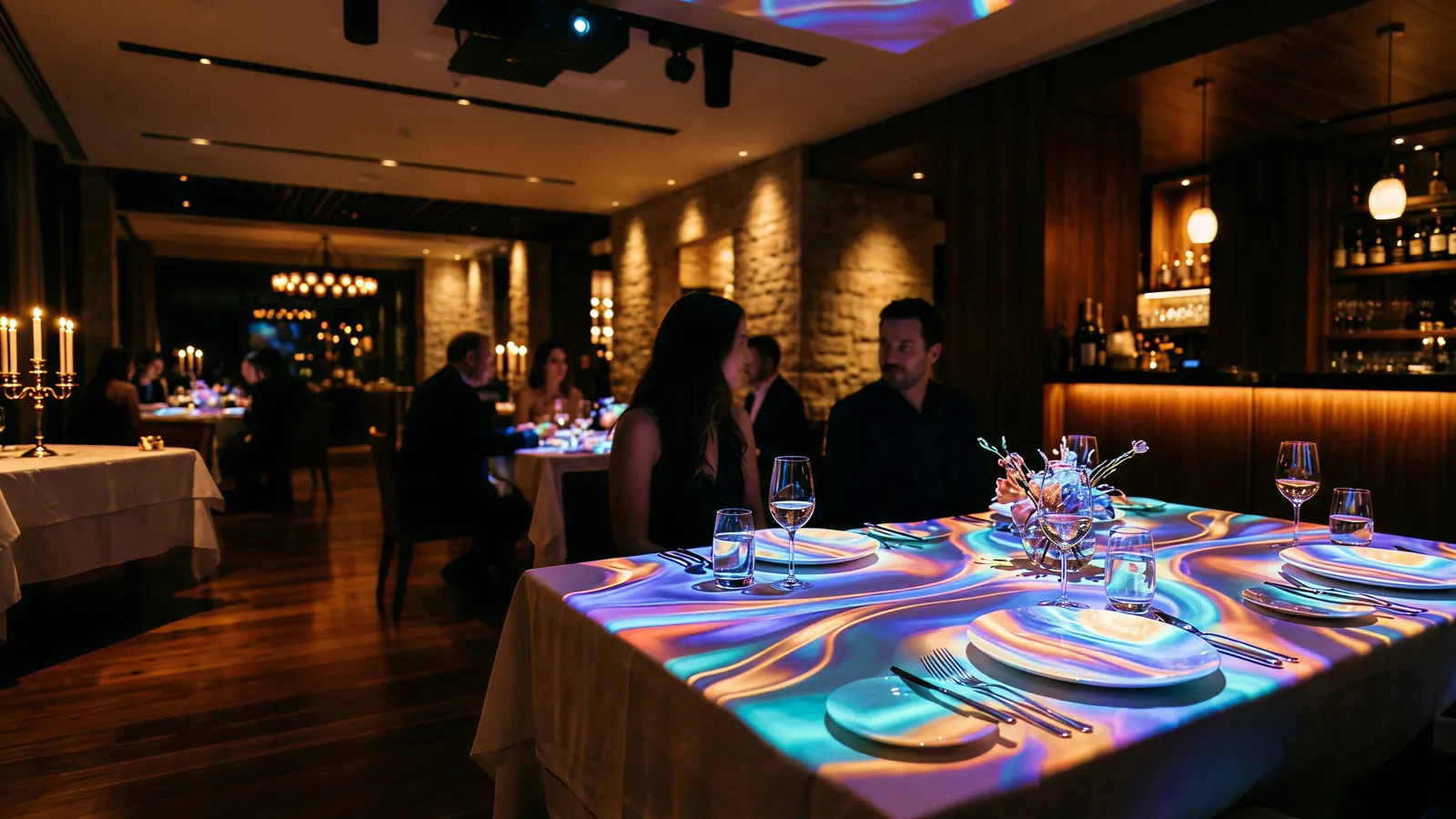
The immersive dining market hit $6.8 billion in 2025 and is growing at 19.8% annually. What started as a novelty at a handful of Michelin-starred restaurants is now a proven business strategy: projection-mapped tables, responsive lighting, multi-sensory environments, and interactive surfaces that turn a meal into a story guests pay a premium to experience—and share.
This guide explains the technology, realistic costs, real-world examples, and practical challenges of building immersive dining experiences. We write this as a studio that designs and builds interactive installations—not as a hardware vendor or marketing platform.
Who this is for: Restaurant group owners, F&B directors, hospitality brand managers, and experience designers evaluating immersive technology for dining venues.
Key Takeaways
- Immersive dining installations range from $15K–$500K+ depending on scale—pop-up table projections to full 360-degree environments.
- 75% of consumers are willing to pay more for unique dining experiences; venues report 12–18% per-seat revenue uplift after installation.
- Projection mapping is the dominant technology, but the best experiences layer in sound, scent, and interactive elements beyond visuals alone.
- The concept-to-opening timeline is typically 15–30 weeks—content creation, not hardware, is usually the longest phase.
- Restaurant environments pose specific challenges: ambient light, kitchen steam, grease, acoustics, and health codes all affect design decisions.
- Turnkey and touring models (Le Petit Chef, Seven Paintings) have proven that immersive dining scales beyond one-off flagship venues.
- The biggest mistake is overspending on hardware while underinvesting in content and staff training.
1. Why Immersive Dining Is Booming
1-1. Consumers want experiences, not just meals
The shift is measurable:
- 72% of diners want more experiential dining options (Technomic)
- 52% of consumers actively seek immersive experiences they cannot replicate at home
- Experiential dining bookings grew 46% year-over-year in 2025
This is the experience economy applied to food and beverage. Guests increasingly judge a restaurant not just by the food, but by the totality of the experience: the environment, the story, the shareable moment.
1-2. Social media as a force multiplier
Immersive dining is inherently photogenic—and that translates directly to discovery:
- 74% of diners use social media to decide where to eat
- 55% of TikTok users visit a restaurant after seeing its menu or experience on the platform
- Restaurants with strong visual experiences see up to 27% higher customer retention
A projection-mapped table course is not just dinner—it's content. Guests film it, share it, and do your marketing for you. The question for restaurant operators is no longer "should we invest in experience?" but "what technology fits our concept and budget?"
That said, UGC only converts when guests can find the venue in the first place. Before a $50K+ projection rig pays back, the restaurant has to show up for "immersive dining Tokyo," "sake bar near me," and equivalent searches in every language a tourist actually uses. For independent restaurants without a bilingual marketing team, lightweight tools like Kokopon, which lets owners publish multilingual updates to Google Maps, Instagram, and LINE OA from a single LINE message, keep the daily discovery layer running so the immersive experience has guests to play to.
2. Technology Options Compared
Immersive dining technology falls into five main categories. Most successful venues combine two or more.
2-1. Projection mapping
The most common and proven approach. Projectors map animated content onto tables, plates, walls, or ceilings—synchronized with each course.
Best for: Table-level storytelling (Le Petit Chef), full-room immersion (The X Pot), and seasonal content rotation.
Hardware: Commercial projectors from $3,000 (entry) to $60,000+ (high-end) per unit. Key specs are brightness (4,800–15,000+ lumens), resolution (1080p–4K), and laser phosphor light sources (20,000-hour lifespan, minimal maintenance).
Software:HeavyM for mapping, custom media servers for multi-projector synchronization.
For a deeper comparison of projection mapping vs. interactive installations, see our decision guide.
2-2. LED walls and lighting systems
LED walls create immersive backdrops without the ambient-light sensitivity of projectors. Programmable lighting (DMX-controlled LEDs, UV, lasers) synchronizes atmosphere shifts with courses.
Best for: Venues with high ambient light, bar/lounge environments, and architectural accent lighting.
2-3. Interactive surfaces and sensors
Motion sensors, touch-sensitive tables, and facial recognition cameras create responsive experiences—the environment reacts to guests rather than playing on a loop.
Best for: High-engagement concepts where guest participation is central to the experience.
2-4. Sound and scent systems
Sound design (directional speakers, surround systems) and scent diffusion (dry scent projectors, aroma systems) add layers that make immersion feel physical—not just visual.
Best for: Multi-sensory fine dining where flavor perception and emotional response matter. Research on the psychology of awe shows that multi-sensory stimulation creates stronger memories and willingness to pay premium prices.
2-5. AR/VR
VR headsets (Sublimotion) or AR overlays add virtual elements to the dining experience. Still emerging and less practical for most restaurants due to hygiene and social dynamics—guests wearing headsets can't see each other.
Best for: Ultra-premium tasting menus where full immersion justifies the disruption, or limited-use moments between courses.
Technology decision matrix
| Factor | Projection Mapping | LED Walls | Interactive Sensors | Sound/Scent | AR/VR |
|---|---|---|---|---|---|
| Budget (entry) | $15K–$50K | $30K–$100K | $10K–$40K | $5K–$25K | $20K–$60K |
| Ambient light tolerance | Low–Medium | High | High | N/A | N/A |
| Content refresh ease | High | High | Medium | Medium | Low |
| Guest interactivity | Low–Medium | Low | High | Low | High |
| Maintenance complexity | Medium | Low | Medium | Medium | High |
| Scalability | High | Medium | Medium | High | Low |
| WOW factor | High | Medium | High | Medium | Very High |
3. What It Actually Costs
Cost is the question every competitor article dodges. Here are realistic budget tiers specifically for restaurant installations—not generic projection rooms.
Tier 1: $15,000–$50,000 (pop-up / single table / accent)
- 1–2 entry-level commercial projectors ($3,000–$8,000 each)
- Basic projection mapping software
- Pre-made or simple custom content (1–2 animated sequences)
- Installation and calibration
- Best for: Private dining rooms, pop-up events, single-table experiences, testing the concept before scaling
Tier 2: $50,000–$150,000 (full dining room / multi-surface)
- 4–8 mid-range professional projectors ($10,000–$25,000 each, 10,000–15,000 lumens, 4K, laser)
- Custom content creation (5–10 animated sequences per course)
- Multi-surface mapping (tables + walls or ceiling)
- Sound system integration
- Custom media server
- Best for: Hotel restaurants, mid-range standalone venues, Le Petit Chef-style per-table experiences
Tier 3: $150,000–$500,000+ (flagship / 360-degree / multi-sensory)
- 8–15+ high-end projectors or LED panels
- Full 360-degree projection or mixed projection + LED
- Custom software and interactive sensors
- Scent and climate control systems
- Surround sound design
- Custom-built surfaces and environments
- Best for: Destination restaurants, hotel flagships, branded entertainment venues
Where the money goes
| Component | % of Budget |
|---|---|
| Hardware (projectors, LEDs, screens) | 40–50% |
| Content creation (animation, video) | 15–25% |
| Software and licensing | 10–15% |
| Installation and environment prep | 10–20% |
| Ongoing maintenance (annual) | 5–10% |
The hidden cost: Content creation is where budgets are most often underestimated. A 5-minute animated sequence for projection mapping costs $500–$10,000+ per minute depending on complexity. If you plan to refresh content seasonally, budget for it upfront.
For a broader breakdown of installation costs across industries, see our complete budget guide.
4. Real-World Examples
4-1. Le Petit Chef — 50+ venues worldwide
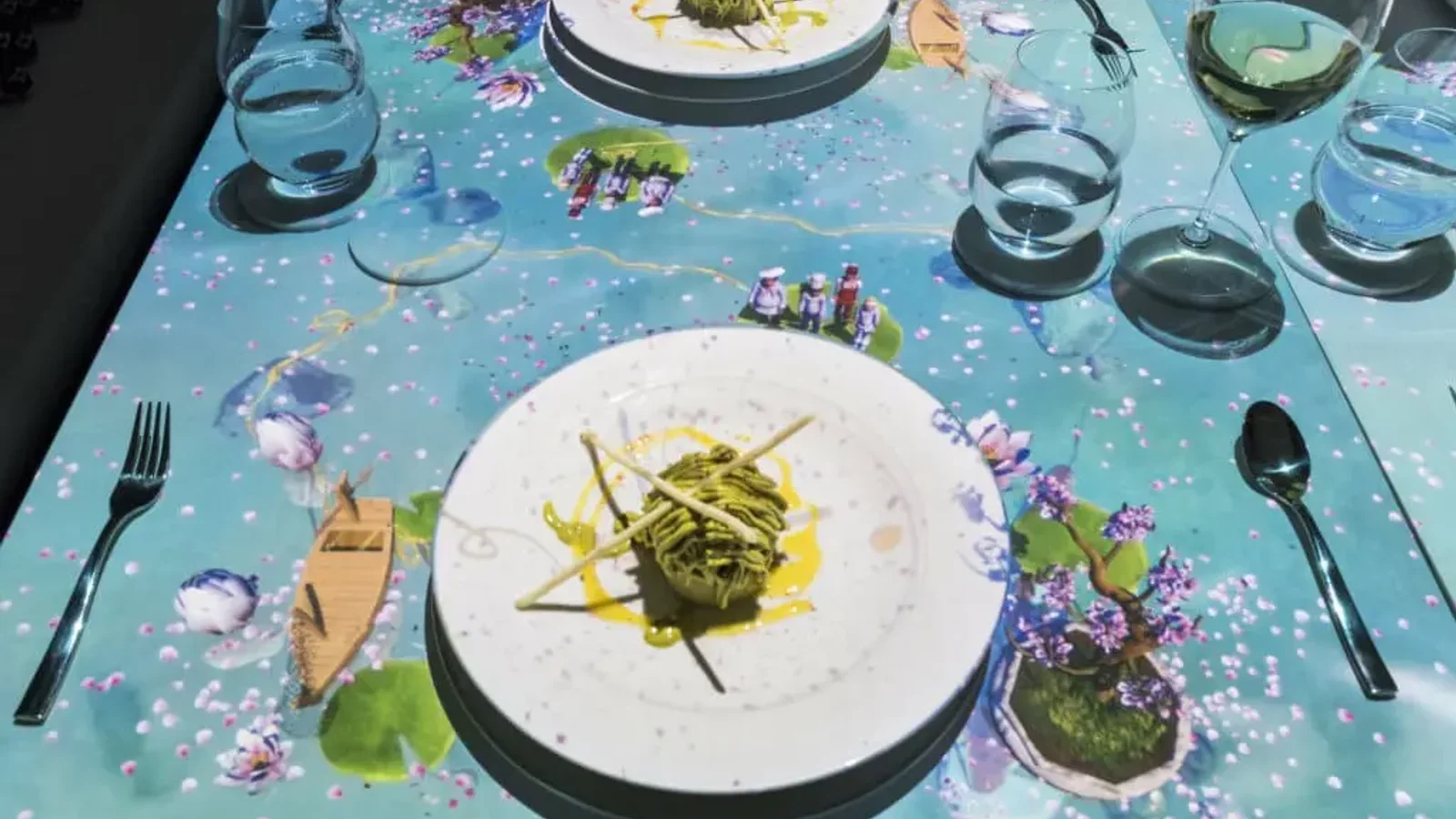
Created by Belgian studio Skullmapping, Le Petit Chef projects a thumb-sized animated chef onto each diner's plate. The character prepares each course in a 3D-animated story, synchronized across the table.
- Technology: Panasonic PT-VZ570 LCD projectors (4,800 lumens, 1920x1200), 3D animation + motion capture
- Price point: $125–$165 per person for a 5-course experience
- Scale: 50+ restaurants across Paris, Shanghai, Dubai, Tokyo, and more
- Why it works: Turnkey licensing model—Skullmapping provides the content and projectors; the restaurant provides the kitchen and space. Proven to work across different cuisines and cultures.
4-2. The X Pot — Las Vegas
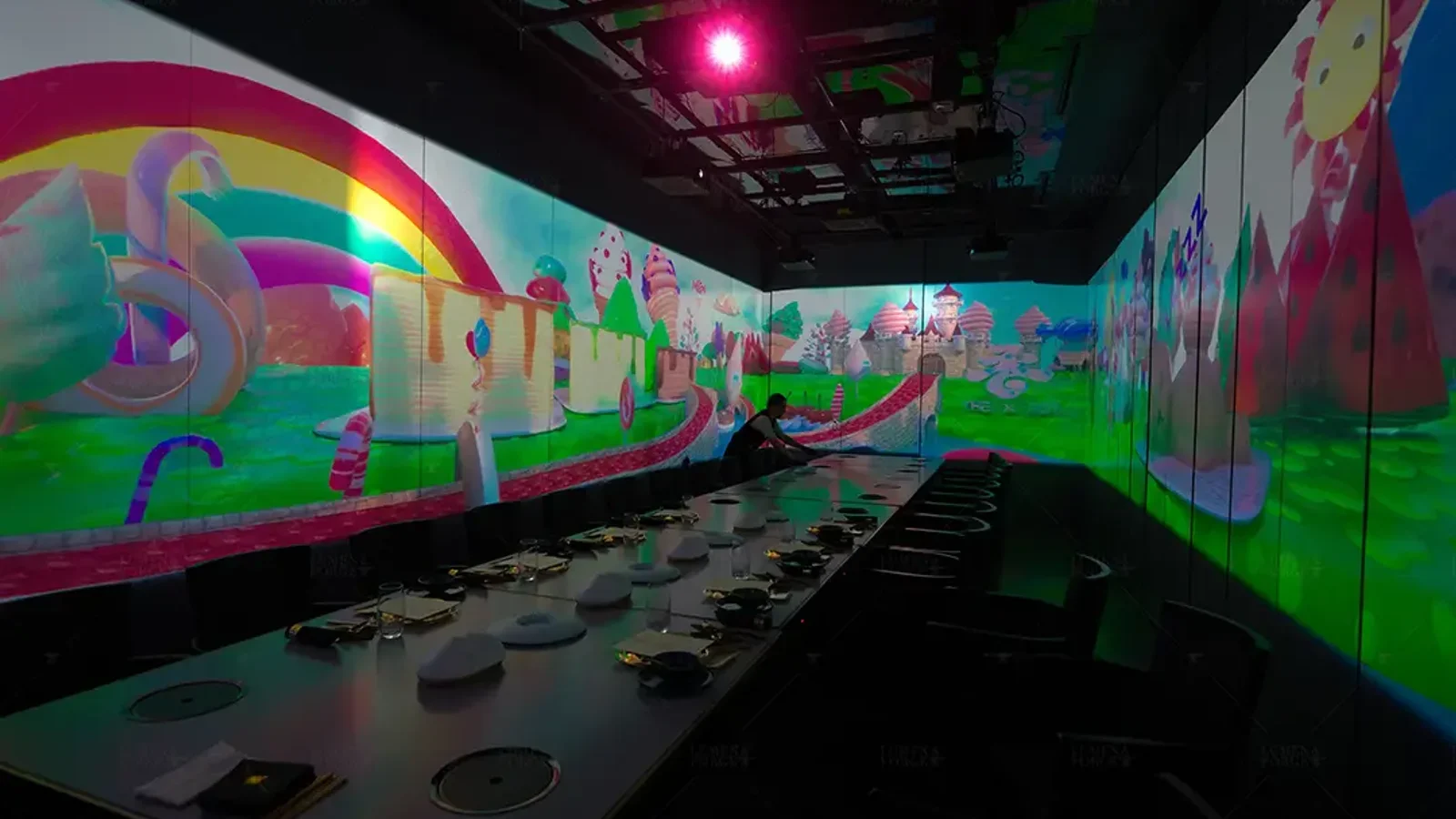
An immersive hot pot restaurant inside The Venetian Resort, designed and installed by Lumen and Forge.
- Technology: $1 million projection system using ten Optoma 660 projectors + custom projection server, 360-degree projections, interactive lighting, ambient soundscapes
- Concept: "5D dining experience"—each course triggers a visual environment shift. VIP rooms feature synchronized cooking tutorials projected onto the table.
- Why it works: The investment is justified by Las Vegas ticket prices and venue traffic. The projection system is the restaurant's primary differentiator in a city full of restaurants.
4-3. Alchemist — Copenhagen
Two Michelin stars. Up to 50 courses ("impressions") over 4–6 hours. Chef Rasmus Munk's venue employs visual effects artists, sound engineers, actors, and dancers.
- Technology: HD 360-degree projection-mapped domed ceiling (Epson L-series), facial recognition that projects guest faces alongside archival figures, surround sound
- Concept: Gastronomy meets theater, art, and social commentary. Courses provoke emotional reactions, not just flavor.
- Why it works: The technology serves the narrative—it's not spectacle for its own sake. Every projection, sound, and scent cue is designed to enhance a specific course's message.
A domed ceiling is not a flat screen bent into shape: it takes a dome master rather than a video file, and it carries its own comfort constraints. See our LED sphere and dome content guide for what commissioning that content involves.
4-4. MoonFlower Sagaya Ginza — Tokyo
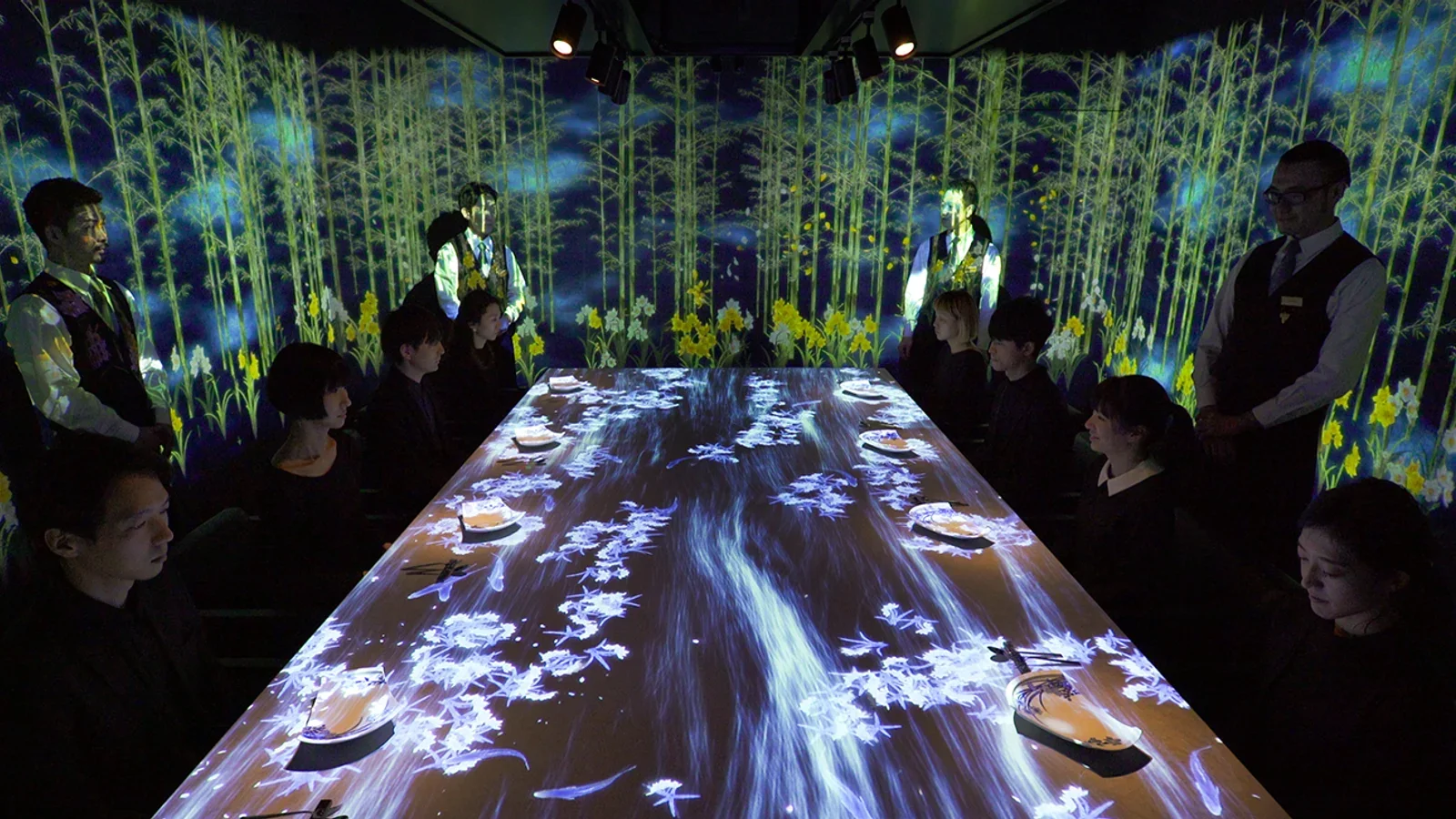
An 8-seat restaurant with a permanent digital art installation by teamLab.
- Technology: Interactive digital flowers and trees unfold across dinnerware, changing with the seasons. iPad lets guests explore projected constellations.
- Concept: "Worlds Unleashed and then Connected"—the art responds to the dishes and the diners.
- Why it works: teamLab's brand draws art-world visitors who become diners. The restaurant is both a culinary and artistic destination.
4-5. Seven Paintings — Touring (Europe, Dubai, Bali, USA)
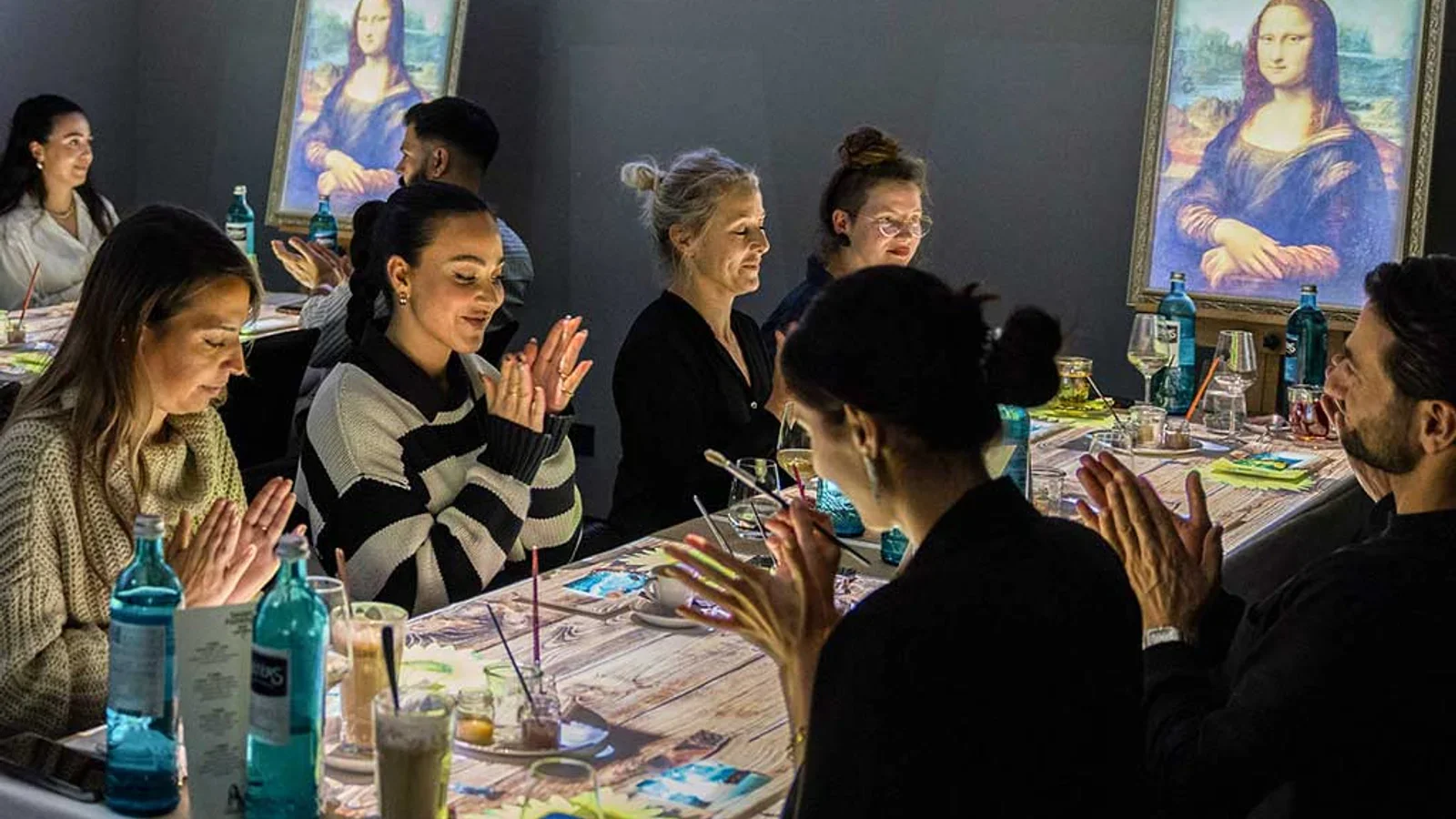
A 2.5-hour dinner show with 7 courses, each inspired by a master artist: Michelangelo, Banksy, Picasso, Pollock, Warhol, Dali, Van Gogh.
- Technology: Projection mapping on tables, paired with music and interactive elements (puzzles, painting with food)
- Scale: Dubai, Ubud (Bali), Edmonton, Mountain View (CA), and expanding
- Why it works: The touring/franchise model means low CAPEX for each venue. The art-world theme gives it cultural credibility beyond "tech gimmick."
4-6. The Radiant Table — San Francisco & Bellevue
A touring immersive dinner combining projection mapping, rotating award-winning chefs, and storytelling. Created by SE Productions.
- Technology: Dynamic projection-mapped table imagery synchronized to each course (rippling waves with seafood, flickering forest light with mushrooms)
- Why it works: The pop-up model builds urgency (sold-out runs), keeps CAPEX low, and proves the concept in multiple markets before committing to a permanent venue.
5. The Installation Process: Concept to Opening
Most restaurant owners want to know: how long does this take? Here's a realistic timeline for a mid-scale installation (Tier 2).
Phase 1: Discovery and concept (2–4 weeks)
- Site survey: measure the space, assess ambient light, power, HVAC, ceiling height
- Concept alignment: match technology to your restaurant's brand, cuisine, and price point
- Budget scoping: define what's in and out at your budget level
Phase 2: Design and engineering (4–8 weeks)
- Technical design: projector placement, surface mapping, cabling, server location
- Creative direction: visual language, color palette, animation style
- Menu integration: which courses get which visual treatments
- Environmental design: acoustic treatment, surface preparation, lighting plan
Phase 3: Content creation (6–12 weeks)
This is typically the longest phase. Custom animation, video production, and interactive programming take time to produce at quality. For a 5-course experience with unique visuals per course, expect:
- Simple 2D motion graphics: 6–8 weeks
- 3D animated content (Le Petit Chef-style): 10–16 weeks
- Interactive/responsive content: 8–12 weeks
Phase 4: Hardware installation and calibration (2–4 weeks)
- Mount projectors, run cabling, install media servers
- Surface calibration and mapping (alignment, color matching, edge blending)
- Sound system installation and tuning
- Integration testing
Phase 5: Testing and staff training (1–2 weeks)
- Full run-throughs with kitchen timing
- Front-of-house training on operation, troubleshooting, and guest experience flow
- Soft launch with test audiences
Total timeline: 15–30 weeks from kickoff to opening, depending on content complexity and construction requirements.
6. Restaurant-Specific Technical Challenges
Restaurants are not galleries or theaters. The environment creates specific challenges that generic installation guides ignore.
6-1. Ambient light
Open kitchens, candles, window walls, and mood lighting all affect projection visibility. Solutions:
- Higher-brightness projectors (10,000+ lumens for ambient-light environments)
- LED walls instead of projection for high-light zones
- Controlled lighting design that dims during projection sequences
- Blackout capability for key experiential moments
6-2. Heat, steam, and grease
Kitchen proximity means heat, humidity, and airborne grease particles. Projectors and electronics need:
- Enclosed or sealed projector housings
- Air filtration for projector intake
- Regular cleaning schedules (filters, lenses)
- Strategic placement away from kitchen exhaust flow
6-3. Acoustics
Restaurants are loud: conversations, kitchen noise, music. Sound-based immersion requires:
- Directional speakers (beam speakers) that deliver audio to specific tables without bleeding
- Acoustic treatment between zones
- Volume automation that adjusts to ambient noise levels
- See our sound design guide for detailed audio planning
6-4. Power requirements
Multi-projector setups draw significant power. A 10-projector installation can draw 10–15 amps. Requirements:
- Dedicated electrical circuits for AV equipment
- UPS (uninterruptible power supply) for graceful shutdown during outages
- Consultation with an electrician during design phase
6-5. Health codes and safety
- Projectors and LED panels must be securely mounted above food preparation and serving areas
- Cabling must meet fire codes (plenum-rated in ceiling spaces)
- No equipment obstruction of emergency exits or sprinkler systems
- Local health department review may be required for any equipment above food service zones
7. How to Choose a Vendor
Not all installation studios are the same. Here's what to evaluate, drawing from our studio selection guide.
What to look for
- Restaurant-specific experience: Have they installed in F&B environments before? Kitchen proximity, timing synchronization with courses, and service flow are different from gallery or retail installations.
- Content creation capabilities: Do they produce content in-house, or subcontract? In-house teams iterate faster and cost less for revisions.
- Maintenance and support: What happens when a projector fails during Friday dinner service? Ask about response times, remote monitoring, and spare parts inventory.
- References: Ask for contact details of 2–3 previous restaurant clients. Call them.
Red flags
- Vendor pushes specific hardware brands without explaining why (may be a reseller, not a designer)
- No discussion of content refresh cycles or ongoing costs
- No site visit before quoting
- Fixed-price quotes without a detailed scope document
Turnkey vs. custom
Turnkey systems (Le Petit Chef, Crave4D, POGUMAX) provide ready-made content and hardware packages. Lower risk, faster deployment, but less brand differentiation.
Custom installations are designed from scratch for your concept. Higher cost and longer timeline, but the experience is uniquely yours.
For pop-up and event-based activations, turnkey often makes more sense. For permanent flagship venues, custom is usually worth the investment.
8. Common Mistakes and How to Avoid Them
8-1. Overspending on hardware, underinvesting in content
The projectors are not the experience—the content is. A $60,000 projector showing mediocre animation will underwhelm. A $15,000 projector showing brilliant content will delight. Allocate at least 20% of your budget to content creation.
8-2. Ignoring staff training
Your servers are the interface between the technology and the guest. If they can't explain the experience, troubleshoot a glitch, or time courses to projections, the whole thing falls apart. Budget 1–2 weeks for training and create simple troubleshooting guides.
8-3. No maintenance plan
Projector lamps dim, filters clog, software needs updates. Without a maintenance contract or in-house capability, the experience degrades quietly until guests stop noticing—or start complaining. Budget 5–10% of CAPEX annually for maintenance.
8-4. Technology that fights the concept
Not every restaurant needs projection mapping. A cozy 20-seat bistro may benefit more from responsive lighting and sound than from a wall of projectors. Match the technology to the dining concept, not the other way around.
8-5. Forgetting the food
The most common critique of immersive dining is that the spectacle overshadows the cuisine. The best venues (Alchemist, Kitchen Theory) design technology to enhance the food, not compete with it. If diners remember the projections but not the meal, the balance is wrong.
9. About Utsubo
Utsubo is a creative studio specializing in interactive installations and immersive digital experiences. We combine Three.js expertise with physical installation design to create memorable brand moments.
What we offer:
- Custom interactive installations for museums, retail, and hospitality
- Three.js and WebGL development
- End-to-end design and implementation
10. Ready to Create Your Immersive Dining Experience?
Let's discuss your project. We work with brands worldwide, with studios in Osaka, Japan.
Checklist: Your Immersive Dining Readiness
- Define the dining concept and guest experience story
- Survey the space (ambient light, ceiling height, power, HVAC)
- Set a realistic budget tier ($15K–$50K / $50K–$150K / $150K–$500K+)
- Decide on content refresh frequency (seasonal, annual, event-based)
- Evaluate technology fit: projection, LED, interactive, sound/scent
- Shortlist 2–3 vendors with restaurant installation experience
- Plan for content creation timeline (6–12 weeks minimum)
- Budget for ongoing maintenance (5–10% of CAPEX annually)
- Train front-of-house staff on operation and troubleshooting
- Schedule a soft launch with test diners before public opening
FAQs
How much does an immersive dining installation cost?
Costs range from $15,000–$50,000 for a single-table pop-up experience to $150,000–$500,000+ for a full 360-degree flagship installation. The biggest variables are the number of projectors, content complexity, and whether you use turnkey or custom-built systems. Content creation (animation, video) typically accounts for 15–25% of the total budget.
How long does it take to install an immersive dining experience?
From concept to opening, expect 15–30 weeks. The longest phase is usually content creation (6–12 weeks for custom animation). Hardware installation and calibration typically takes 2–4 weeks. Factor in an additional 1–2 weeks for staff training and soft launch.
What is projection mapping in a restaurant?
Projection mapping uses commercial projectors to display animated content onto surfaces—tables, plates, walls, or ceilings—precisely aligned to the physical geometry. In restaurants, it's typically synchronized with courses: each dish is accompanied by a unique visual story projected onto the dining surface.
Is immersive dining just a gimmick?
It can be, if the technology overshadows the food. The most successful immersive restaurants (Alchemist, Kitchen Theory) use technology to enhance the dining narrative, not replace culinary quality. When done well, immersive elements increase perceived value, justify premium pricing (12–18% per-seat revenue uplift), and drive social media word-of-mouth.
What technology is best for a restaurant with lots of natural light?
LED walls and panels tolerate ambient light far better than projectors. If your space has significant natural light during service hours, consider LED for primary visuals and reserve projection for controlled environments like private dining rooms. Alternatively, higher-brightness projectors (10,000+ lumens) and controlled lighting design can mitigate ambient light challenges.
Can I start small and scale up later?
Yes—and we recommend it. Begin with a single private dining room or a pop-up event ($15K–$50K) to test guest response and operational workflow. If it works, scale to more tables or rooms. Many successful venues started with a pilot before committing to a full-room installation.
How do I keep the content fresh?
Build content refresh into your budget from day one. Most venues update visual content seasonally (4x per year) or for special events. Turnkey systems (Le Petit Chef) handle this for you via licensing. Custom installations need a content creation partner or in-house capability. Budget $5,000–$20,000+ per content refresh cycle depending on complexity.
What are the ongoing maintenance costs?
Budget 5–10% of your initial CAPEX annually for maintenance. This covers projector filter cleaning and lamp replacement, software updates, content management, and emergency support. Laser phosphor projectors (20,000-hour lifespan) significantly reduce lamp replacement costs compared to older bulb-based models.


 Design your next signature moment