In March 2026, TOCA Social opened a 20,000 sq ft interactive soccer venue at Grandscape in Dallas. In June, Level99 opened 46,800 sq ft of physical challenge rooms at Disney Springs. In Japan, Bandai Namco's VS PARK at LaLaport EXPOCITY outside Osaka came into the year off two floor renewals in 2025, rotating fresh activities into a lineup that already carries more than 25.
The category is real, it is capital-intensive, and the technical decision underneath it is poorly understood. Motion-based sports bays — jump, throw, swing, dance, serve — put a demand on tracking that a gesture wall never does. A visitor waving at a projection is forgiving. A visitor jumping as hard as they can, and being told they jumped 8cm lower than they did, is not.
We write this as a studio that designs and builds interactive installations. We are not a hardware vendor and we do not sell a tracking platform, which means we have no reason to tell you a sensor is better than it is.
Who this is for: Operators of amusement and active-entertainment facilities, FEC and shopping-mall developers, and planners evaluating motion-based sports bays as an attraction category.
Key Takeaways
- Repeat play is the business model. A sports bay earns through retries, not first visits. Every technical decision below either protects or destroys the retry.
- Capacity is the number that matters, not headline throughput: cycle time + reset time + players per bay + operating hours. A worked example is in section 4.
- Content refresh is a line item, not a project. VS PARK renewed its EXPOCITY floor twice in 2025. Budget for rotation from day one.
- The turnkey skeleton SDKs are pinned to 30fps, and the flagship sensor behind them was discontinued in October 2023.
- 60fps is a venue constraint, not a compute ceiling. Inference has been cheap since 2019. Light, display refresh, and projector lag are what actually cap you.
- Ask any vendor for a latency number, not a frame rate. Frame rate is the easy half.
1. Why Sports Bays Are a Different Category
1-1. Repeat play is the business model
A museum installation succeeds if a visitor engages once and remembers it. A sports bay succeeds only if the same person queues again.
That difference drives everything. The experience needs a score, the score needs to feel earned, and the gap between "I did that" and "the system agreed I did that" needs to be small enough that a player blames themselves for a bad run rather than blaming the machine. The moment a guest believes the attraction is not reading them properly, the retry stops — and with it the revenue model.
This is also why sports bays tolerate less technical compromise than almost any other installation type. A gesture wall that drops a frame produces a slightly sluggish ribbon of light. A jump-height bay that drops a frame produces a wrong number, in public, in front of the player's friends.
1-2. The abuse and safety envelope of full-effort motion
Guests at a sports bay are not being careful. They are jumping at full extension, swinging through, and landing hard — often while filming each other.
The practical consequences are physical before they are digital: ceiling height that accommodates a full swing and a jump, run-up space that does not put a sprinting guest into a wall, flooring that handles repeated landings, and sightlines that let staff see a bay without standing in it. Hardware sits out of reach or behind protection. Cable routing assumes someone will trip over anything reachable.
For general durability specification in high-abuse environments, our children's museum guide covers industrial-grade display specs and enclosure design in detail; the same standards apply here and we will not repeat them.
1-3. What this guide covers (and what it does not)
This guide covers what makes motion-based sports bays different: the five motion archetypes and what each demands of tracking, the capacity math, and how to specify tracking so you do not buy a 30fps system for a 60fps problem.
It does not cover spectator and fan-zone experiences in sports venues — see our stadium fan experience guide for sponsor activations, concourses, and in-bowl displays. It does not cover queue entertainment or ride systems — see the theme park guide. For the full sensor comparison matrix across installation types, see our interactive point cloud guide. For admission and ticketing economics, see interactive installation revenue models, and for base budget tiers, the installation cost guide.
2. What's Actually Operating in 2026
2-1. Japan: VS PARK, LaLaport EXPOCITY (Osaka)
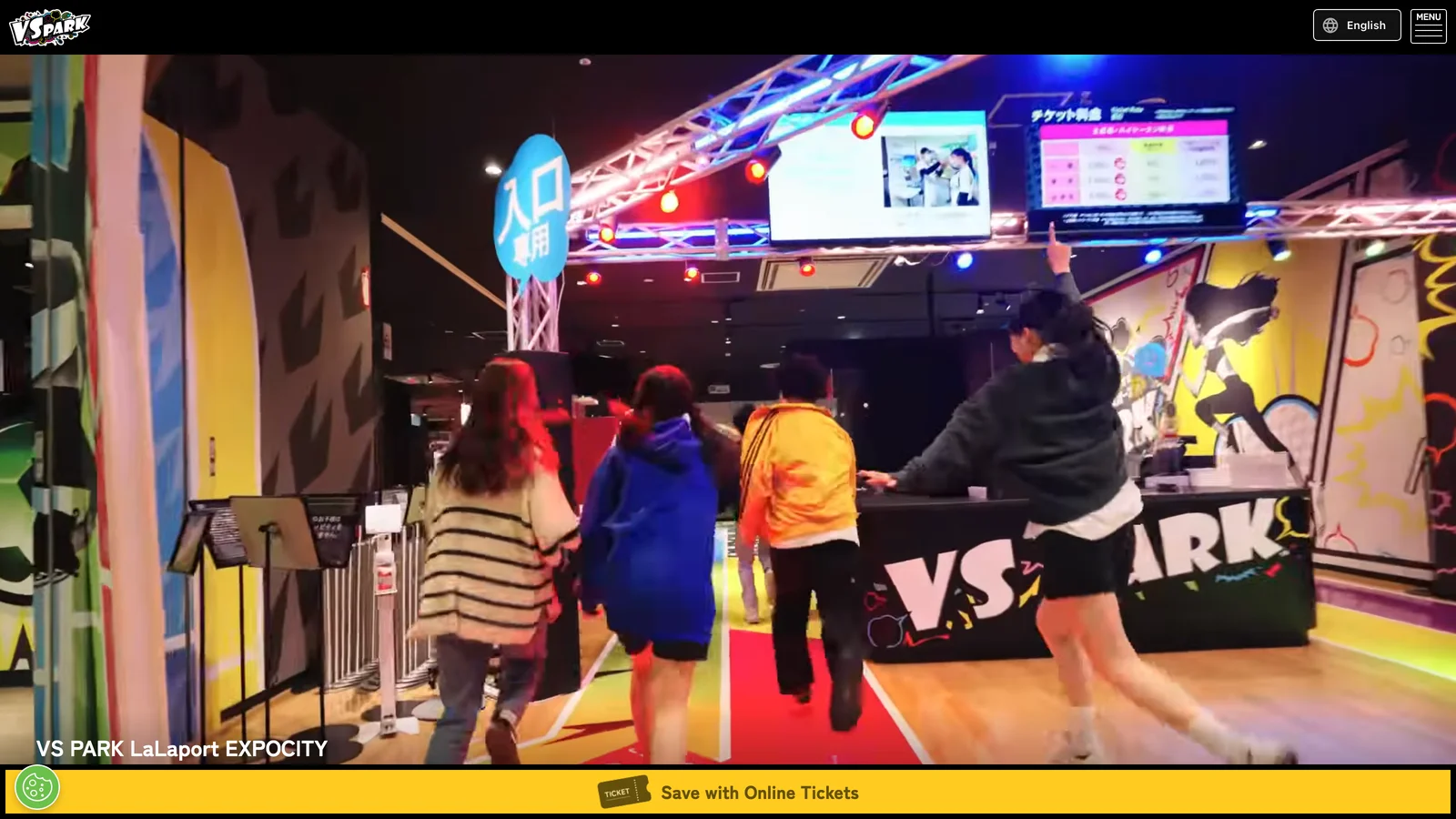
Bandai Namco Amusement's VS PARK is the clearest permanent example of the format. The flagship sits inside LaLaport EXPOCITY, a large retail and entertainment complex in Suita, northern Osaka, built on the Expo '70 Commemorative Park site and served directly by the Osaka Monorail — a high-footfall mall context rather than a standalone destination. The floor carries more than 25 activities marketed as "yabasugi sports" (roughly: absurd sports) — deliberately exaggerated variations on real ones.
The operationally interesting detail is not the count, it is the cadence. The Osaka floor was renewed on 6 February 2025 with five new activities, and again on 5 December 2025 with three more, two of them Kansai firsts. A venue that renews twice a year is telling you something structural: in this category, content is consumable. The attraction mix is the product, and it depreciates.
That has a direct technical implication. If your tracking layer is welded to one game, every refresh is a rebuild. If the tracking layer is general — a skeleton, a set of events — a refresh is a content project.
2-2. Japan: Round One Spo-Cha

Spo-Cha (Round One's "sports and leisure buffet") is the incumbent volume operator: nationwide coverage, decades of running active entertainment at scale, and a flat-rate model that turns the floor into a browse-and-graze experience rather than a per-attraction purchase.
For an operator evaluating motion-based bays, Spo-Cha is the useful benchmark for what "normal" looks like on staffing, throughput, and wear — before any digital layer is added. Most of the hard operational questions in section 4 have already been answered there in analogue form.
2-3. US: TOCA Social, Dallas

TOCA Social opened its US flagship at Grandscape in The Colony on 6 March 2026 — 20,000 sq ft, backed by soccer figures including Eddie Lewis and Abby Wambach, timed to a Dallas World Cup year in which the city hosts nine matches and the International Broadcast Center.
Guests book private boxes and kick real balls at large digital targets; TOCA's proprietary ball-delivery and tracking system turns each strike into points and game modes. It is the clearest commercial proof that the format sells — and it is worth being precise about what it proves. TOCA tracks a ball into a target area, a constrained, well-lit, known-geometry problem. That is a different engineering problem from reading a full body in free motion, and it is solved with different tools.
2-4. The RFID incumbents: Activate and Level99
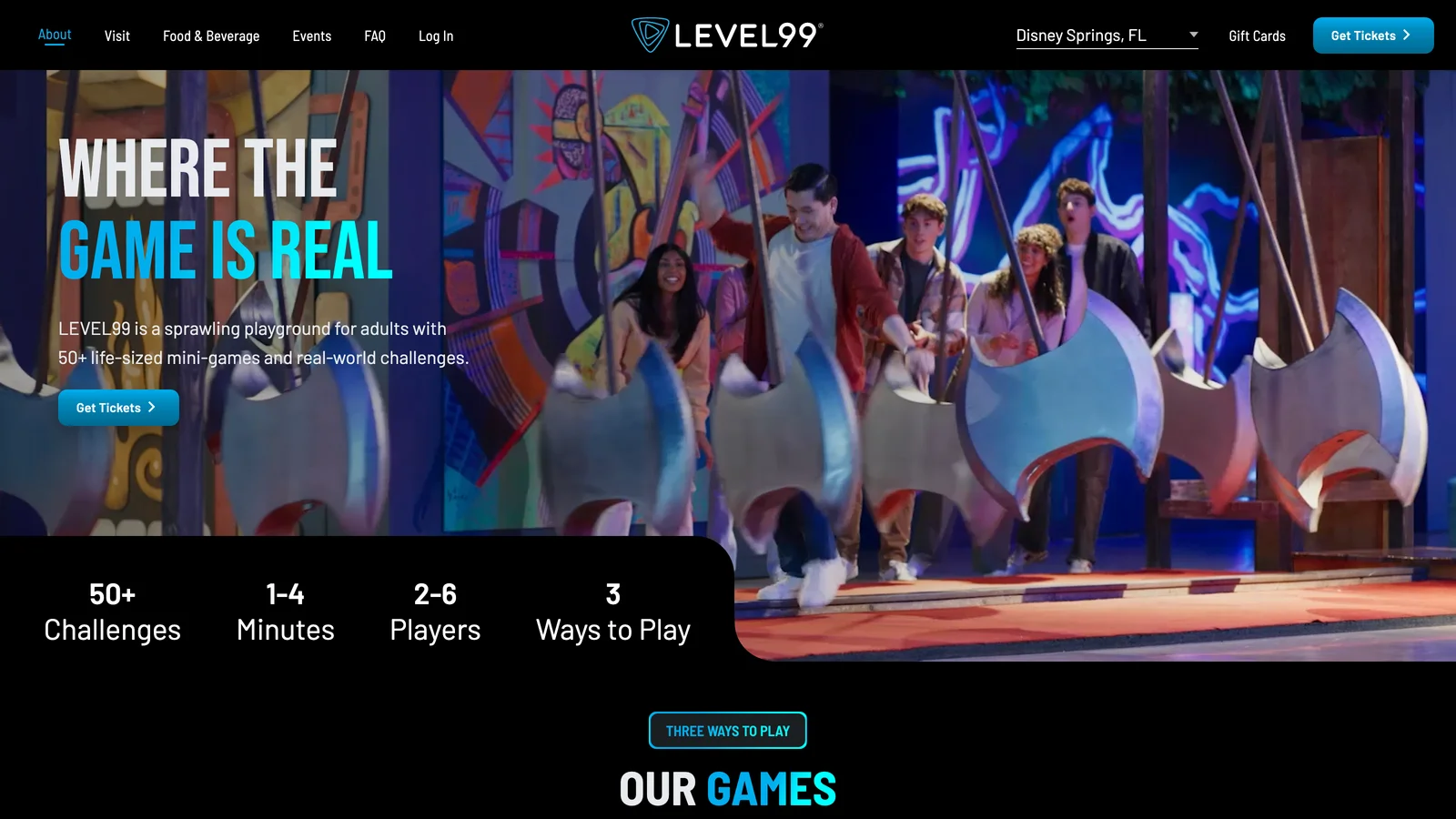
Activate Games runs rooms where players jump, run, and climb, tracked by RFID wristbands and pressure-sensitive floors. Its Roseville location, opening in 2026, fits 14 interactive game rooms into 10,900 sq ft. Level99 opened at Disney Springs on 29 June 2026 with 60+ challenges across 46,800 sq ft, using an RFID "Veloband" to carry progress between them.
These are the category leaders, and neither is doing camera-based motion tracking. That is not a weakness in their model — it is a deliberate and correct choice. RFID and pressure floors are cheap, essentially unbreakable, indifferent to lighting, and perfectly suited to where a player is and what they touched.
What they cannot tell you is how a player moved. There is no jump height, no swing speed, no form. Motion-tracked bays are not a replacement for the RFID layer; they sit beside it, covering the games that need a body read rather than a position read. An operator planning a mixed floor should expect to run both.
IP × sports is a growing adjacent format. Japan saw a large-scale example in 2026 with the "Haikyu!! On the Court" volleyball experience, built around jump, hit, and receive booths (official post). Licensed pop-ups follow a different economic and technical model from permanent bays — shorter runs, faster builds, and content tied to a licence window. See our pop-up event installation guide for that model.
3. The Five Motion Archetypes and What Each Demands
Not all sports motion is equally hard to read. Sorting the games you want by archetype is the fastest way to tell which are safe on commodity tracking and which need real specification.
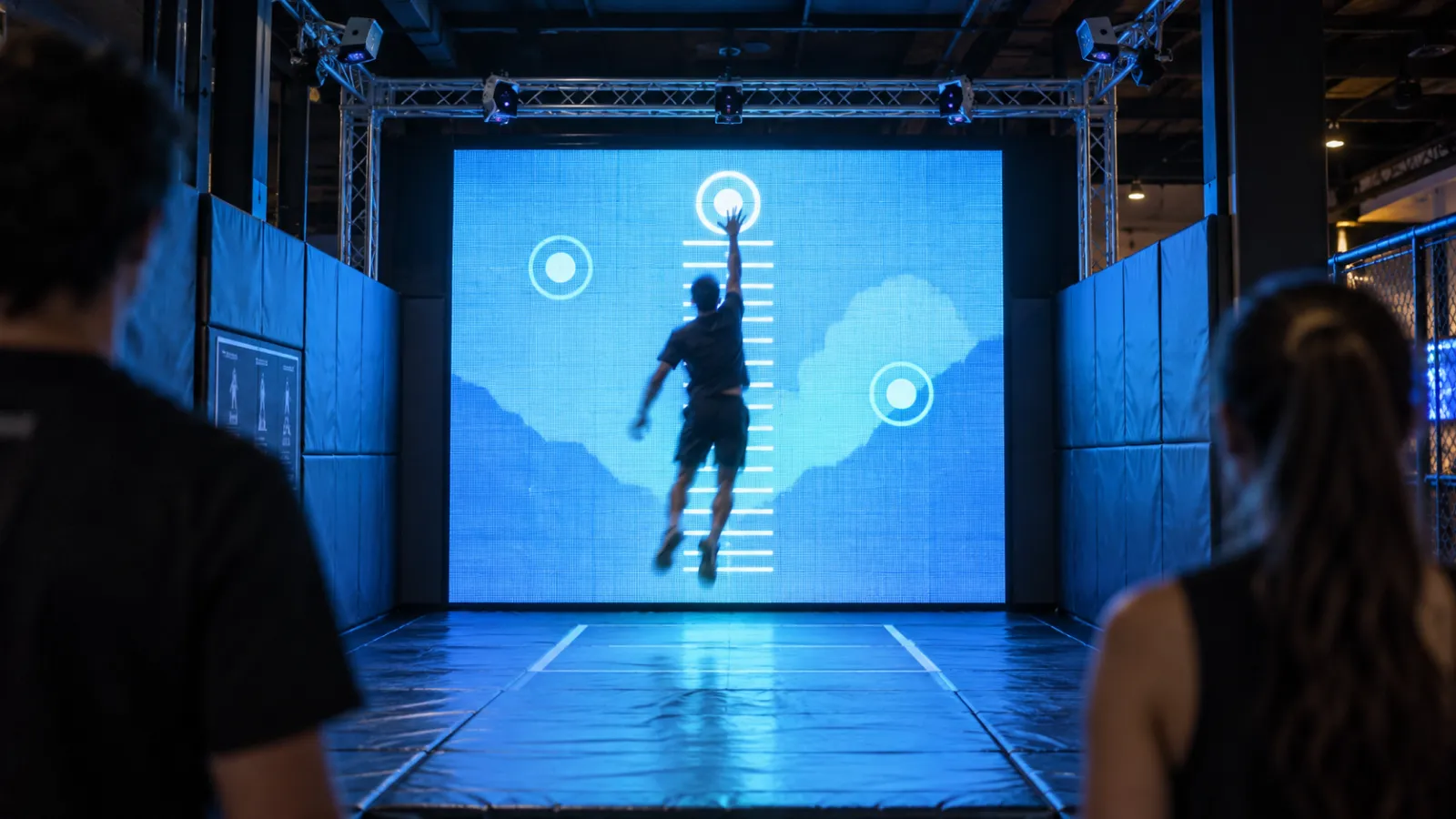
3-1. Jump — vertical displacement, peak-frame detection
The system needs one number: the highest point reached. This is a peak-detection problem, and peaks are exactly where a low sample rate hurts most — the true apex almost never lands on a sampled frame, so the value is interpolated from the frames either side.
Jump also needs metric scale, not just a skeleton. Knowing a hip rose "some amount" in image space is useless; you need centimetres, which means floor calibration and a known camera geometry.
3-2. Throw — arm velocity, release-point timing
Two quantities: how fast the hand was moving, and when it let go. Velocity from a skeleton is a difference between samples, so it inherits all the noise in the joint positions and amplifies it. Release timing determines the direction the virtual ball leaves in, and an error here is highly visible — the ball goes somewhere the player did not aim.
3-3. Swing — swing detection and velocity, not impact frame
A bat or racket swing is readable as a body motion: the system can detect that a swing happened, roughly how fast, and roughly on what plane.
What it cannot do, at any consumer frame rate, is observe the moment of contact. A bat tip moving at 30 m/s travels half a metre between frames even at 60fps. This is why the industry that genuinely measures implements — Toptracer, TrackMan — uses radar or dedicated high-speed cameras, not body tracking. Design the game so contact is a decision the game makes from swing timing and position, not a physical event the camera must catch.
3-4. Dance — continuous full-body, multi-person
Dance has no discrete event to detect, which removes the timing precision problem entirely. Instead it demands continuity: the skeleton must stay stable for minutes, across multiple people who occlude each other constantly.
This is the archetype most sensitive to tracking dropouts and identity swaps — two players crossing and coming out with each other's scores is an unrecoverable experience failure. It is also the most forgiving on latency.
3-5. Serve and receive — reaction window, timing tolerance
Reaction games judge whether the player responded inside a window. The tracking requirement is modest; the design requirement is that the window be honest and consistent. A generous, stable window feels fair. A tight window on a jittery signal feels broken even when the average accuracy is fine.
| Archetype | Tracked quantity | Timing tolerance | Failure mode at 30fps |
|---|---|---|---|
| Jump | Peak vertical displacement, in cm | Peak frame | Apex missed between samples; height reads low |
| Throw | Hand velocity, release moment | ~1 frame | Ball leaves on the wrong vector |
| Swing | Swing occurrence, speed, plane | ~1–2 frames | Sluggish, disconnected from the swing |
| Dance | Continuous multi-person skeleton | Low | Identity swaps, dropouts mid-routine |
| Serve / receive | Response inside a window | Window-dependent | Jitter makes a fair window feel unfair |
4. Designing for Venue Economics
4-1. Capacity math
The number that decides whether a bay works is guests per day, and it is built from four inputs:
(cycle time + reset time) → plays per hour per bay × players per play × operating hours
A worked example. A jump bay with a 45-second play cycle and a 15-second reset runs 60 plays per hour. At one player per play and 12 operating hours, that is 720 plays per day per bay. Add a second player position and the ceiling doubles, but only if the tracking handles two people reliably — which is a technical decision made months earlier.
Two things fall out of this immediately. Reset time is as valuable as play time: cutting a 15-second reset to 5 seconds adds 12 plays per hour, roughly a 20% capacity gain, for no additional floor space. And multi-player capability is a capacity multiplier, which is why single-player tracking in a social venue is an expensive mistake rather than a minor limitation.
4-2. Repeat-play rate as the KPI
Capacity is the ceiling. Repeat-play rate determines how close you get to it.
This is the KPI a 30fps experience quietly destroys. A player whose jump reads low, or whose throw leaves on the wrong vector, does not file a complaint — they play once and walk to the next bay. The bay looks busy on opening weekend and empty by month three, and the diagnosis usually lands on "content got stale" when the real cause was that the system never felt like it was reading them.
Instrument this. Plays per unique visitor, and the drop-off between first and second play on the same bay, will tell you which attractions are actually working long before the revenue does.
4-3. Physical envelope
Motion bays are specified in three dimensions, and the vertical one is routinely forgotten:
- Ceiling height must clear a full overhead swing and a jump with arms extended, plus the mounting height of anything above the play area
- Run-up and follow-through space beyond the nominal play zone, sized for a guest who does not stop where you expected
- Camera sightlines that are not blocked when the bay is full, which is the only condition that matters
- Lighting geometry — see section 5-3; this is a tracking input, not just an aesthetic decision
4-4. Staffing and instruction-free onboarding
A bay that needs a staff explanation has a hidden per-play cost and a hard capacity limit. Design for a guest who walks up, sees what to do, and does it — no reading, no instruction, no attendant.
The practical test is whether a first-time player starts correctly without help. If they hesitate, the bay is costing you capacity every single cycle.
4-5. Uptime
Twelve hours a day, every day, is a harsher duty cycle than most installation work. What breaks first, in rough order: physical props and anything hand-held, then displays, then mounting hardware loosened by vibration, then the compute. Cameras and sensors themselves rarely fail — they get bumped out of alignment, which is worse, because it degrades quietly rather than failing loudly.
Any bay that depends on calibration needs a calibration check that a non-technical staff member can run daily and a defined recalibration path. Without it, accuracy drifts for weeks before anyone notices.
5. The Tracking Problem, and How to Specify Around It
5-1. Sampling density and latency
Here is the actual argument, stated carefully, because the loose version of it is wrong.
An amateur guest's hand moves roughly 8–12 m/s in a hard throw or swing. At 30fps, samples are 33ms apart, so the hand travels 30–40cm between consecutive samples. Velocity estimates, peak detection, and release timing are all built from two or three points spread across that distance. Then the body-tracking SDK adds its own processing delay on top.
At 60fps you get twice the samples and roughly half the sampling latency. Not because 60 is a magic number — because it is the point where the residual error is small enough that game design can absorb it and still feel fair.
What 60fps does not buy you is contact detection. At 60fps a fast hand still moves 15–20cm between frames. Contact is inferred at any consumer frame rate. The honest architecture is that the camera reads the body and the game owns the ball: the system decides that a hit occurred from swing timing and position, then simulates the ball. Any vendor claiming to physically observe the moment of impact with a body-tracking camera is describing something else.
5-2. Why the turnkey skeleton SDKs are stuck at 30fps
The off-the-shelf body-tracking stack has a frame-rate ceiling that has not moved in years. Microsoft's Azure Kinect DK — the reference sensor for most of the industry — caps depth at 30fps and was discontinued in October 2023. The Orbbec Femto Bolt, its closest drop-in replacement, uses the same iToF technology and inherits the same 30fps cap. Users of the Azure Kinect Body Tracking SDK have reported end-to-end latency around 200ms at 30fps even with GPU acceleration. Nuitrack, the leading third-party skeleton SDK for RealSense and Orbbec sensors, is community-reported in the 14–20fps range in practical deployments.
To be precise about where the limit actually is: raw high-frame-rate depth capture is not the problem. An Intel RealSense D435 will deliver depth at 90fps at 848×480. What it will not give you is a skeleton — there is no first-party skeletal tracking SDK for it. The gap is in the turnkey skeleton pipelines, not in physics or in sensor hardware.
For the full comparison of sensor types across installation use cases — depth, LiDAR, camera, IMU, audio — see our interactive point cloud guide, which covers that matrix properly. The relevant point here is narrower: if you specify a Kinect-lineage sensor for a fast sports bay, you have specified 30fps, and you have specified a discontinued supply chain.
5-3. Why 60fps is a venue constraint, not a compute ceiling
The common assumption is that higher frame rates need exotic computers. They do not, and understanding why changes what you should negotiate over.
Inference has been cheap since 2019. RTMPose-m, a standard real-time pose model, runs at 430+ FPS on a GTX 1660 Ti — a mid-range card from 2019 — using TensorRT. Resolution barely matters either: top-down pose estimation runs on a cropped person box of roughly 256×192 pixels, not the full frame, and the person detector that does see full resolution is typically skip-framed. Feeding it 1080p instead of 720p costs almost nothing.
Cameras are cheap too. Global-shutter machine-vision modules built on sensors like the AR0234 deliver 120fps at full 1920×1200 over USB3, in the low hundreds of dollars. Global shutter matters here independently of frame rate: it exposes every pixel simultaneously, so a fast-moving limb is not skewed across the frame the way a rolling shutter renders it.
So what actually caps you, in order of how often it bites:
(a) Light. This is the binding constraint. At 120fps your maximum exposure is 8.3ms; at 240fps it is 4.16ms. Halving exposure halves the light reaching the sensor. Active-entertainment venues are deliberately dark — dark room, bright screen, that is the whole aesthetic. Your options are all costly: add lighting and damage the atmosphere the venue was designed around, open the aperture and lose depth of field so players at other distances go soft, or raise gain and introduce noise that degrades keypoint precision. This is a lighting-design and electrical problem, and no computer solves it.
(b) Display refresh. A 60Hz screen or projector emits a new image every 16.7ms no matter how fast you track. Tracking faster than the display still reduces latency — you sample sooner — but it does not make the output smoother.
(c) Projector input lag. Commonly 30–60ms of internal processing, and routinely omitted from vendor latency claims. On a projected bay this can exceed every other source of delay combined.
(d) Buffering. Anywhere in the chain — capture driver, compositor, display pipeline — and invisible in an fps number.
The conclusion for an operator: 60fps is where camera, light, display, and latency line up at sane cost. It is not a wall anyone heroically broke, and a vendor presenting it that way is selling the wrong thing.
5-4. Camera-only tracking: what it gives up
We build camera-only tracking — RGB plus on-device neural inference, no depth sensor. It is the right architecture for this category, and it has real costs that any honest specification has to account for.
- No metric depth for free. A depth sensor knows how far away things are. A camera does not. Jump height in centimetres requires floor calibration and known camera geometry, and it stays right only as long as nothing gets bumped. This is a genuine operational burden, not a footnote — see 4-5.
- Single-viewpoint occlusion. One camera cannot see a limb hidden behind a torso. Depth sensors share this problem, but a camera pipeline has no depth channel to help disambiguate. Multi-person bays generally need more than one viewpoint.
- Lighting dependence. Covered above, and it is the constraint that most often decides whether a specific bay is feasible in a specific room.
If a vendor tells you camera-only tracking has no trade-offs, they have not deployed one.
5-5. Our path: from Kinect to camera-only, and what transfers
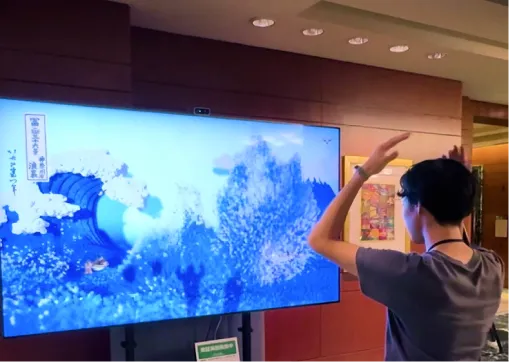
Our Hokusai installation used a Kinect depth camera to track up to six visitors simultaneously, turning their movement into forces acting on a million-particle wave. It works, and it was the right choice: a slow, ambient wave has no timing precision requirement at all, so 30fps was never a limitation. That project is a good illustration of when depth sensing is entirely adequate.
We have since built camera-only body tracking for a brand retail activation with body-driven interactive experiences. We are not able to name the client.
We want to be straight about what that does and does not qualify. We have not delivered a permanent sports attraction. What transfers from that work: markerless full-body capture with zero guest onboarding, handling multiple people in frame, unattended daily operation, and camera-only calibration in a fixed space. What does not transfer: sustained full-effort athletic motion, sport-specific timing tolerances, and the wear profile of high-abuse repeat play. Those are real gaps and we would treat them as the risk areas in a first sports bay.
We would rather state that plainly than let a case study imply otherwise — and it is exactly why the next section matters more than any vendor's portfolio.
5-6. What to ask any vendor to demonstrate
Anyone quoting you a frame rate without a latency number is quoting the easy half. Frame rate is a spec sheet line. Latency is a system property, and it is what the guest actually feels.
Ask for:
- Measured motion-to-photon latency, with the method stated. Hand moves, screen responds — how many milliseconds, and how was it measured? A defensible method is filming the player and the display together at high frame rate and counting frames. Anyone who cannot produce this number has not measured it.
- That number measured under your venue's actual lighting. Not their studio. Lighting is the binding constraint (5-3), so a demo in a bright workshop tells you nothing about a dark bay.
- Display and projector lag included in the figure. A 40ms tracking pipeline into a 60ms projector is a 100ms experience. Insist the number is end-to-end.
- Occlusion recovery, shown live. Have someone walk in front of the player mid-motion. Watch what the skeleton does and how long it takes to come back.
- Simultaneous players, at your intended count. Two people crossing paths. Check that scores stay attached to the right person.
- A calibration procedure a staff member can run. If recalibration needs the vendor, budget for the vendor.
6. Common Pitfalls
- Generalising from a gesture wall. "We already do motion tracking" is true and irrelevant. Slow ambient interaction and fast athletic motion are different engineering problems with different frame-rate and latency requirements.
- Specifying a discontinued sensor. Kinect-lineage hardware is still widely quoted in proposals. It caps you at 30fps and puts a discontinued part in a system you plan to run for five years.
- Forgetting the vertical envelope. Ceiling height kills more sports bay concepts at the survey stage than budget does, and it is discovered late with depressing regularity.
- Single-player tracking in a social venue. These venues are social by definition. Single-player tracking halves your capacity ceiling and removes the head-to-head play that drives retries.
- Content welded to the tracking layer. If refreshing a game means rebuilding the tracking, your renewal cadence dies. VS PARK renewed twice in 2025 — assume you will need to.
- No latency figure in the acceptance criteria. If measured end-to-end latency is not a contractual number you can test on delivery, you have no basis to reject a bay that feels wrong.
7. How to Get Started — a Roadmap
- Sort your candidate games by archetype (section 3). Anything in the jump, throw, or swing group needs the tracking specification treated as a primary risk. Dance and reaction games are more forgiving.
- Survey the room before designing the game. Ceiling height, run-up space, sightlines, and — critically — the lighting you are willing to change. Lighting decides feasibility.
- Run the capacity math (4-1) for each candidate bay, including reset time and player count, and check it against the floor area it consumes.
- Write latency into the brief. A measured end-to-end motion-to-photon target, under your lighting, tested on delivery.
- Prototype the single hardest bay first, not the easiest. If the jump bay works, the reaction games will.
- Plan the refresh cycle from the start. Decide what a content update costs and how often it happens before you commission the first attraction.
About Utsubo
We are an Osaka-based studio building interactive installations and real-time 3D experiences. Relevant to this category:
- Full-body markerless tracking, camera-based and depth-based, built and deployed in public environments
- Real-time rendering for large-format displays and projection
- Experience design for unattended, instruction-free public use
We have built body-tracked installations for museum and retail environments. We have not yet delivered a permanent sports attraction, and we would scope a first one around the gaps named in section 5-5 rather than claim they do not exist.
Let's Talk
If you are evaluating motion-based bays for a facility and want a project discussion — including an honest read on whether your room and lighting can support what you have in mind — we are happy to talk it through and work out whether we are the right fit.
Checklist: Motion-Based Sports Bay Readiness
- Candidate games sorted by motion archetype, with the timing-critical ones flagged
- Ceiling height confirmed for full swing and jump, including overhead mounting
- Run-up and follow-through space measured beyond the nominal play zone
- Lighting plan agreed as a tracking input, not only an aesthetic one
- Capacity math run per bay: cycle time, reset time, players per play, operating hours
- Multi-player tracking confirmed at the player count your capacity model assumes
- Measured end-to-end motion-to-photon latency written into the acceptance criteria
- Display and projector input lag included in that measured figure
- Daily calibration check defined and runnable by non-technical staff
- Content refresh cadence and cost agreed before the first bay is commissioned
FAQs
Can current off-the-shelf sensors do 60fps full-body tracking?
Not as a turnkey product. The Kinect-lineage sensors — Azure Kinect DK, discontinued in October 2023, and the Orbbec Femto Bolt that replaced it — cap depth at 30fps, and their body-tracking SDK has been reported at around 200ms latency even on GPU. Nuitrack, the main third-party skeleton SDK, is community-reported at 14–20fps in practice. Raw high-frame-rate depth capture does exist: an Intel RealSense D435 delivers 90fps depth at 848×480. It simply has no first-party skeletal tracking. The gap is in the turnkey skeleton pipelines, not in sensor hardware.
Why does frame rate matter more for sports than for a gesture wall?
Because of what is being measured. An amateur guest's hand moves 8–12 m/s in a hard throw, so at 30fps it travels 30–40cm between samples. Peak jump height, hand velocity, and release timing all get estimated from two or three points across that distance. A slow ambient gesture wall has no timing-critical event to detect, so 30fps is entirely adequate there.
Can a camera system detect the exact moment a bat hits a ball?
No, and no consumer frame rate changes that. A bat tip at 30 m/s travels half a metre between frames even at 60fps. The industries that genuinely measure implement impact use radar or dedicated high-speed cameras. The correct design is for the camera to read the body and the game to own the ball — contact is decided from swing timing and position, then simulated.
Do we need an expensive computer to run 60fps tracking?
Compute is the cheapest part of the problem. A standard real-time pose model runs at over 430 FPS on a mid-range GPU from 2019, and pose estimation operates on a small cropped region rather than the full frame, so resolution costs little. The real constraints are lighting — at 120fps your maximum exposure is 8.3ms, which is demanding in a deliberately dark venue — plus display refresh rate and projector input lag.
What is the single most useful question to ask a tracking vendor?
Ask for measured end-to-end motion-to-photon latency, under your venue's lighting, with display and projector lag included, and with the measurement method stated. Frame rate is a spec-sheet number; latency is what the guest feels. A vendor who cannot produce a latency figure has not measured one.
How many people can be tracked in one bay at once?
It depends on the sensor and the geometry, not on a fixed limit. Our Kinect-based museum work tracked six people simultaneously in an ambient context. The harder constraint in a sports bay is occlusion — one camera cannot see a limb hidden behind another body — so multi-player bays generally need more than one viewpoint. Confirm the count in a live demo with players crossing paths, since capacity models depend on it.
How often does a motion-based attraction need new content?
Plan for at least annual rotation and be ready for more. VS PARK's LaLaport EXPOCITY location in Osaka renewed its activity lineup twice during 2025. The practical implication is architectural: keep the tracking layer general so that a new game is a content project rather than a rebuild.


 Osaka Interactive Installation Studio