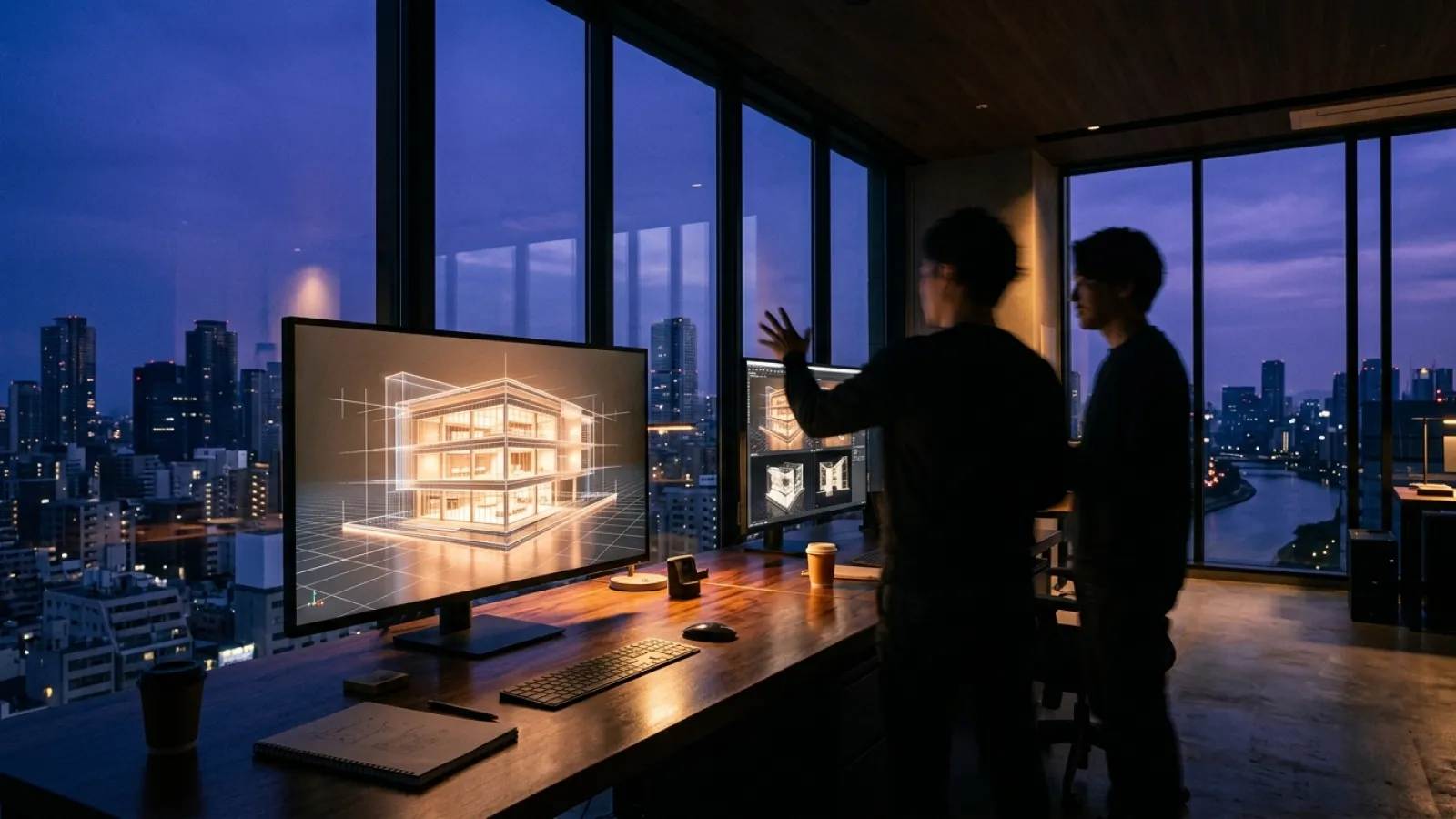
A flagship store costs a brand $500K–$5M to build and reaches the people who walk past it. A digital twin of that same space — navigable in any browser, on any continent, at 2 a.m. — costs a fraction of that and never closes. That gap is why brand and retail teams are commissioning experiential digital twins in 2026: not to manage a building's HVAC, but to put a living, explorable version of a product, store, factory, or brand world in front of every customer who can't be there in person.
This guide is about that second kind of twin — the brand-facing experience, not the operations dashboard. It covers what a brand or showroom digital twin actually is, where it pays off, how it's built and delivered on the web, what it costs, and when you genuinely don't need one.
Who this is for: Brand, marketing, and retail-experience directors evaluating a virtual showroom or brand world; innovation and experience-design leads scoping a real-time 3D project; and agencies that need a credible way to brief and budget one.
Key Takeaways
- A brand/showroom digital twin is a navigable, real-time 3D replica of a physical product, space, or brand world, delivered in the browser — distinct from an operational/IoT digital twin and from a static 360° tour.
- It is an always-on experience surface, not a one-off campaign asset. Budget it against the reach and lifespan of the experience, not against a single launch.
- Five use cases consistently justify the spend: virtual flagship/showroom, hero product storytelling, factory/heritage tours, large-product (vehicle/equipment) exploration, and a persistent brand world.
- Cost follows the custom-website ladder: $20K–$50K for a focused single-product twin, $50K–$100K for a full showroom experience, and $100K–$200K+ for a flagship brand world — plus a $15K–$80K real-time 3D adder and 15–20%/yr maintenance.
- The two technical decisions that drive everything are how you capture (photogrammetry / Gaussian splatting / built-in-3D) and how you deliver (real-time 3D on the web, with a mobile fallback that doesn't tank performance).
- The most expensive mistakes are scoping a full twin when a configurator or a few renders would do, ignoring mobile reality, and treating a heavy 3D scene as something you can bolt onto an existing site without a performance budget.
1. What a Brand or Showroom Digital Twin Actually Is
The phrase "digital twin" is overloaded. Three different things hide under it, and only one is the subject of this guide.
1-1. Three meanings, one relevant here
- Operational digital twin — a data-synced model of a machine, building, or process used by engineers to simulate and monitor it (sensors, IoT, HVAC, predictive maintenance). This is industrial software, not a brand experience. Out of scope here.
- Static virtual tour — a 360° photo or Matterport-style scan you click through. Useful, but a slideshow of viewpoints, not a real-time experience you can move freely inside.
- Experiential digital twin — a navigable, real-time 3D replica of a product, space, or brand world that a customer explores in the browser, with motion, lighting, interaction, and storytelling layered on top. This is what brands and showrooms commission, and what this guide covers.
If you're capturing an existing building to lease office or retail space, that's commercial real estate, not brand experience — see the Gaussian Splatting for Commercial Real Estate guide instead. If you're selling condo units pre-construction, see the Real Estate Developer Website guide. This article is for the brand that wants the experience of its store, product, or world to exist online.
1-2. The defining trait: you move, it responds
A static tour shows you fixed positions. A digital twin experience lets you walk the floor, orbit the product, open a drawer, change a finish, follow a guided path, or wander off it — in real time, at 60fps where the hardware allows. That interactivity is the whole point: it converts "looking at photos of the thing" into "being with the thing," which is what closes the perception gap between online and in-person.
2. Where a Digital Twin Pays Off
Not every brand needs one. These five scenarios are where the experiential twin earns its budget instead of being a tech demo.
2-1. Virtual flagship / showroom
Your flagship reaches a city. Its digital twin reaches everyone who searches your name. A virtual showroom lets a customer in another country walk your space, see products in context, and feel the brand's spatial language — the thing a product grid on a website can never convey. Strongest for premium retail, furniture, automotive, beauty, and any brand whose physical space is the pitch.
2-2. Hero product storytelling
A single flagship product — a watch, a sneaker, a device, a bottle — rendered as a real-time 3D centerpiece that the visitor orbits, disassembles, and inspects. This is where capture quality and material fidelity matter most. It's the spiritual sibling of a scroll-driven splat landing page, but built around free exploration rather than a fixed scroll narrative.
2-3. Factory, atelier, or heritage tour
Brands with a story in their making — a distillery, an atelier, a heritage factory — use twins to take customers somewhere they'd never physically go. This doubles as recruitment and trust content: "here is how, and where, this is actually made."
2-4. Large or inaccessible products
Vehicles, machinery, yachts, architecture, installations — anything too big, too expensive, or too rare to put in front of every prospect. A twin lets a buyer explore a $2M machine or a concept car at full scale before a single sales visit.
2-5. A persistent brand world
Beyond any single store or product: a branded 3D environment that hosts launches, seasonal campaigns, and collaborations over time. Unlike a campaign microsite that's archived after eight weeks, a brand world is an asset you build on. This only makes sense for brands with a sustained content cadence — otherwise it's an expensive room nobody returns to.
3. How Digital Twins Are Built
Two decisions dominate the build: how you capture reality, and how you deliver it on the web. Everything else is execution.
3-1. Capture: turning the real thing into 3D data
There are several ways to turn a physical object or space into 3D, and they trade off photorealism, file size, edit-ability, and cost. We won't re-explain the full matrix here — the capture-method commissioning guide scores photogrammetry vs Gaussian splatting vs NeRF vs LiDAR on six axes, and the Gaussian Splatting guide covers formats and web viewers. The short version for brand twins:
- Gaussian splatting — best photoreal capture of real spaces and objects, web-streamable, light on geometry. The default for "make this real place feel real online."
- Photogrammetry → clean mesh — when you need an editable, relightable model (a hero product you'll spin, recolor, or animate).
- Built-in-3D (Blender/CAD) — when the product or space is designed digitally first, or doesn't physically exist yet (a concept, a pre-production vehicle).
Most real brand twins are hybrids: a splat-captured environment with clean, interactive built-3D products placed inside it.
3-2. Delivery: real-time 3D in the browser
Capture is not delivery. A 200MB scan is data; an experience is what runs smoothly on a phone over hotel Wi-Fi. Delivering a twin that feels premium is a performance-engineering problem, and it's where most projects quietly fail.
The production pipeline we use on real-time 3D brand work — proven on the Vectr WebGPU case study — is:
- Three.js / WebGPU for rendering, with a WebGL fallback for older devices.
- OffscreenCanvas so the 3D scene renders off the main thread and the rest of the page stays responsive.
- Draco-compressed GLB assets, cutting payloads 80–95% versus raw meshes.
- Progressive / streamed loading so the visitor sees something fast and detail fills in.
3-3. Where it lives: web, on-site, or both
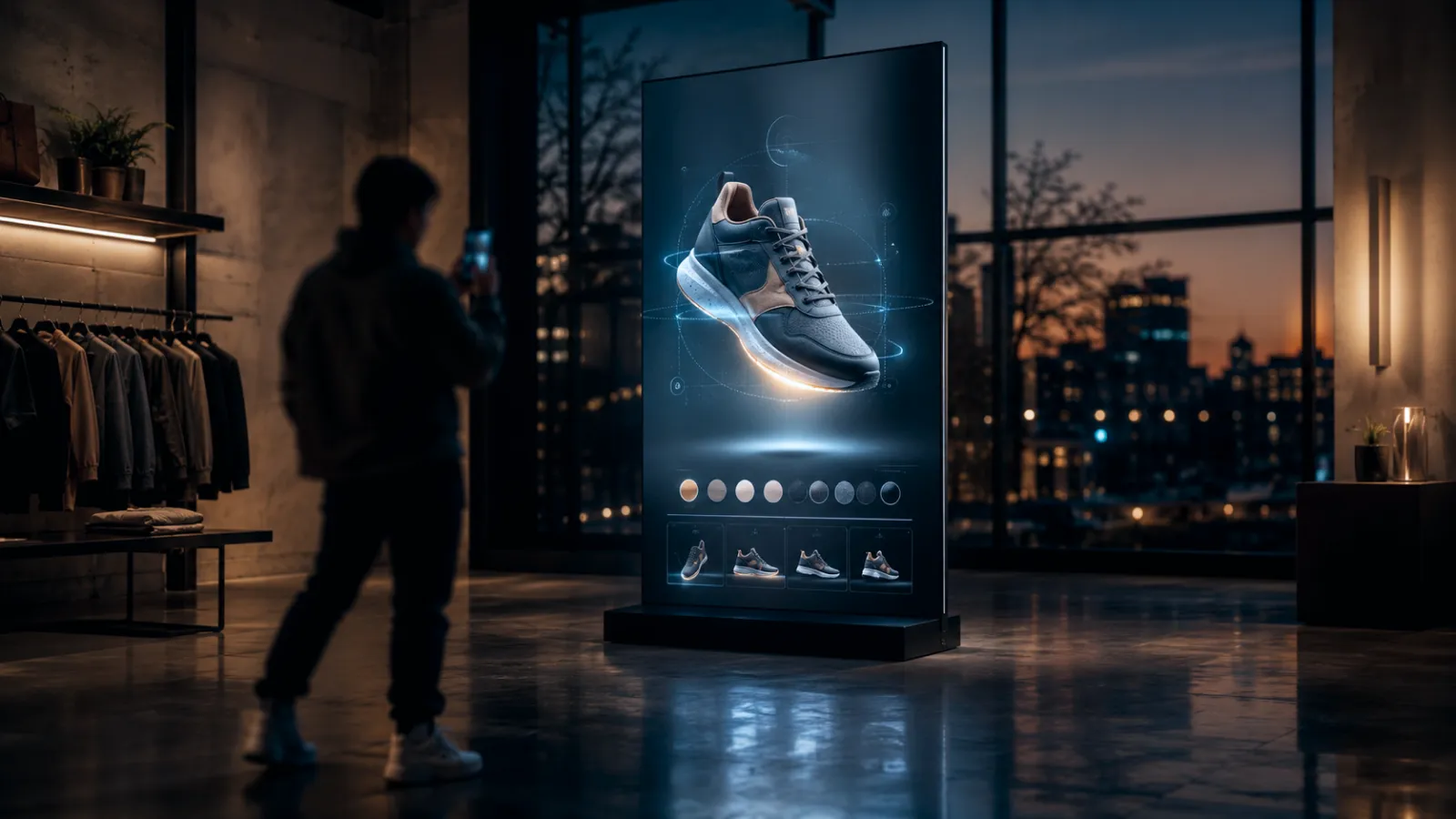
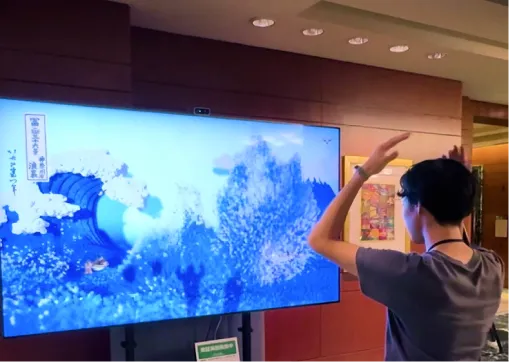
The same twin can ship to three places: the open web (marketing reach + SEO), an on-site kiosk or large display in the actual store (sales-team tool, endless aisle), and occasionally a headset. Browser-first is almost always the right primary target in 2026 — WebXR is improving but still trails phone and tablet in real-world use. Build for the browser, then consider the kiosk; treat the headset as a nice-to-have.
4. Performance & Mobile Reality
The single most common failure mode is a beautiful twin that crawls on the devices most of your audience actually uses.
- Most traffic is mobile. A scene that's flawless on a workstation can be unusable on a mid-range phone. The twin needs a real mobile budget — reduced geometry, capped texture resolution, or a graceful static/lighter fallback.
- First paint can't wait for the whole scene. Defer the 3D bundle past initial render, stream assets, and show a meaningful poster frame immediately.
- It affects your SEO. A heavy canvas with no fast text content hurts Core Web Vitals and rankability. We won't re-cover that here — the WebGL & Three.js SEO guide details deferring the 3D bundle, moving shader compile into a worker, and shipping a static mobile image.
Treat performance as a line item in the brief, not a thing you fix at the end. A twin that loses half its audience to jank is a twin that didn't ship.
5. Budget: What a Brand Twin Costs
A digital twin experience sits on the custom-website cost ladder — it's a high-motion, integrated 3D web build, not a separate category. These are starting ranges; real numbers depend on capture scope, how many products are interactive, language count, and how much of the creative direction you bring.
For broader context on what drives custom web pricing, see the Premium Website Cost Guide.
| Scope | Range | What you get |
|---|---|---|
| Focused single-product twin | $20K–$50K | One hero product or one captured space, real-time 3D moment, one focused interaction, CMS, SEO. |
| Full showroom experience | $50K–$100K | A navigable space with multiple interactive products, scroll/guided storytelling, integrated 3D, headless CMS, 90+ Lighthouse. |
| Flagship brand world | $100K–$200K+ | Full 3D environment, multiple zones, custom interactions, multi-market, dedicated performance engineering. |
Cost drivers on top of the base:
- Real-time 3D / WebGL adder: +$15K–$80K depending on scene complexity and interactivity — this is usually the largest single variable.
- Capture: a separate budget from delivery. Splat/photogrammetry capture typically runs lower than custom-built 3D worlds; the capture guide covers ranges.
- Multilingual: +30–50% per language (real for any global brand or inbound-facing showroom).
- Maintenance:15–20% of build per year for hosting, content updates, and keeping the experience current as browsers and devices move.
A useful sanity check: if a single physical flagship costs $500K–$5M and reaches one location, a $50K–$150K twin that reaches your entire online audience is rarely the expensive line item — provided you have the traffic and the brand bar to justify it.
Context:
- Brand / category: [fill in]
- What we'd capture or build (product, store, factory, brand world): [fill in]
- Primary audience and where they are: [fill in]
- Primary goal (reach, sales support, brand, recruitment): [fill in]
- Rough budget range: [fill in]
Please help me:
- Decide whether a full twin, a single-product 3D moment, or a simpler 360 tour fits the goal
- Identify which scope tier (single-product / showroom / brand world) matches
- List the 5 questions a studio will need answered to quote accurately
6. ROI — and When NOT to Build One
A twin earns its place when reach, decision-support, or brand differentiation justify it. It does not when a cheaper asset does the same job.
6-1. When it's worth it
- Your physical space or product is the pitch, and most of your audience will never stand in front of it.
- You sell cross-border or to remote buyers who decide before they visit.
- Your category is crowded and a generic product grid makes you look like everyone else.
- You have a content cadence (launches, seasons, collabs) that a persistent brand world can host.
For the bigger picture on splitting budget between physical and digital experience, see the Digital vs Physical Experience guide and The Experience Economy.
6-2. When to skip it
- A configurator is enough. If customers just need to pick a color and size, build a configurator, not a navigable twin. (Note: we don't build standalone commerce configurators — but the honest answer is sometimes "you need a configurator, not a twin.")
- A few renders do the job. For a product with one or two key angles, photoreal stills cost a fraction of a real-time twin and convert fine.
- You won't drive traffic to it. A brand world nobody visits is a sunk cost. No content plan, no twin.
- The brand bar doesn't need it. Mass-market, price-led categories rarely see the return.
7. Common Pitfalls
- Building a twin when a configurator or renders would do. The most expensive over-scope. Match the asset to the decision the customer is making.
- Ignoring mobile until the end. The audience is on phones; the budget must reflect it from day one.
- Treating heavy 3D as a bolt-on. A real-time scene needs a performance budget and the right delivery pipeline — not a plugin dropped onto an existing site.
- Capturing without a delivery plan. A gorgeous 200MB scan that won't stream is data, not an experience.
- No maintenance plan. Browsers and devices move; an unmaintained twin degrades from flagship to liability.
8. How to Get Started
- Define the goal first — reach, sales support, brand, recruitment. The goal picks the scope.
- Pick the use case from Section 2; don't build a brand world when you need one hero product.
- Decide capture vs build — real place → capture (splat/photogrammetry); designed/non-existent → built-3D. See the capture guide.
- Set a performance budget and name mobile as a first-class target in the brief.
- Match the tier to inventory of attention — how much traffic and brand weight justifies how much spend.
- Brief a studio that ships real-time 3D on the web, not just renders or a CMS.
Our situation:
- What we want explorable in 3D: [product / store / factory / brand world]
- Goal and primary KPI: [fill in]
- Audience devices and locations: [fill in]
- Languages needed: [fill in]
- Budget tier: [single-product / showroom / brand world]
Produce a one-page brief covering: objective, scope, capture vs built-3D, delivery (web/kiosk), performance + mobile requirements, languages, success metrics, and the questions we still need to answer.
9. About Utsubo
Utsubo is an Osaka-based creative-technology studio specializing in real-time 3D on the web and interactive installations. We build WebGL/WebGPU brand experiences with production-grade performance engineering — our Vectr case study shipped a real-time WebGPU 3D hero off the main thread via OffscreenCanvas, with a WebGL fallback and a Draco/GLB pipeline that cut payloads 80–95%, scoring 94+ on Lighthouse. The same capture-to-web pipeline is what makes a brand digital twin feel premium instead of janky.
If you need a real-time 3D partner who treats performance as a deliverable, that's the work we do: WebGPU Experts.
10. Let's Talk
Building a virtual showroom or brand-world experience in 3D? We work with teams on interactive experiences, real-time 3D, and immersive brand projects.
If you're exploring a partnership, let's discuss your project:
- What you're building and the constraints you're working with
- Which technical approach makes sense for your goals
- Whether we're the right fit to help you execute
11. Checklist
- Goal defined (reach / sales support / brand / recruitment)
- Use case chosen (showroom / product / factory / large-product / brand world)
- Capture vs built-3D decided per the capture guide
- Performance + mobile budget written into the brief
- Scope tier matched to traffic and brand bar
- Languages and localized contact channels planned
- Delivery target chosen (web-first, optional kiosk)
- Maintenance budgeted at 15–20%/yr
- Studio shortlisted for real-time 3D web (not just renders)
FAQs
What's the difference between a digital twin and a virtual tour?
A virtual tour is a set of fixed 360° viewpoints you click between — essentially a slideshow. A digital twin experience is a real-time 3D space you move freely inside, with interaction, lighting, and storytelling. The tour shows you positions; the twin lets you explore.
Isn't a digital twin an operations/IoT thing?
That's the other meaning. Operational digital twins are data-synced models engineers use to monitor machines and buildings. This guide is about experiential twins — brand-facing, navigable 3D replicas of products and spaces used for marketing and showrooms. Same phrase, different product.
How much does a brand digital twin cost?
It sits on the custom-website ladder: roughly $20K–$50K for a focused single-product twin, $50K–$100K for a full showroom experience, and $100K–$200K+ for a flagship brand world — plus a $15K–$80K real-time 3D adder, capture costs, +30–50% per extra language, and 15–20%/yr maintenance.
Do we need Gaussian splatting, or built-in-3D?
Capture a real place or object with splatting (or photogrammetry if you need an editable mesh); build it in 3D when it's designed digitally first or doesn't physically exist yet. Most real twins are hybrids — a splat-captured environment with clean built-3D products inside. The capture guide covers the trade-offs.
Will it work on phones?
Only if it's budgeted to. Most of your audience is mobile, so the twin needs a real mobile plan — reduced geometry, capped textures, or a lighter fallback — and a delivery pipeline (OffscreenCanvas, Draco/GLB, streaming) that keeps it smooth. Ignore mobile and you lose half the audience.
Can we put the same twin in our physical store?
Yes. The same build can run as an on-site kiosk or large display as an "endless aisle" sales tool, alongside the public web version. Build browser-first, then add the kiosk; treat VR headsets as a nice-to-have, not the primary target.
When is a digital twin overkill?
When a configurator (just pick options), a few photoreal renders, or a simple 360 tour does the same job — or when you won't drive traffic to it. A twin earns its budget through reach, decision-support, or differentiation; if none of those apply, skip it.


 Technology-First Creative Studio